Helping design and engineering professionals discover, evaluate and specify technologies and processes that shorten the design cycle and enable success.


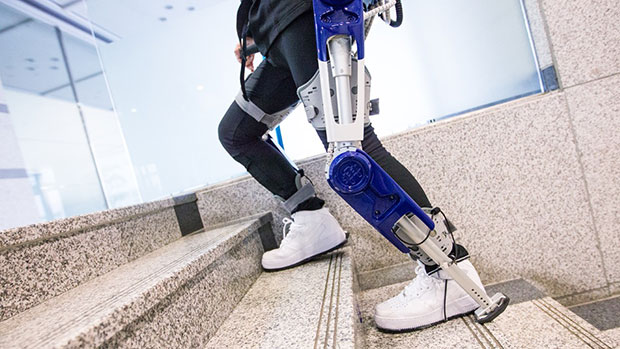
Developing a system that can handle complex control algorithms to capture data remotely from various sensors simultaneously and perform real-time control of multiple actuators for a wearable robotics device for walking assistance.
Using the LabVIEW RIO platform, including a CompactRIO embedded system and a real-time controller with an FPGA control architecture provided by Single-Board RIO, to acquire data from various sensors and control peripheral units, high-speed communication devices, and actuators; and using LabVIEW software to acquire reliable data by conducting real-time analysis and applying various robot control algorithms to dramatically reduce development time.
The Central Advanced Research and Engineering Institute at Hyundai Motor Company develops future mobility technologies. Rather than provide conventional vehicle products to customers, this research center creates new mobility devices with a wide range of speeds for a variety of people, including the elderly and the disabled. As our society ages, there is a greater need for systems that can aid mobility. Thus, we are developing wearable exoskeleton robots with NI embedded controllers for the elderly and patients with spinal cord injuries to use.
 Life-caring exoskeleton in use. Image courtesy of NI.
In the field of wearable robotics, physical interfacing between the human body and a robot causes various engineering issues with mechanical design, control architecture construction, and actuation algorithm design. The allowed space and weight for electrical devices is extremely limited because a wearable robot needs to be put on like a suit. Additionally, the overall control sampling rate of the robot should be fast enough that it does not impede human motions and can properly react to external forces. Also, many questions remain regarding human augmentation and assistance control algorithms for wearable robots, even though many of the endeavors of robotic researchers have resulted in successful performances of wearable robots. Therefore, our group mainly considered the following requirements for selecting a main controller for our wearable robots:
The real-time control and field programmable gate array (FPGA) hardware environment ensure reliability and stability by providing I/O that is compatible with various robotic control devices. For instance, in the process of building our wearable robots, the overall control architecture drastically changed several times due to the replacement of sensors or changes in the control communication method. However, the unique onboard combination of the real-time controller and FPGA features provided by NI products empowered our group to manage these changes promptly, which helped reduce our development period.
In addition, adopting the compact sbRIO-9651 System on Module (SOM) device helped us reduce the robot’s weight to less than 10 kg while maximizing battery efficiency through a low-power base system configuration.
"Using LabVIEW and the LabVIEW RIO architecture allowed us to reduce development and test time for our new robot control algorithm to just one week, compared to one month with a text-based approach. We are able to prototype with software and hardware faster and adapt to rapidly changing control requirements."
- DongJin Hyun, PhD, Hyundai Motor Company
The number of sensors and actuators increases significantly to achieve more complex tasks in robotics, and the complexity of the control algorithms increases exponentially. Therefore, simultaneously processing all data from multiple sensors and sending instructions to multiple actuators becomes one of the most important challenges to address in robotics. LabVIEW supports concurrent visualization for intuitive signal processing for installed sensors on robots and further control algorithm design in the experimental stages. Lastly, NI products are expandable and compatible, so we can possibly use smart devices as user interfaces (UIs) in the future.
Originally, the following types of wearable robots were built:
We have research plans for integrating smart devices into the UI to address future challenges. Currently, robots for people with lower body disabilities are designed to use crutches as wireless UIs for changing configuration, such as converting to walking, sitting, climbing or going down steps, or normal mode. Embedding smart devices into this kind of UI can help users conduct tuning of additional parameters including stride, time for taking one step, or depth/width for sitting on a chair. Also, data related to walking patterns or normal activity range is useful for treatment or rehabilitation. Rehabilitation experts or doctors can configure more advanced parameters, such as forced walking time or adjusting joint movement, to continue to use them for treatment.
We started to develop the next-generation exoskeleton robot based on wireless technology to make gait analysis possible. When someone wears this robot, it is possible to identify intention and walking status by collecting data from an area between the ground and the sole of the foot. Technology that transmits this data through wireless ZigBee communication is already in place. This technology can be further expanded now using Internet of Things (IoT) technology. In other words, you can send information acquired wirelessly to a robot to make it assist with the walker’s movements. In addition, gathering relevant data can help users identify a personal range of activities and conditions based on location, and that information can be integrated into the robot and lead to more comprehensive service. If a patient wears this robot for rehabilitation purposes, doctors can monitor patient and robot conditions during rehabilitation and deliver real-time training or adjustments to enhance efficiency and effectiveness of treatment, a good example of implementation of data information-based technology.
By DongJin Hyun, Ph.D., of Hyundai Motor Company.


Join over 90,000 engineering professionals who get fresh engineering news as soon as it is published.






About Us · Contact Us · Editorial Team · Advertising · Privacy Policy · Subscriber Services · © 2026 Digital Engineering 24/7 · Peerless Media