Helping design and engineering professionals discover, evaluate and specify technologies and processes that shorten the design cycle and enable success.



Digital Engineering April 2026
In the latest issue of Digital Engineering, we take a look at the latest innovations in design for additive manufacturing, including the use of natural language inputs, social media cosplayers, and AI integration. The issue also includes a feature…

January Special Focus Issue: Design for Additive
In this Special Focus Issue of Digital Engineering, learn about the latest advancements in design for additive manufacturing, including new software tools, additive in automotive, custom medical devices, and more.
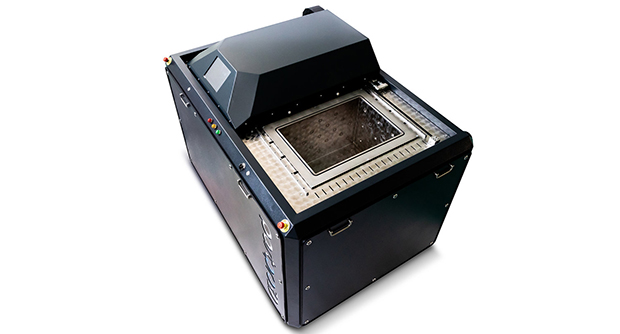
PostPro3D is an enabling technology based on Additive Manufacturing Technologies’ BLAST process (Boundary Layer Automated Smoothing Technology) and is designed to reduce lead time, cost of manufacture, operational and maintenance costs.
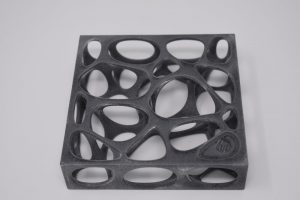 Before PostPro3D. Images courtesy of PostPro3D.
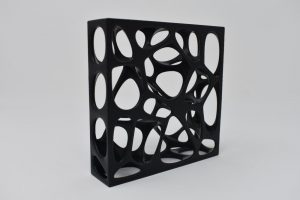 After PostPro3D.
PostPro3D has been fully tested for a wide range of consumer products ranging from sports footwear to medical applications and automotive to aerospace. PostPro3D can achieve a surface finish with an Ra of less than 1 micron.
The BLAST process is a physiochemical process that can smooth a wide variety of thermoplastic polymers. The process is a non-line-of-sight and can smooth complex internal cavities of polymer parts. The PostPro3D technology is highly controllable, allowing reproducible results with no degradation of a parts’ mechanical properties, the company reports.
The PostPro3D technology is an automated turnkey solution, which can be easily integrated into the digital workflow. Using a series of predefined parameter sets and algorithms PostPro3D achieves a surface finish that matches injection molding techniques.
The PostPro3D machine is connected remotely to the 3G cellular network. This allows for automatic over-the-air updates, remote monitoring, automated consumable reordering and automated predictive maintenance and diagnostics.
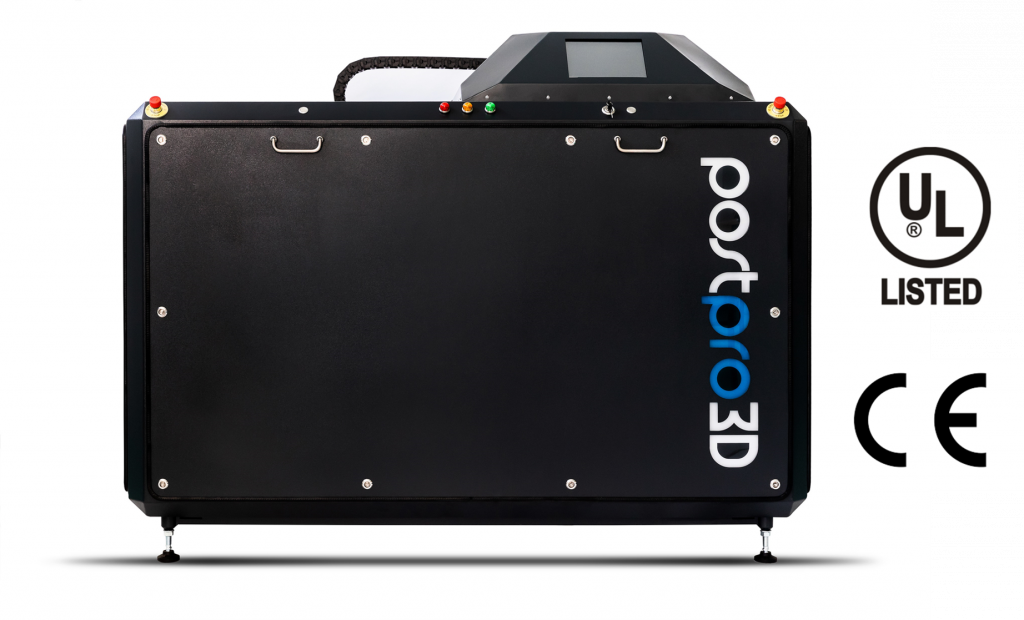
The process chamber is 600x400x400 mm in size and allows large batches of multiple parts to be processed simultaneously.
The typical process time is 90-120 minutes with parts ready for end-use application without any additional process steps.
The BLAST process does not degrade the mechanical properties of the parts. Extensive testing demonstrates no loss in part Ultimate Tensile Strength (UTS) with an increase in Elongation at Break (EAB). The increase in EAB is due to the reduction of crack initiation sites on the polymer surface due to the removal of surface porosity.
Parts processed in the PostPro3D machine exhibit no more than 0.4% dimensional change regardless of desired finish level. This negligible dimensional variation ensures retention of fine feature details.
The PostPro3D technology is compatible with all powder-bed and filament-based printing technologies. The following printing technologies have been validated by AMT and include Laser Sintering (LS), HP MultiJet Fusion (MJF), High Speed Sintering (HSS) and Fused Deposition Modelling (FDM).
PostPro3D has been developed to process thermoplastic polymer materials. Currently the technology can process Polyamide (Nylon) (6,11,12), Flame retardant Nylons, Carbon/Glass filled derivatives of Nylons, ULTEM, PMMA, Thermoplastic polyurethane (TPU), and Thermoplastic Elastomers (TPE).
For more info, visit Additive Manufacturing Technologies.
Sources: Press materials received from the company.


DE's editors contribute news and new product announcements to Digital Engineering. Press releases may be sent to them via [email protected].
Follow DE
Join over 90,000 engineering professionals who get fresh engineering news as soon as it is published.






About Us · Contact Us · Editorial Team · Advertising · Privacy Policy · Subscriber Services · © 2026 Digital Engineering 24/7 · Peerless Media