Helping design and engineering professionals discover, evaluate and specify technologies and processes that shorten the design cycle and enable success.


Alert!
Digital Engineering ceased publication on July 1, 2026. This website remains available as an archive of engineering content.
For inquiries or information, please email [email protected].

May 2026 Special Focus: Artificial Intelligence in Design and Simulation
In this Special Focus Issue, learn about the latest developments in the integration of artificial intelligence into engineering workflows.

April 2026 Special Focus Issue: Generative Design
In this Special Focus Issue, Digital Engineering takes a look at how generative design solutions can be used across different types of design problems and with a variety of manufacturing approaches to accelerate design space exploration, and…
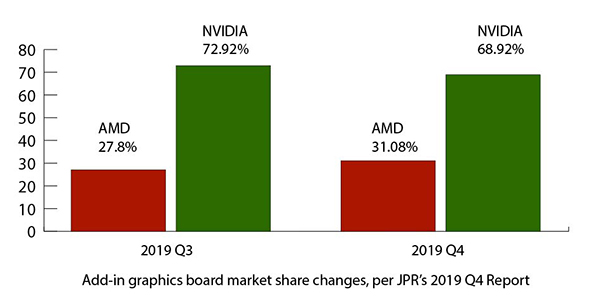
Last week, industry analyst JPR released its Quarterly Add-In Board (AIB) Report for 2019 Q4. "Over $3.9 billion dollars of AIBs shipped in the quarter," JPR estimates.
The GPU market at its core is a two-horse race between NVIDIA and AMD, with NVIDIA often in the lead with a larger market share. But 2019 Q4 saw AMD with an increased quarter-to-quarter market share.
AMD market share rose from 27.8% in 2019 Q3 to 31.8% in Q4. By contrast, NVIDIA market share dipped from 72.92% in 2019 Q3 to 68.92% in Q4, according to the JPR report.
"The fourth quarter is normally flat to up from the previous quarter. This quarter it was up 12.2% from the last quarter (2019 Q3)," according to JPR.
Intel attempted to grab a share of the GPU market with its Larrabee Project, but it didn't take off. The product was previewed at Supercomputing 2009, but no commercial launch took place. Instead, Intel shelved the project in December 2009. Afterward, the CPU giant focuses instead on integrated graphics -- graphics processors embedded in the same die as the CPUs. The outcome was Intel Haswell, part of the Intel iCore CPU line.
In January at CES 2020, Intel revealed its plan to enter the GPU market with its own discrete GPU, built on the Intel Xe GPU architecture. "Intel Vice President of Architecture for Graphics and Software Lisa Pearce provided insight into the progress on the new Intel Xe graphics architecture, which will provide huge performance gains in Tiger Lake, and previewed Intel’s first Xe-based discrete GPU, code-named DG1," announced Intel.
"Intel’s entry into the AIB market in 2020 will shift market share but not have an immediate influence on overall sales," JPR predicted. "However, we believe Intel’s brand is so powerful that new AIB customers will come into the market. Offsetting that will be the effect of streaming gaming from Google, NVIDIA, and others which may cause some gamers to delay buying a new AIB. 2020 is going to be a game-changer with Intel’s entry into the discrete GPU market and a possible fourth entry by an IP company.”
The AIB market topped out at $16.1 billion last year. JPR forecasts it will reach $16.3 billion by 2023. Since 1981, 1,303 million AIBs have been shipped, JPR counted.
"This is the third consecutive quarter of increased AIB shipments," noted Jon Peddie, president of JPR. "However, Q1 which is seasonally flat to down, may show an unusual dip because of supply chain interruptions from China due to the Coronavirus epidemic.
For more on Coronavirus's impact on manufacturing and engineering, read the previous report here.
For JPR's AIB report, visit JPR's dedicated page here.


Since its founding in 1993, NVIDIA (NASDAQ: NVDA) has been a pioneer in accelerated computing. The company’s invention of the GPU in 1999 sparked the growth of the PC gaming market, redefined computer graphics, ignited the era of modern AI and…

Cut Retrieval-Augmented Generation (RAG) Hallucinations by 50%
Most teams hit the same wall with enterprise AI: LLMs that hallucinate, pipelines that don’t scale, and infrastructure that’s harder to design than the models themselves.

Kenneth Wong is Digital Engineering's resident blogger and senior editor. Email him at [email protected] or share your thoughts or suggestions at digitaleng.news/facebook.
Follow DE
Join over 90,000 engineering professionals who get fresh engineering news as soon as it is published.






About Us · Contact Us · Editorial Team · Advertising · Privacy Policy · Subscriber Services · © 2026 Digital Engineering 24/7 · Peerless Media