Helping design and engineering professionals discover, evaluate and specify technologies and processes that shorten the design cycle and enable success.



Digital Engineering April 2026
In the latest issue of Digital Engineering, we take a look at the latest innovations in design for additive manufacturing, including the use of natural language inputs, social media cosplayers, and AI integration. The issue also includes a feature…

January Special Focus Issue: Design for Additive
In this Special Focus Issue of Digital Engineering, learn about the latest advancements in design for additive manufacturing, including new software tools, additive in automotive, custom medical devices, and more.
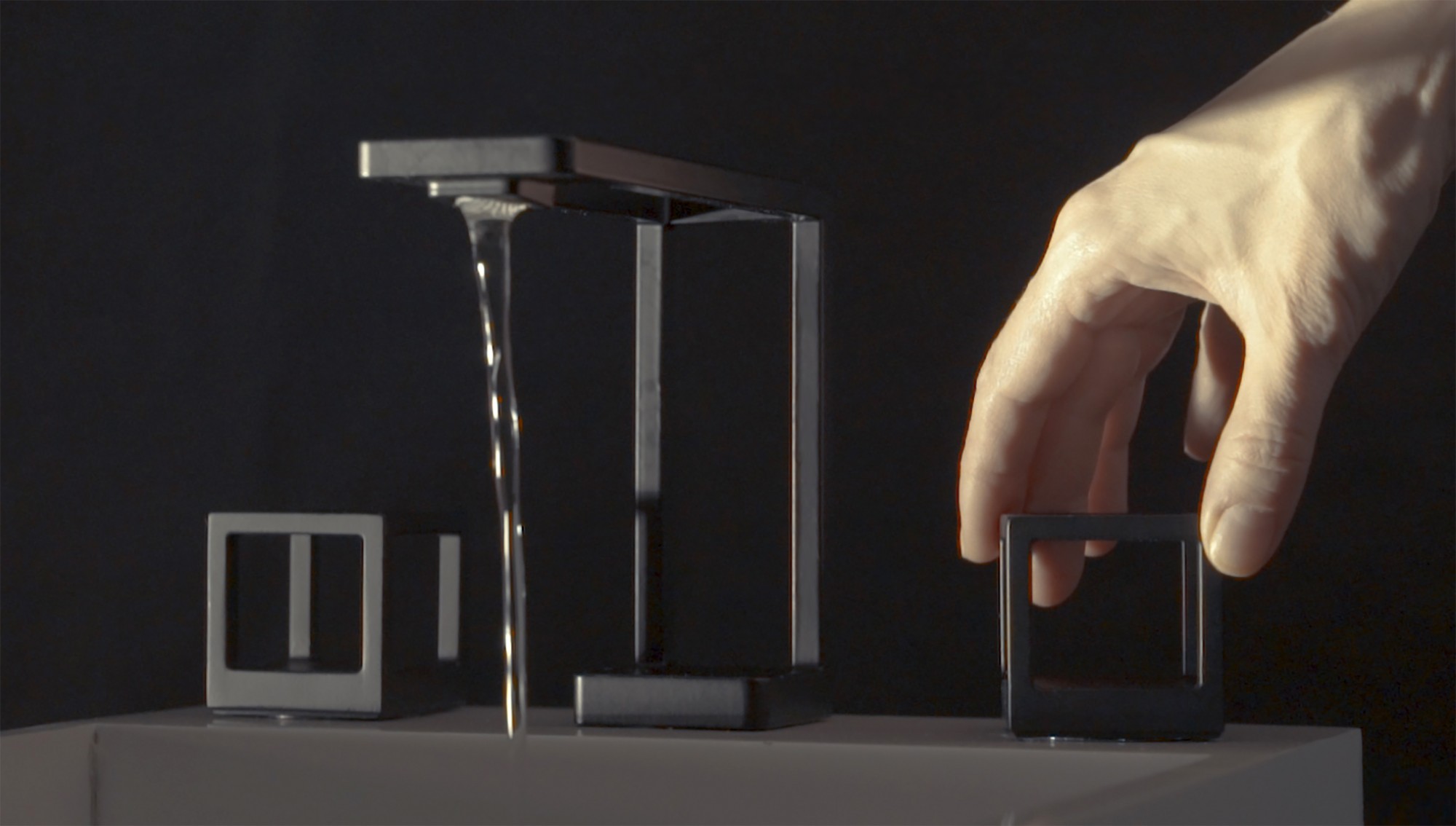
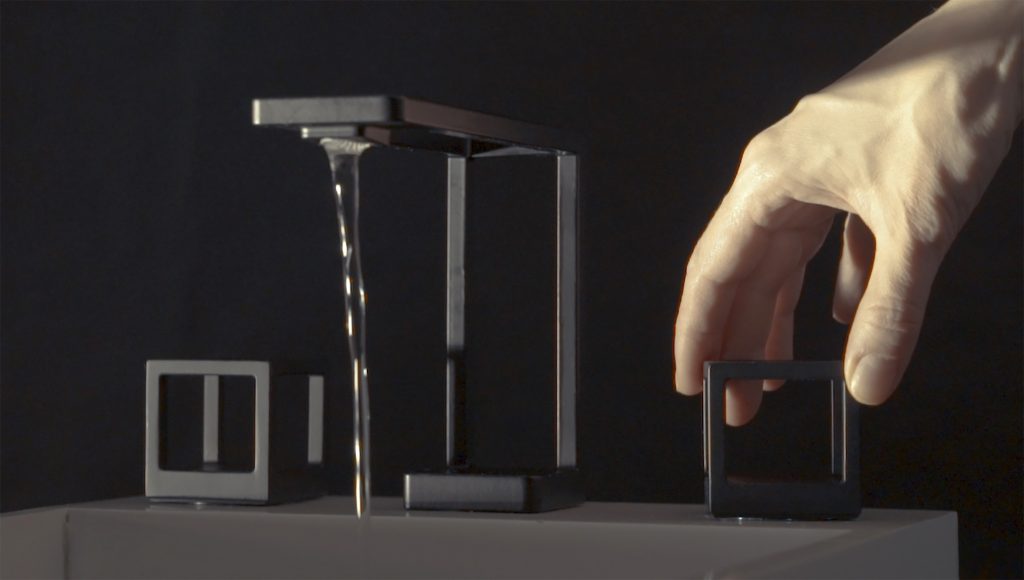 The Grid faucet: designed by Kohler KALLISTA and 3D printed by 3rd Dimension on a 3D Systems ProX DMP 320 metal system. Image courtesy 3D Systems.
But a trio of companies, each experts in their own field, has applied 3D printing to a break-the-rules design that is not only elegant and functional but almost magical. So eye-catching is this faucet that it was just voted Best of Show at the prestigious Kitchen & Bath Industry Show (KBIS) 2018, a first-ever achievement for designer/manufacturer Kohler and its KALLISTA division of high-end products.
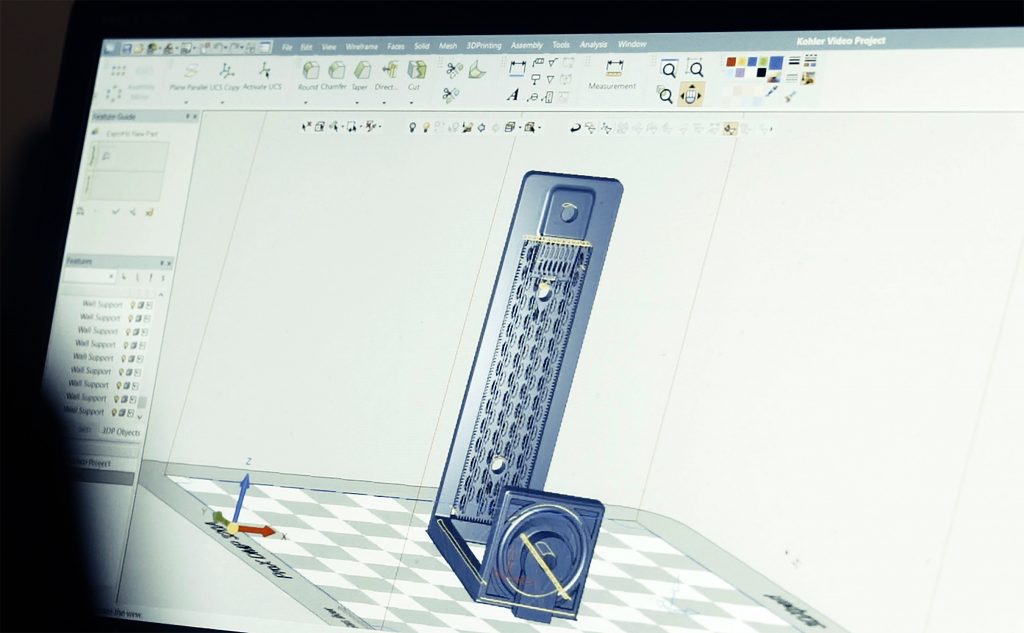 CAD model for KALLISTA Grid faucet, shown imported into 3D-printing layout software, with support structures added. Image courtesy of 3D Systems.
KALLISTA teamed up with metal 3D-printing specialist, 3rd Dimension of Indianapolis, which in turn used its experience with direct metal printing (DMP) equipment from 3D Systems to produce the unique faucet design, dubbed the Grid. Printed in 3D Systems’ LaserForm 316L stainless steel on a ProX DMP 320 system, the Grid dramatically breaks away from the classic manufacturing approach of casting a spout using a mold and sand core.
“Designers usually need to consider a manufacturing process and design around that process,” said Bill McKeone, design studio manager, KALLISTA. “By choosing to produce this faucet via 3D printing, we opened ourselves to limitless design possibilities.”
In some ways, this project has been in the works for years. McKeone says back in 2016, his general manager approached him asking: If you could take manufacturing out of the equation, what would you do? What is your dream/ideal design? “The whole industry has been embracing minimalist design,” notes McKeone, “where you abstract whatever is not needed in a model and take away as much material as possible. What if we could just outline a shape – trace an outline around a geometric shape?”
For the Grid, a set comprising faucet-spout and hot/cold handles, the result is a clean, open alignment of black powder-coated squares and rectangles with integrated water channels. “The handles take us back to playing with blocks,” says McKeone. “The biggest challenge was the spout — how to move water through it.” Given that the second traditional process after casting involves using tube stock, he explains that cutting and brazing narrow tubing to form the perfectly aligned corners of the bifurcated spout would have been a nightmare.
Since McKeone had been using 3D Systems’ stereolithography apparatus (SLA) resin capabilities for the better part of a decade as a design visualization tool, the obvious solution was metal 3D printing.
Designed for high precision and high throughput direct metal printing, the 3D Systems ProX DMP 320 has been optimized for critical applications requiring complex, chemically-pure titanium, stainless steel or nickel super alloy parts. 3rd Dimension advised the use of 316L to both avoid rust and corrosion, and to form a highly suitable base for the final powder-coating process.
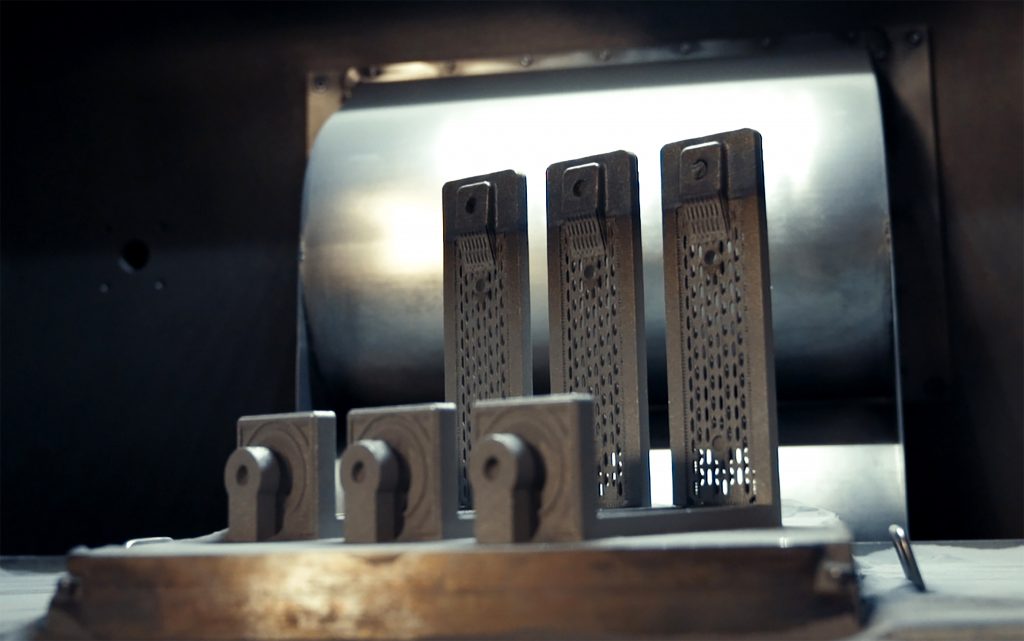 Three as-built KALLISTA faucets, on the build-plate of the ProX DMP 320 system, after de-powdering. Image courtesy of 3D Systems.
Already well-experienced with DMP technology, the engineers and machinists at 3rd Dimension knew just how to design the 3D-printing layout and support structure, remove the supports, add threads for an aerator and connectors, tumble/deburr the parts and apply the matte-black finish. Each segment of the faucet has a square cross-section of 9mm, housing a 3mm inner-diameter water channel.
Parts were produced within hours; this video shows three faucets printed at a time, though the system’s build volume of 10.82 inches by 10.82 inches by 16.53 inches could conceivably allow even more.
He perfectly sums up the technology’s impact on the kitchen/bath industry: “So many times, when you’re making products, function is dictating the form. What 3D printing is doing to the industry is it’s allowing that form doesn’t necessarily have to follow function any more. You don’t have to have a certain wall thickness because it’s required by a particular manufacturing process.”
Not a compromise. Not a pipe dream, but reality.


Pamela Waterman worked as Digital Engineering's contributing editor for two decades. Contact her via DE-Editors@ digitaleng.news.
Follow DE
Join over 90,000 engineering professionals who get fresh engineering news as soon as it is published.






About Us · Contact Us · Editorial Team · Advertising · Privacy Policy · Subscriber Services · © 2026 Digital Engineering 24/7 · Peerless Media