Helping design and engineering professionals discover, evaluate and specify technologies and processes that shorten the design cycle and enable success.




May 2026 Special Focus: Artificial Intelligence in Design and Simulation
In this Special Focus Issue, learn about the latest developments in the integration of artificial intelligence into engineering workflows.

Design & Simulation Software Guide 2025
In this Special Issue, Digital Engineering presents its second annual guide to design and simulation software vendors.
The 2.2 release of the Polygonica mesh modeling software toolkit from MachineWorks includes upgrades to the point cloud to mesh processing pipeline. CAD, CAM and CAE vendors can now easily integrate advanced point cloud import functionality directly into existing software systems, allowing direct support for scan-based workflows without the requirement for external software.
Images courtesy of MachineWorks.
As well as general performance improvements, memory usage has been reduced to support the processing of larger point clouds.
The new surface-fitting method initially builds a surface-based structure from the point cloud and the mesh is then generated from that. This technique delivers much smoother mesh surfaces for noisy point data that are more suitable as a starting point for reverse engineering.
Polygonica’s hole-filling algorithms have also been upgraded. Annular hole-filling automatically recognises islands and attaches them to the correct hole. Ruled-surface filling joins a hole with a single island using a ruled surface. This can also be used to bind disjoint sheets.
The features method respects features across a hole in one direction whilst the features smooth method recognizes features in all directions and creates a smooth surface that respects the curvature at the hole’s edges.
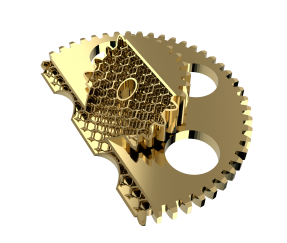
Polygonica’s new automatic hole filling allows multiple holes to be filled in at once which can greatly improve the performance for large meshes. Hole boundaries can be automatically smoothed during post-processing.
A new offsetting method has been added that allows simultaneous inwards and outwards offsetting in one function call. Open surfaces can now be extended to allow for improved trimming.
The adaptive-simplification algorithms in Polygonica are now multi-threaded meaning large meshes from laser scans can be decimated in seconds whilst maintaining tolerance.
A new shrink-wrapping function has been added that closes very poor quality meshes and triangle soups whilst removing internals from CAD assemblies to reduce data for faster visualisation in VR/AR and mixed-reality scenarios.
Polygonica component technology offers OEMs focused on leveraging the benefits of new Additive Manufacturing processes a speedy access-to-market and years of specialized software development at their fingertips.
Sources: Press materials received from the company.


Our technology is employed in CAM applications, standalone verification applications and control-based applications, including Collision Avoidance Systems. MachineWorks’ libraries are ideally suited to any type of machining and can simulate any…

DE's editors contribute news and new product announcements to Digital Engineering. Press releases may be sent to them via [email protected].
Follow DE
Join over 90,000 engineering professionals who get fresh engineering news as soon as it is published.






About Us · Contact Us · Editorial Team · Advertising · Privacy Policy · Subscriber Services · © 2026 Digital Engineering 24/7 · Peerless Media