Helping design and engineering professionals discover, evaluate and specify technologies and processes that shorten the design cycle and enable success.



April 2026 Special Focus Issue: Generative Design
In this Special Focus Issue, Digital Engineering takes a look at how generative design solutions can be used across different types of design problems and with a variety of manufacturing approaches to accelerate design space exploration, and…

Electrum utilizes the 3DEXPERIENCE platform on the cloud to develop their new electric motorcycle
Electrum, a new brand of electric motorcycles, utilizes the 3DEXPERIENCE platform. Their mission is to support Indonesia’s shift to low-carbon, sustainable transport and to ultimately help the country’s government achieve its vision of net…
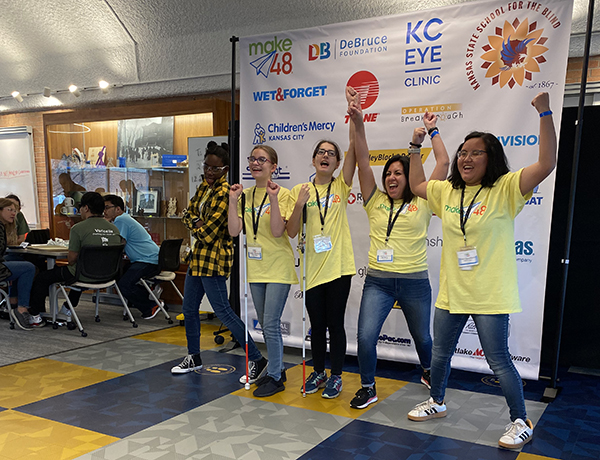
Designing something from scratch in 48 hours, from concept to prototype, is difficult enough for anyone, veteran or novice. But the task is doubly hard for someone visually impaired. Amazingly, 19 students from the Kansas State School for the Blind (KSSB) decided they would take on the challenge, hosted by Make48.
Tom Gray, President and CEO of Make48, believes the deadline brings out the best in the contestants. "If you made the deadline a month, you're going to have the same result, but people will drag their feet. We knew that 24 hours was too tight. And we knew that 48 hours was a good number, because we could do these competitions on a weekend," he said.
Jon Harding, the KSSB's Superintendent, said, "Over 70% of adults who are blind or low vision are not employed. That drives what we do here every day." The school's history stretchd back to 1867, two years following assassination of President Lincoln.
Riley was one of the KSSB students who took part in the design contest held in early December. Her team was called Wild Things. Why the name? "If you let us be in a room by ourselves for more than three hours, we could do some pretty crazy things," she proudly said.
This was also Riley's first experience using CAD--specifically Onshape, a partner of Make48. "One of the guys handed me a tablet and said pointed at the table. I'm like, Wait, that product is not there, but it's on the screen. And so [my teammate] Jen and I were moving the tablet in all sorts of ways. crawling on the floor. It seemed like it was almost as if it was there, but it wasn't," she recalled. What she discovered was Onshape's augmented reality (AR) function.
Gray, a chicken farmer himself, decided to ask the contestants to design an artistic chicken egg holder and dispenser. "We brought in a lot of eggs. Those eggs were real, not hard boiled. So we expected to see a lot of cracked eggs. And I was really surprised that there weren't too. Even even when they were trying out their prototypes, there were just a few cracks here and there, but nothing crazy," recalled Gray.
Riley said, "We had a lot of different ideas. One was a spinning cake tray-type thing. In the end, we just decided to go with cabinets. The front door was absolutely gorgeous."
On improving CAD software's accessibility to visually impaired inventors, Harding said, "Our students use products like NVDA (NonVisual Desktop Access) or JAWS (a computer screen reader) that make software accessible ... Once it's numerical or text, our students can manipulate that software."
For the full story, listen to the podcast.

About this podcast
Make48 Hosts 48-hour Design Challenge for Kansas State School for the Blind
December 16, 2022 at 2:00 pm
12:00 hr/min/sec
Media file
Latest podcasts
Find us
Tune in to Digital Engineering 24/7's podcast and get engineering news, products and analysis from industry experts delivered in real time. Follow us on these popular platforms:

PTC is a computer software and services company founded in 1985 and headquartered outside of Boston, Massachusetts.

Kenneth Wong is Digital Engineering's resident blogger and senior editor. Email him at [email protected] or share your thoughts or suggestions at digitaleng.news/facebook.
Follow DE
Join over 90,000 engineering professionals who get fresh engineering news as soon as it is published.






About Us · Contact Us · Editorial Team · Advertising · Privacy Policy · Subscriber Services · © 2026 Digital Engineering 24/7 · Peerless Media