Helping design and engineering professionals discover, evaluate and specify technologies and processes that shorten the design cycle and enable success.



Digital Engineering April 2026
In the latest issue of Digital Engineering, we take a look at the latest innovations in design for additive manufacturing, including the use of natural language inputs, social media cosplayers, and AI integration. The issue also includes a feature…

January Special Focus Issue: Design for Additive
In this Special Focus Issue of Digital Engineering, learn about the latest advancements in design for additive manufacturing, including new software tools, additive in automotive, custom medical devices, and more.
Marshall Aerospace and Defence is using advanced 3D printing from Stratasys to manufacture, flight-ready parts for several of its military, civil and business aircraft, while producing specific ground-running equipment at a lower cost than aluminum alternatives, the company reports. The company is a large privately owned and independent aerospace and defense companies.
Marshall already has several pieces of 3D-printed ductwork flying on heavily modified aircraft, as well as holders for safety knives and switches for aircraft interiors. 3D printing flight-approved parts on demand enables the company to produce lighter parts than traditional methods.
According to Chris Botting, Materials, Processes and Additive Manufacturing Engineer at Marshall ADG, the ability to create accurate, repeatable and reliable 3D printed parts using aerospace-approved materials are key factors in achieving the performance requirements necessary for use within aircraft.
“When manufacturing on complex engineering programs, we need a method that can create an accurate, complex, functional and lightweight duct efficiently with minimal tooling costs – this is where 3D printing fits perfectly," says Chris Botting, Materials, Processes and Additive Manufacturing Engineer at Marshall ADG. "But we also need to ensure that the ducting work produced will be approved by the EASA for flight.”
“As a result, we’re using the Stratasys Fortus 450mc FDM Printer and ULTEM™ 9085 resin—a tough, yet lightweight 3D printing material with high thermal and chemical resistance," Botting says. "This has been crucial to overcoming the stringent requirements of our industry, as we can now 3D print parts with the desired flame, smoke and toxicity properties for use on aircraft interiors.”
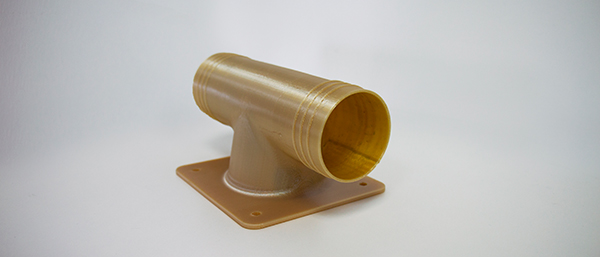
The company is also using its Fortus 450mc 3D printer, purchased from Stratasys UK and Ireland Platinum Partner SYS Systems, to build final parts on the ground. Marshall recently created a ducting adapter prototype for vital ground-running equipment for providing fresh air to cool the aircraft’s avionics.
“Before committing to expensive aluminum machining, we used the Fortus 450mc to 3D print a prototype in ASA material,” says Botting. “It enabled us to create an accurate working prototype of a complex component. We were then able to demonstrate it had the potential to be 3D printed in Nylon 12 material as opposed to the more conventional method of machining from aluminum.
"The 3D printed duct led to a significant cost reduction compared to machining the part out of aluminum, as well as a 63% reduction in overall weight,” he adds.
The group is also using Stratasys 3D printers for a range of complex tooling applications, including drill jigs, masking templates, bonded fixtures and composite mold tooling. Botting foresees the use of Stratasys FDM additive manufacturing to increase across all elements of the business and to drive new applications.
“FDM technology has altered the way we work, and the aerospace-grade 3D printers and materials enable us to meet our increasingly aggressive deadlines and complex manufacturing requirements,” Botting says. “In the future, there is no doubt that 3D printing will continue to have a significant impact in the way we design and manufacture in our business.”
To learn more about Stratasys’ additive manufacturing solutions for the aerospace industry, visit Hall 4, Stand D192 at the International Paris Air Show, 2019, June 17–23, Paris, France.
Sources: Press materials received from the company and additional information gleaned from the company’s website.


Every day, our customers find simpler, smarter approaches to stubborn design problemsand greater confidence to confront towering human and technological challenges. Less hindered by the usual constraints, they can imagine, design, iterate and…
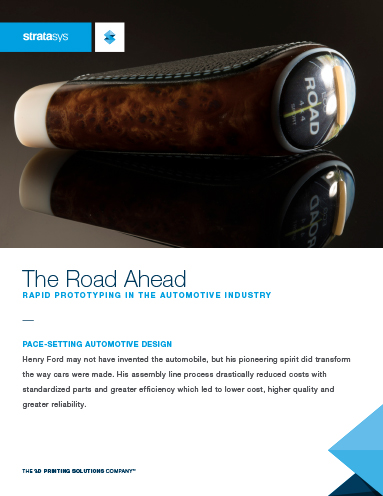
Rapid Prototyping in The Automotive Industry
Henry Ford may not have invented the automobile, but his pioneering spirit did transform the way cars were made. His assembly line process drastically reduced costs with standardized parts and greater efficiency which led to lower cost, higher quality and greater reliability.

DE's editors contribute news and new product announcements to Digital Engineering. Press releases may be sent to them via [email protected].
Follow DE
Join over 90,000 engineering professionals who get fresh engineering news as soon as it is published.






About Us · Contact Us · Editorial Team · Advertising · Privacy Policy · Subscriber Services · © 2026 Digital Engineering 24/7 · Peerless Media