Helping design and engineering professionals discover, evaluate and specify technologies and processes that shorten the design cycle and enable success.


Sponsored

Digital Engineering April 2026
In the latest issue of Digital Engineering, we take a look at the latest innovations in design for additive manufacturing, including the use of natural language inputs, social media cosplayers, and AI integration. The issue also includes a feature…

January Special Focus Issue: Design for Additive
In this Special Focus Issue of Digital Engineering, learn about the latest advancements in design for additive manufacturing, including new software tools, additive in automotive, custom medical devices, and more.
Spectroscopy is the study of the interaction between electromagnetic radiation and matter. With liquids, this research tool usually involves a cuvette, an optically-clear container that holds samples while they are irradiated.
In some applications, such as terahertz (THz) spectroscopy or studies using a dye laser, the cuvette can produce artifacts or otherwise interfere with spectroscopic analysis. To eliminate the need for a cuvette, researchers can use a small but highly precise nozzle that produces a liquid sheet, or jet.
Electrical discharge machining (EDM) can fabricate small, high-precision nozzles, but EDM equipment is not readily available in research settings, is expensive, can only machine conductive materials, and cannot produce the required sharp corners.
3D printers are more commonplace and versatile, but most cannot produce small high-precision parts, especially those with an opening just 0.2 mm diameter. Among 3D printers that can produce parts like this, the print times are relatively slow, a problem when higher quantities and quick turnaround times are required. Plus, the material properties of 3D printed parts may be inadequate.
These were the challenges faced by Adrian Buchman, a PhD student for the Chair of Physical Chemistry II at the Ruhr-University Bochum (RUB) in Bochum, Germany. Buchman was using hand-made nozzles for spectroscopic research but wanted a better alternative. He found it with Boston Micro Fabrication (BMF).
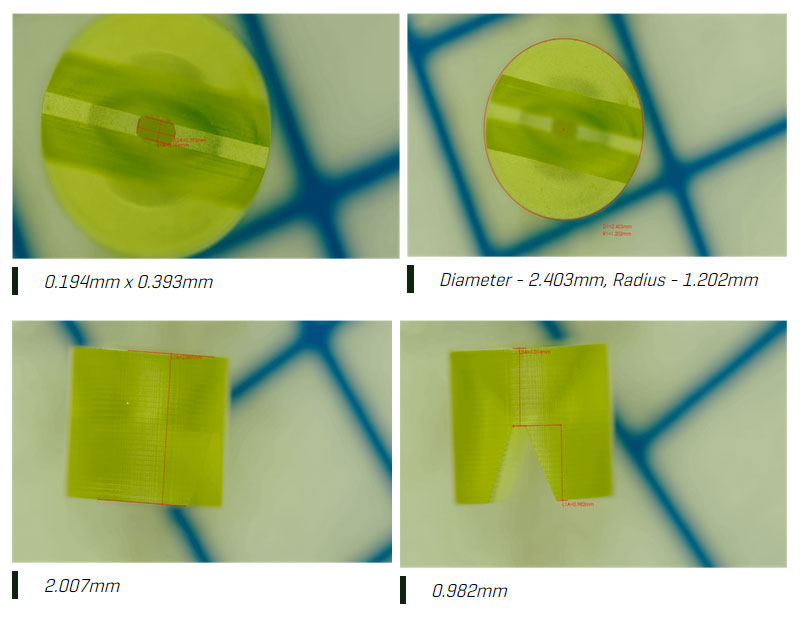
The nozzle that Adrian Buchman needed was not commercially available and required a degree of precision that was measured in tens of micrometers (µm). Moreover, he wanted 18 versions of this nozzle, many with steeper or shallower outlets, to support a variety of applications.
The nozzle material needed to withstand the high pressures associated with these applications, and the method of fabrication needed to support production in larger quantities with a relatively quick turn-around time.
Buchman then discovered Projection Micro Stereolithography (PμSL), an additive manufacturing technology from BMF that can achieve +/- 10 µm accuracy.
A form of stereolithography (SLA), PμSL uses a flash of ultraviolet (UV) light to rapidly photopolymerize an entire layer of material for more efficient processing and faster build times. PμSL also uses specially-formulated liquid polymers with well-qualified mechanical properties. BMF also has an open material system that supports third-party materials and expands the potential solutions.
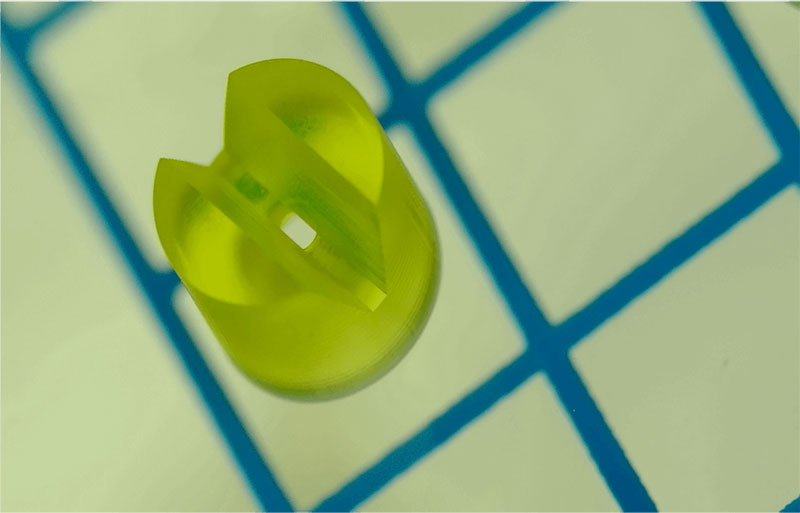
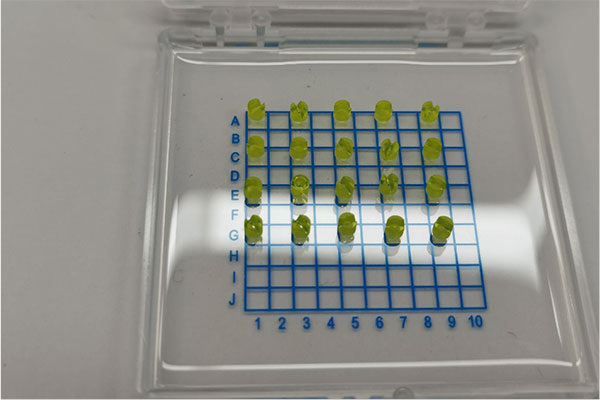
Buchman asked BMF to micro 3D print nozzles in 18 slightly different versions using one of the company’s microArch™ S240 3D printers. This 10 µm series platform is an ideal solution for businesses and universities that require ultra-high resolution, accuracy and precision in a desktop package.
The RG photopolymer that BMF selected is a Forward AM Ultracur® photopolymer resin from BASF. This durable engineering material is transparent yellow or black in color and can be used to print both functional and end-use parts.
Each of the spectroscopic components that BMF 3D printed measured 2.4*2.4*2 mm^3. The layer height was 10 µm and the total print time for 18 pieces was just 4 to 5 hours.
Buchman liked how BMF’s 3D printer offered the required precision and could produce the different nozzles quickly and in large quantities. When cured, the RG photopolymer has well-qualified tensile and flexural properties that can withstand spectroscopic pressures. Importantly, BMF was able to produce all of the parts that Buchman needed within several weeks.
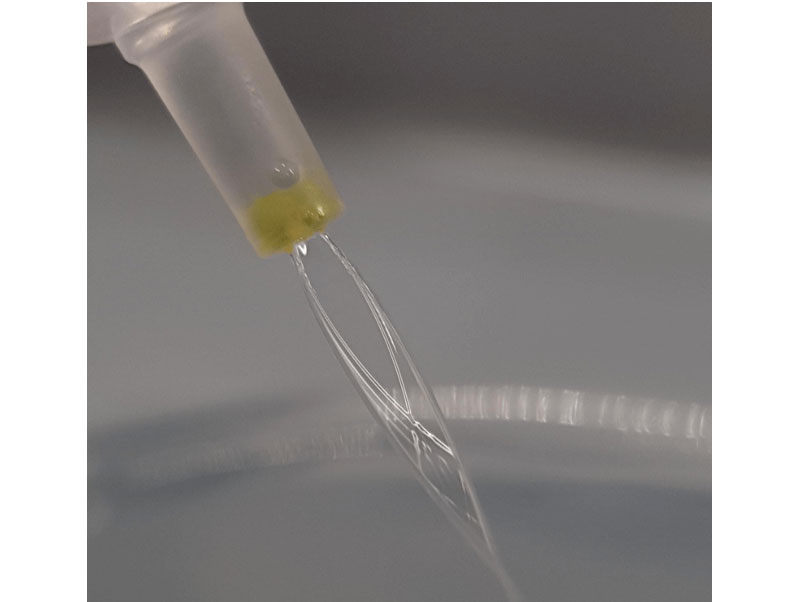
Final Test


Boston Micro Fabrication is the world leader in micro-precision 3D printers utilizing Projection Micro Stereolithography (PµSL) technology. Many leading companies worldwide are adopting PµSL to 3D print true microstructures with ultra-high…

Ultra-high Accuracy, Precision, and Resolution Micro 3D Printed Medical Device Manufacturing
Discover how the use of micro-precision 3D printing is aiding medical device producers to tackle two common issues through this white paper.

DE's editors contribute news and new product announcements to Digital Engineering. Press releases may be sent to them via [email protected].
Follow DE
Join over 90,000 engineering professionals who get fresh engineering news as soon as it is published.






About Us · Contact Us · Editorial Team · Advertising · Privacy Policy · Subscriber Services · © 2026 Digital Engineering 24/7 · Peerless Media