Helping design and engineering professionals discover, evaluate and specify technologies and processes that shorten the design cycle and enable success.



Design & Simulation Software Guide 2025
In this Special Issue, Digital Engineering presents its second annual guide to design and simulation software vendors.

Design & Simulation Software Guide
In this Special Issue, Digital Engineering presents its inaugural guide to design and simulation software vendors, including listings for CAD, CAM, simulation, generative design, PLM, rendering and visualization, design for additive manufacturing,…
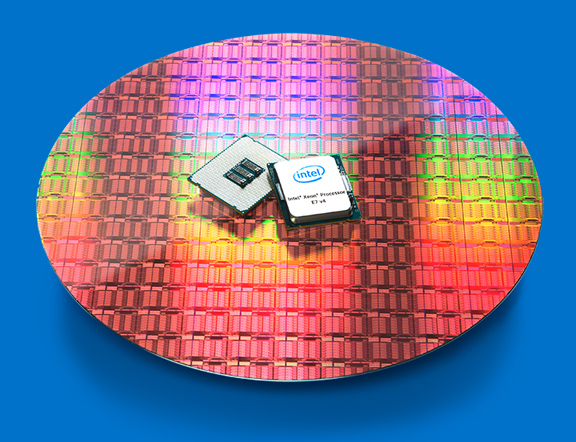 Intel Xeon E7 V4 seeks opportunities in IoT-driven big data (image courtesy of Intel).
The microprocessor industry likes large-scale computing problems. Petascale, exascale projects demand supercomputers, powered by hundreds of thousands of processors. That means sales opportunities for chip makers. In the past, the market for high performance computing (HPC) was confined to university researchers, government institutions, and large enterprises. In the IoT era, however, Big Data may become everybody's headache.
In the report titled “IoT in Logistics” (April 2015), coauthors from Cisco and DHL predict, “By 2020 … there will be more than 50 billion devices connected to the Internet. By that time, computers (including PCs, tablets, and smartphones) will represent just 17% of all Internet connections; the other 83% will result from IoT, including wearables and smart-home devices.”
Many believe the anticipated data deluge is simply too complex for the naked eye to process, too voluminous for the current crop of data-management software to handle; therefore, it must be addressed with robust data-mining, pattern-hunting algorithms running on HPC.
This week, when Intel introduced its Intel Xeon E7 V4 product line in Beijing, China, the company identifies the market in its crosshair: "Dramatic growth in the volume and variety of data is bringing unprecedented opportunities for businesses to make new discoveries and to deliver improved services and customer experiences. The key opportunity is turning the massive amount of core business data plus new sources of unstructured data into actionable and timely insights. The Intel Xeon processor E7 v4 family offers robust performance, the industry’s largest memory capacity per socket, advanced reliability, and hardware-enhanced security for real-time analytics so that businesses can rapidly gain actionable insights from massive and complex data sets."
In her blog post, Jennifer Huffstetler, Intel's senior director of marketing for data center products, notes, "The payoff for enterprises to embark on this analytics journey can be huge. Research indicates that companies that use data-driven insights are two times more likely to have top quartile financial performance and five times more likely to make decisions faster than their competition—so it is no surprise that many companies are investing in analytics and view it as a mission-critical function. All types of companies are already deploying advanced analytics solutions to be more competitive and create new business opportunities and choosing the Intel Xeon processor family as the foundation."
In the data sheet on Xeon E7 V4, Intel claims the processors can tackle big data analytics "up to 1.26X faster than the previous generation" ("Unlock the Potential for Timely, Actionable Insights," Intel). The company writes, "Deep insights produced from big data are reshaping business opportunities, with advanced research, improved products and services, and better customer experiences."
Along with Intel, GPU maker NVIDIA is also pitching its multi-threaded graphics hardware to the same market. Introducing a new server-class hardware at this year's GPU Technology Conference, NVIDIA CEO Jen-Hsun Huang said, "[The NVIDIA TESLA P100] is the most advanced hyperscale datacenter GPU ever built." (Read "NVIDIA GTC 2016: The GPU Wants to Accelerate VR, AI and Big Data Analysis," April 2016).


Kenneth Wong is Digital Engineering's resident blogger and senior editor. Email him at [email protected] or share your thoughts or suggestions at digitaleng.news/facebook.
Follow DE
Join over 90,000 engineering professionals who get fresh engineering news as soon as it is published.






About Us · Contact Us · Editorial Team · Advertising · Privacy Policy · Subscriber Services · © 2026 Digital Engineering 24/7 · Peerless Media