Helping design and engineering professionals discover, evaluate and specify technologies and processes that shorten the design cycle and enable success.



May 2026 Special Focus: Artificial Intelligence in Design and Simulation
In this Special Focus Issue, learn about the latest developments in the integration of artificial intelligence into engineering workflows.

April 2026 Special Focus Issue: Generative Design
In this Special Focus Issue, Digital Engineering takes a look at how generative design solutions can be used across different types of design problems and with a variety of manufacturing approaches to accelerate design space exploration, and…
Star Trek primed an entire generation to expect certain things from future technology. The show featured various pieces of imaginary technology that has since become reality. Compact communications devices, face-to-face voice chat and voice recognition are just a few concepts that appeared on the show before they appeared in the real world.
Holograms are another instance of a technology that appeared on the show (though it was more Next Generation material, honestly), and it is one piece of tech that companies have continually tried to develop for at least 30 years, with little success. Oculus Rift and augmented reality combined with Google Glass are about the closest anyone has come to bringing holograms into our world.
The brains behind the Microsoft’s Kinect have developed a new platform that might bring a simulated reality into both our workplace and living rooms. The new system is called HoloLens, and it takes the shape of a pair of goggles rather than a holosuite (one step at a time). Unlike Oculus Rift, HoloLens doesn’t attempt to trick your brain into thinking it’s someplace else, rather it uses augmented reality (AR) to overlay holograms into your everyday space.
For everyday usage, adding holograms to work would be useful for everyone from mechanics to brain surgeons. Teachers could find numerous ways to leverage holographic technology at every level of education. No doubt, the entertainment industry might find ways to use the technology for video games or to augment movie night as well.
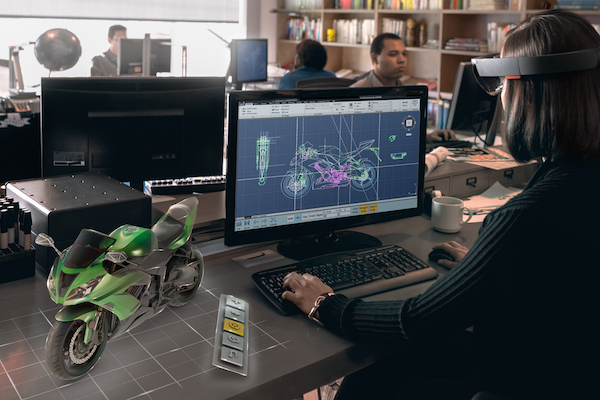
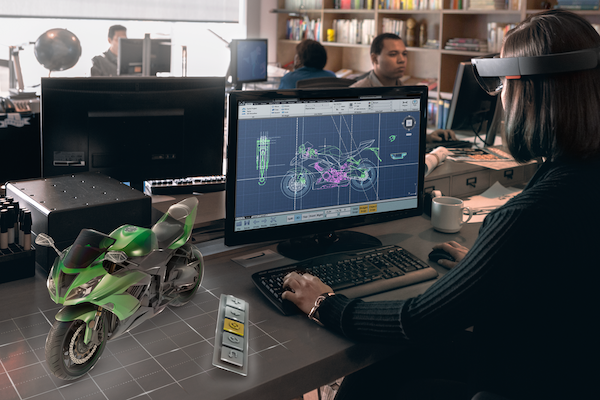
All of that is cool, but this is Rapid Ready, where 3D printing is king. Why do we care about the HoloLens? You guessed it (maybe the headline was a hint). HoloLens offers new opportunities for 3D design. Rather than sketching 3D images on a 2D surface, with the HoloLens, designers and engineers could design and develop 3D parts in 3D.
Microsoft also realizes how much potential for design the new platform offers, and has included instances of 3D design in its demos and video marketing. It wouldn’t be surprising if the HoloLens shipped with 3D design software included, with haptic feedback tools already in the pipeline for development. Add a pair of haptic gloves to the HoloLens and suddenly you have the ability to mold new parts in 3D without using a mouse or stylus.
Below and above you’ll find videos about Microsoft’s HoloLens.
Source: Microsoft


John Newman is a Digital Engineering contributor who focuses on 3D printing. Contact him via [email protected] and read his posts on Rapid Ready Technology.
Follow DE
Join over 90,000 engineering professionals who get fresh engineering news as soon as it is published.






About Us · Contact Us · Editorial Team · Advertising · Privacy Policy · Subscriber Services · © 2026 Digital Engineering 24/7 · Peerless Media