Helping design and engineering professionals discover, evaluate and specify technologies and processes that shorten the design cycle and enable success.



Digital Engineering April 2026
In the latest issue of Digital Engineering, we take a look at the latest innovations in design for additive manufacturing, including the use of natural language inputs, social media cosplayers, and AI integration. The issue also includes a feature…

January Special Focus Issue: Design for Additive
In this Special Focus Issue of Digital Engineering, learn about the latest advancements in design for additive manufacturing, including new software tools, additive in automotive, custom medical devices, and more.
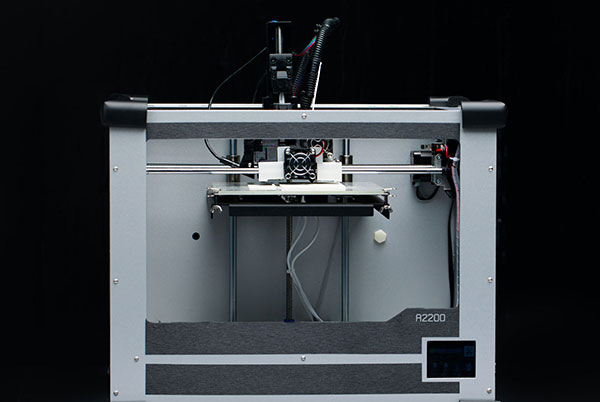
nano3Dprint, a next-generation additive manufacturing solutions provider, has released its upgraded A2200 3D Multi-material Electronics Printer. The improved A2200 has a sleeker design, a more compact materials dispensing print head, improved ink/paste dispensing mechanism and an improved built-in video system with clarity and higher magnification, according to the company.
The A2200’s side-by-side precision filament extruder and enhanced materials dispensing system prints fused deposition modeling (FDM) materials, like acrylonitrile butadiene styrene (ABS) and polylactic acid (PLA), next to functional inks and pastes, like silver, gold and copper. The positive displacement print head can precisely meter functional inks with viscosities ranging from 1mPa·s to 54000 mPa·s.
The FDM Extruder on the upgraded A2200 3D prints 1.75 mm filament materials, including PLA, ABS, PETG, nylon (PA), PC, POM, flexible filament (TPU, PLA+) and Moldlay (cartable filament). The Materials Dispensing System, a syringe pump type microdispenser, 3D prints inks and higher viscosity pastes, like conductive inks/pastes, semiconducting and insulating inks/pastes, medical grade silicone, UV curable polymers, epoxies, fast-drying solvent-based inks, silver nano-particle inks and graphene solutions.
The redesigned materials dispensing print head allows for faster print speeds, and the upgraded printer allows for more precise metering of pastes and inks.
The upgraded A2200 camera now has a 5 megapixel CMOS sensor with 1080p or 720p resolution, which can be adjusted on the user’s computer, and auto-focus capabilities via the user’s preferred camera app. The camera in the previous version of the A2200 had a 0.3 megapixel CMOS sensor with 480p resolution. Users can fine-tune and monitor the accuracy of their 3D designs by watching them print in real time via computer or phone.
The A2200 prints fully 3D objects embedded with functional materials.
“The A2200 can produce circuit boards, batteries, sensors, antennas, medical devices, solar cells, flexible electronics, conductors and microfluidics. Our direct-write technology can incorporate strain gauges, heaters, complex antenna geometries and optical components in a 3D print,” says Gretta Perlmutter, product success manager, nano3Dprint.
“The A2200 also works in tandem with our B3300 Dual-Dispensing 3D Printer. Together they can create an electronics assembly line with four-plus materials for R&D, rapid prototyping, and low-volume manufacturing,” Perlmutter adds.
The A2200 printer is compatible with most CAD or Slicer software and retails for $4,950.
To purchase the A2200 3D Multi-Material Electronics Printer, click here.
Sources: Press materials received from the company and additional information gleaned from the company’s website.


DE's editors contribute news and new product announcements to Digital Engineering. Press releases may be sent to them via [email protected].
Follow DE
Join over 90,000 engineering professionals who get fresh engineering news as soon as it is published.






About Us · Contact Us · Editorial Team · Advertising · Privacy Policy · Subscriber Services · © 2026 Digital Engineering 24/7 · Peerless Media