Helping design and engineering professionals discover, evaluate and specify technologies and processes that shorten the design cycle and enable success.



Digital Engineering April 2026
In the latest issue of Digital Engineering, we take a look at the latest innovations in design for additive manufacturing, including the use of natural language inputs, social media cosplayers, and AI integration. The issue also includes a feature…

January Special Focus Issue: Design for Additive
In this Special Focus Issue of Digital Engineering, learn about the latest advancements in design for additive manufacturing, including new software tools, additive in automotive, custom medical devices, and more.
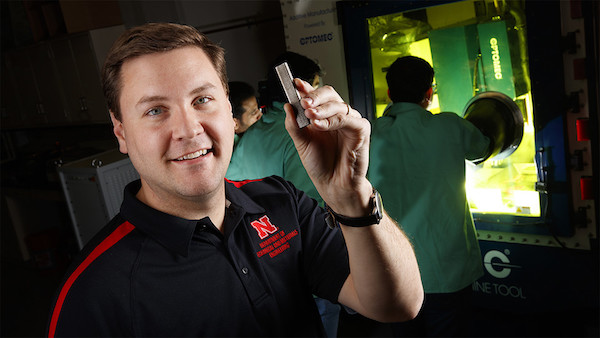
Engineers at the University of Nebraska-Lincoln’s College of Engineering have created a process to print dissolvable surgical implants using a 3D hybrid printer.
The controlled atmosphere system can print dissolvable magnesium implants that researchers say could reduce the cost, risk and pain associated with implants like surgical screws and pins.
Team leader Michael Sealy, an assistant professor of mechanical and materials engineering, presented the research at the International Manufacturing Technology show in Chicago in September.
Sealy and his team worked on the project at the Nebraska Engineering Additive Technology (NEAT) Labs using an Optomec Laser Engineered Net Shaping 3D metal hybrid machine tool. The printer provides an atmosphere-controlled environment for printing reactive metals.
Most current medical implants are made of stainless steel or titanium, which remain in the body indefinitely or have to be surgically removed.
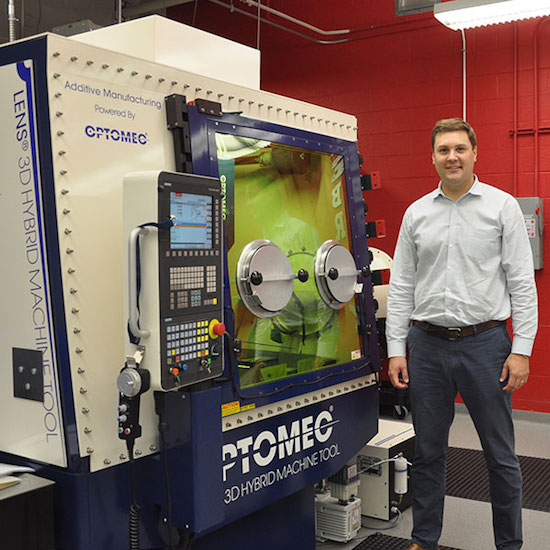
"Our research is focused on advancing the performance and functionality of dissolvable devices," said Sealy, assistant professor of mechanical and materials engineering. "Using LENS, we are applying a hybrid additive manufacturing process to control the disintegration of medical fasteners and plates so they stay intact long enough to serve their purpose and then degrade away once the bone is healed."
According to Sealy, he was partly inspired to develop the process because of the screws in his own elbow, remnants of an injury he sustained in the fifth grade that still cause him occasional pain.
“Instead of having these permanent metal implants, let’s have one that degrades over time,” Sealy said. “Let’s eliminate this whole idea of a second surgery to have these implants removed.”
The 3D print process allows for control of the magnesium’s degradation process in the body via laser peening.
“Instead of [laser] peening as a surface treatment, where I just hammer my outer surface, I’m going to print so many layers, and then hammer it, and then print a few more layers, and then hammer that,” Sealy said. “Then I can control corrosion all the way through these devices. This approach is essentially a way to print your own mechanical properties. It’s something that traditional manufacturing has never really had the ability to do before.”
Potentially, implants that degrade at different rates could be developed.
Source: University of Nebraska-Lincoln

Optomec printers offer unique advantages over traditional approaches to 3D printing. Most industrial 3D Printers on the market today print plastic parts used as a visual mock-up for the real end-user part. In some cases, 3D Printers will deposit…

Brian Albright is the editorial director of Digital Engineering.
Contact him at [email protected].

Join over 90,000 engineering professionals who get fresh engineering news as soon as it is published.






About Us · Contact Us · Editorial Team · Advertising · Privacy Policy · Subscriber Services · © 2026 Digital Engineering 24/7 · Peerless Media