Helping design and engineering professionals discover, evaluate and specify technologies and processes that shorten the design cycle and enable success.




Digital Engineering April 2026
In the latest issue of Digital Engineering, we take a look at the latest innovations in design for additive manufacturing, including the use of natural language inputs, social media cosplayers, and AI integration. The issue also includes a feature…

January Special Focus Issue: Design for Additive
In this Special Focus Issue of Digital Engineering, learn about the latest advancements in design for additive manufacturing, including new software tools, additive in automotive, custom medical devices, and more.
The Oak Ridge National Laboratory (ORNL), a technology lab sponsored by the U.S. Department of Energy, has aligned with software maker nTopology in an effort that illustrates the power of public-private partnerships to advance innovation in the area of additive manufacturing.
Under one of ORNL’s Cooperative Research and Development Agreements (CRADA), the lab is working to develop a toolkit based on nTopology’s computational modeling software to optimize design and print preparation for its Big Area Additive Manufacturing (BAAM) machine, which is architected specifically to handle large-scale polymer 3D printing. In exchange, nTopology will embed expertise gleaned from ORNL into its nTop platform as way to make the innovations and corresponding best practices commercially available for the broader advanced manufacturing community.
ORNL has developed its own machine control capabilities for the BAAM large-scale system, but the integration of the nTop capabilities will improve design and modeling controls as well as foster the design of reusable, configurable templates for users working in the Department of Energy’s Manufacturing Demonstration Facility at ORNL. In the initial phase, the new toolkit, integrated into the nTop platform, will connect directly to the ORNL slicer, which will assist in fabricating more accurate parts on the BAAM advanced printing system.
“ORNL has its own slicer in house and it’s capable, but it’s not optimized for [average] people to use,” notes Duann Scott, vice president of partnerships and business development at nTopology. “They can make minimally viable products, but there’s more potential that can be unlocked.” Specifically, the nTop platform helps drive the BAAM slicer in an intelligent way, using simulation data to optimize toolpaths. “It’s not about producing super complex parts, but rather driving the manufacturing process to be more efficient,” he explains.
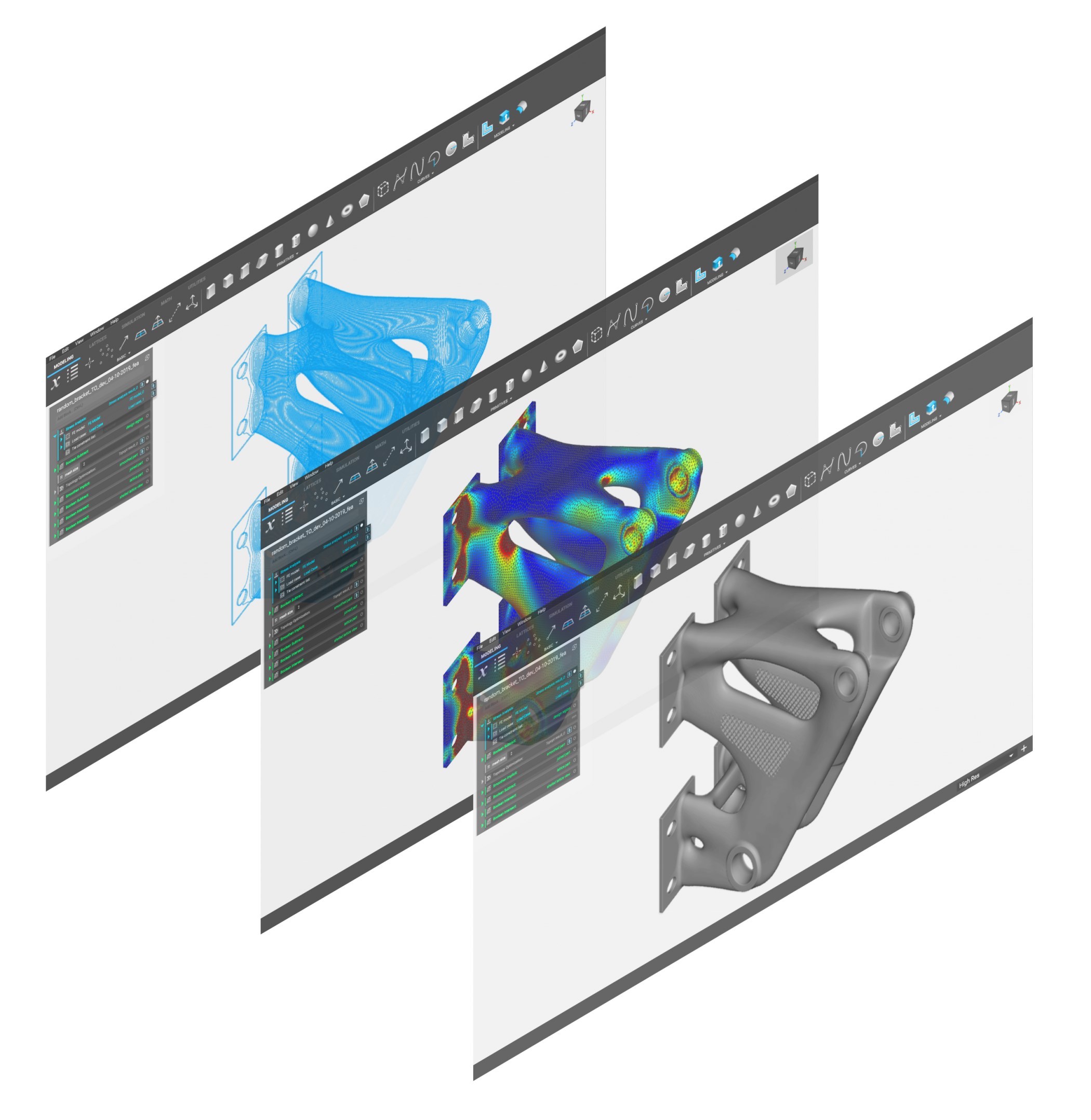
Phase two of the collaboration involves the creation of a toolkit to engineer direct metal grain growth with an Electron Beam Manufacturing (EBM) system, such as an Arcam, as well as developing another toolkit to design honeycomb infill based on circle packing and simulation for fused deposition modeling (FDM). Another piece of the alliance calls for nTopology to develop simulation-based optimization of support structures for BAAM, Direct Metal Laser Sintering (DMLS), and EBM technologies.
For nTopology, the ability to collaborate on such an extensive R&D exercise means it can capture and incorporate ORNL’s advanced manufacturing process expertise into its platform, helping to disseminate subject matter expertise at a commercial level. “It gives us access to people who’ve spent years understanding how processes work and have a high degree of expertise,” Scott says. The ORNL intellectual capital will also be instrumental for evolving the nTop software, especially to add weight to the Engineering Notebooks used as part of the system to store and share product manufacturing knowledge.
Watch this video to learn more about the nTop platform.


Beth Stackpole is a contributing editor to Digital Engineering. Send e-mail about this article to [email protected].
Follow DE
Join over 90,000 engineering professionals who get fresh engineering news as soon as it is published.






About Us · Contact Us · Editorial Team · Advertising · Privacy Policy · Subscriber Services · © 2026 Digital Engineering 24/7 · Peerless Media