Helping design and engineering professionals discover, evaluate and specify technologies and processes that shorten the design cycle and enable success.



Digital Engineering April 2026
In the latest issue of Digital Engineering, we take a look at the latest innovations in design for additive manufacturing, including the use of natural language inputs, social media cosplayers, and AI integration. The issue also includes a feature…

January Special Focus Issue: Design for Additive
In this Special Focus Issue of Digital Engineering, learn about the latest advancements in design for additive manufacturing, including new software tools, additive in automotive, custom medical devices, and more.
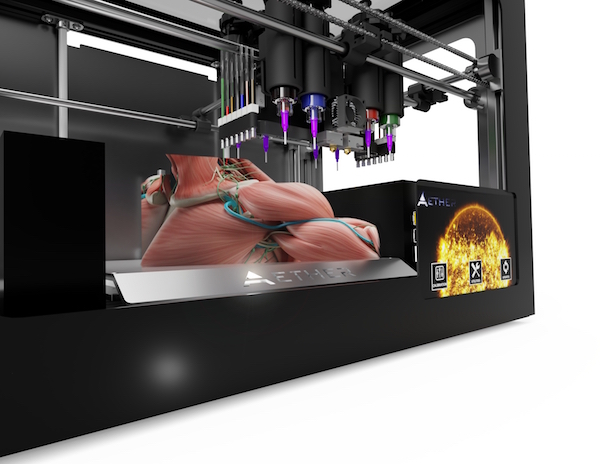
Consumer products giant Procter & Gamble has teamed up with bioprinting firm Aether to advance 3D bioprinting with machine learning and in situ print monitoring, while also developing the next-generation Aether printer. The companies announced a two-year joint development in agreement in February.
The companies will use the Aether 1 multi-material printer to develop hardware and software capabilities that can automate and improve product research applications for P&G.
“Aether is working with P&G to completely redefine 3D printing. It’s no longer going to be just about depositing a material or two in a specific pattern,” said Aether CEO and founder Ryan Franks. “We’re building something more like an intelligent robotic craftsman, able to perform highly complex tasks with many different tools, visually evaluate and correct its work throughout the fabrication process, and constantly learn how to improve.”
The Aether 1 can print up to 24 materials at a time, and also provides a multi-tool hybrid manufacturing solution.
As part of the development agreement, the companies will create an “interconnected network of computer vision and AI algorithms to significantly increase multi-tool and multi-material 3D printing automation.” The companies will also combine an array of high-performance cameras with custom hardware for new robotics capabilities, including real-time in-situ print monitoring with “dynamic intelligent response for parameter adjustment and error correction,” automatic performance of post-processing treatments, object recognition and manipulation, automation of multi-tool hybrid manufacturing processes, and a new user interface.
Aether will develop software to automate image processing for P&G, and deep learning techniques will be used to train multiple neural networks to achieve high-accuracy, automatic 2D-to-3D file conversion.
P&G has been working in the bioprinting space for several years, and launched a grant competition in Singapore for 3D bioprinting applications back in 2015. The company also launched a research program at the same time to investigate the creation of skin tissue that could be used for testing new products.
Source: Aether


Brian Albright is the editorial director of Digital Engineering.
Contact him at [email protected].

Join over 90,000 engineering professionals who get fresh engineering news as soon as it is published.






About Us · Contact Us · Editorial Team · Advertising · Privacy Policy · Subscriber Services · © 2026 Digital Engineering 24/7 · Peerless Media