Helping design and engineering professionals discover, evaluate and specify technologies and processes that shorten the design cycle and enable success.



Digital Engineering April 2026
In the latest issue of Digital Engineering, we take a look at the latest innovations in design for additive manufacturing, including the use of natural language inputs, social media cosplayers, and AI integration. The issue also includes a feature…

January Special Focus Issue: Design for Additive
In this Special Focus Issue of Digital Engineering, learn about the latest advancements in design for additive manufacturing, including new software tools, additive in automotive, custom medical devices, and more.
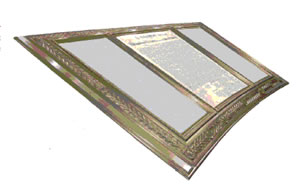 Bronze frame: New bronze frame for the Declaration of Independence replicates the original one built in 1924. |
In the United States, July 4 celebrates the signing of the Declaration of Independence on July 4, 1776. That document broke the ties between the colonies and Great Britain and marked the formation of the United States of America. Drafted by Thomas Jefferson between June 11 and June 28, 1776, the Declaration of Independence now resides in the Rotunda of the National Archives Museum in Washington, D.C.
Over time, the hand-crafted frame that protects this document has become worn down, its intricate details eroded by the many visitors who come to view the document that founded the United States. No records or drawings exist for the original design of the frame, built in 1924.
Several attempts were made to recreate the frame using conventional bronze sculpting techniques. The results, however, did not meet the standards of the National Archives and Records Administration.
The National Archives contracted 3DScanCo, an Atlanta-based engineering firm specializing in 3D scanning, to make a final attempt at restoring the frame. Using 3D scanning in combination with digital restoration, 3DScanCo. succeeded in recreating and restoring the frame.
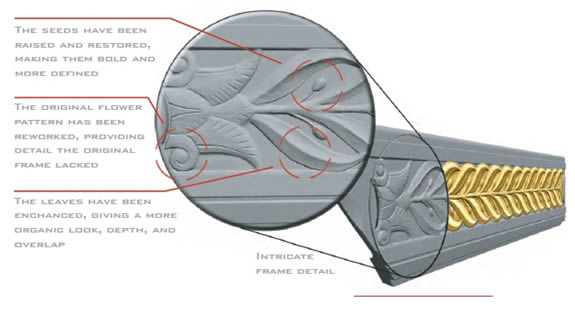 Examples of how 3DScanCo digitally restored the details on the frame. |
The company scanned the existing frame and used that data as the foundation for a digital model. 3DScanCo then reworked the patterns and details digitally. For example, faded features such as leaf patterns, the stem, the flowers, and the seeds were raised and defined. Bronze medallions were recreated with a rounder look to better suit the newly curved frame shape.
Once the renovations were complete, 3DScanCo sent the CAD file to Valley Bronze for use in the casting of a new frame. Next up for 3DScanCo is restoration of the frame holding the U.S. Constitution.
www.3dscanco.com
www.archives.gov/national-archives-experience/charters/declaration.html
Sources: Press materials received from the company and additional information gleaned from the company's website.


DE's editors contribute news and new product announcements to Digital Engineering. Press releases may be sent to them via [email protected].
Follow DE
Join over 90,000 engineering professionals who get fresh engineering news as soon as it is published.






About Us · Contact Us · Editorial Team · Advertising · Privacy Policy · Subscriber Services · © 2026 Digital Engineering 24/7 · Peerless Media