Helping design and engineering professionals discover, evaluate and specify technologies and processes that shorten the design cycle and enable success.



Digital Engineering April 2026
In the latest issue of Digital Engineering, we take a look at the latest innovations in design for additive manufacturing, including the use of natural language inputs, social media cosplayers, and AI integration. The issue also includes a feature…

January Special Focus Issue: Design for Additive
In this Special Focus Issue of Digital Engineering, learn about the latest advancements in design for additive manufacturing, including new software tools, additive in automotive, custom medical devices, and more.
On May 10 at the Society of Manufacturing Engineers (SME) Rapid Prototyping & Manufacturing conference in Dearborn, Michigan, leaders of the Rapid Prototyping (RP) industry announced free medical support for victims of the war in Iraq. "RP for Baghdad" is a joint humanitarian effort led by Fried Vancraen of Materialise, Abe Reichental of 3D Systems, Scott Crump of Stratasys, and Tom Clay of Z Corporation to provide medical models for victims in Iraq.
The effort will focus on the most severely injured victims with serious head injuries or missing limbs. While helping people in serious need, the RP industry will demonstrate how its technology can fundamentally influence people’s lives for the better. Even in the difficult environment of war, 3D printed models based on medical image data are important tools to support surgeons in the most complex craniofacial reconstruction surgeries.
|
|
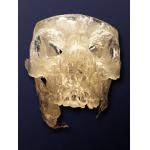
| Medical model of skull with gunshot trauma. Courtesy of RP4Baghdad. |
The Iraqi League for Medical Profession is providing the infrastructure for this service. People with serious injuries will first be CT Scanned at a medical facility. The data from the scan will be processed using the Mimics software of Materialise to generate a 3D Model of the anatomy. 3D Systems, Stratasys, and Z Corporation will provide physical models based from the virtual model. The models will be delivered back to a surgeon in Iraq who can use this bone replica to plan and practice surgery on. As the project progresses the plan is to build RP parts for socket construction in artificial limbs.
The use of rapid prototyping in the medical field starts with digital CT scan data, from which it’s possible to print exact replicas from parts of the human body. For example, if you scan a person’s head and make a model of their skull. These medical models offer surgeons the possibility to study, prepare, and even practice before starting complex surgeries. A well-known example of the use of medical models was the separation of the Egyptian conjoined twins Ahmed and Mohamed in October 2003. Without the models provided by Medical Modeling Corporation, this surgery would have never been attempted.
The RP for Baghdad website online just recently. The organization is looking for medical model builders, additional sponsors, and cash donations.
Please visit the site at by clicking here. Then click on the "Can I Help" tab to support this effort.


DE's editors contribute news and new product announcements to Digital Engineering. Press releases may be sent to them via [email protected].
Follow DE
Join over 90,000 engineering professionals who get fresh engineering news as soon as it is published.






About Us · Contact Us · Editorial Team · Advertising · Privacy Policy · Subscriber Services · © 2026 Digital Engineering 24/7 · Peerless Media