Helping design and engineering professionals discover, evaluate and specify technologies and processes that shorten the design cycle and enable success.



May 2026 Special Focus: Artificial Intelligence in Design and Simulation
In this Special Focus Issue, learn about the latest developments in the integration of artificial intelligence into engineering workflows.

April 2026 Special Focus Issue: Generative Design
In this Special Focus Issue, Digital Engineering takes a look at how generative design solutions can be used across different types of design problems and with a variety of manufacturing approaches to accelerate design space exploration, and…
Parasolid v30.1 delivers enhancements across classic B-rep functionality to enable application developers to code and maintain sophisticated functionality more effectively for end-users. Facet B-rep enhancements cover complex modeling with facet data and repair of imported facet data, in addition to architectural foundations to support fully integrated Convergent Modeling in future releases. Enhancements include the following:
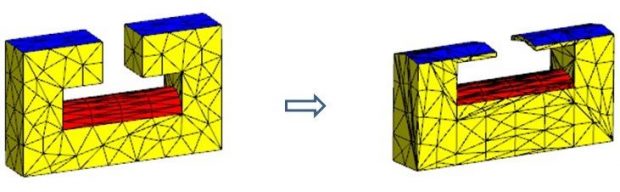 The top faces (blue) and parallel underlying faces (not visible) are dependently offset from a lower face (red). Image courtesy of Siemens PLM Software.
A number of classic B-rep operations have been added to enable application developers to manage end-user workflows more easily, including creation of general wire bodies, perspective outlines and symmetric periodic B-curves; mass properties of transformed topologies including reflections; improved diagnostics for swept tool and fill hole; and increased case coverage in tapering when creating mitre faces.
Sources: Press materials received from the company.


DE's editors contribute news and new product announcements to Digital Engineering. Press releases may be sent to them via [email protected].
Follow DE
Join over 90,000 engineering professionals who get fresh engineering news as soon as it is published.






About Us · Contact Us · Editorial Team · Advertising · Privacy Policy · Subscriber Services · © 2026 Digital Engineering 24/7 · Peerless Media
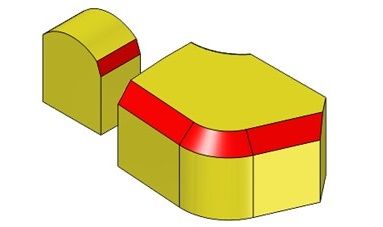 Examples of apex-range chamfer blends. Image courtesy of Siemens PLM Software.