Helping design and engineering professionals discover, evaluate and specify technologies and processes that shorten the design cycle and enable success.



Digital Engineering April 2026
In the latest issue of Digital Engineering, we take a look at the latest innovations in design for additive manufacturing, including the use of natural language inputs, social media cosplayers, and AI integration. The issue also includes a feature…

January Special Focus Issue: Design for Additive
In this Special Focus Issue of Digital Engineering, learn about the latest advancements in design for additive manufacturing, including new software tools, additive in automotive, custom medical devices, and more.
Solidoodle is one of these smaller companies that seems to be doing quite well. We first covered the company here, with a look at the first generation of Solidoodles. The company is now up to version three, and we thought we might take a look at the latest offering to see what’s new.
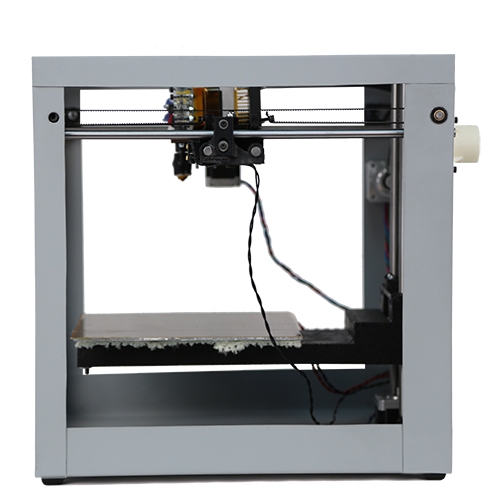
The Solidoodle 3 is larger than its older brethren, with a build area of 8 x 8 x 8 in. (20.32 x 20.32 x 20.32 cm). It still uses 1.75 mm ABS plastic filament, but Solidoodle claims the system can also use PLA. According to the company, the spool feed has been redesigned to reduce tangles, allowing users to let the 3D printer run unattended for longer periods of time. Print layers remain at .3 mm.
The third generation Solidoodle still suffers from the same lack of resolution as the company’s other AM systems, but I’m still not sure how much home users will really care about that sort of thing. The company is pretty straightforward about the resolution. From the Solidoodle website:
“Clarification: the precision of the printhead in the horizontal plane (X-Y direction) is about .011mm (about 2300dpi). However, this number is a little superflous [sic] because we are extruding ABS plastic through a relatively larger .35mm nozzle, and all ABS plastic oozes a bit. So a more realistic & practical estimate of resolution in the horizontal plane is about .1mm. And to be crystal clear — this creates great prints. Trying to define the resolution more accurately than this is similar to trying to define the position of a garden hose nozzle to within millimeters — it's essentially meaningless since the water is going to expand anyway.”
Another change for the Solidoodle 3 is the price. The first set of printers ran $499, which is pretty much what I feel is the sweet spot for home systems. The newest iteration has been bumped up to $799. Is two more inches of build envelope worth $300? I’m not sure if customers will agree.
Below you’ll find an interview with Sam Cervantes, CEO of Solidoodle.
Source: Solidoodle


John Newman is a Digital Engineering contributor who focuses on 3D printing. Contact him via [email protected] and read his posts on Rapid Ready Technology.
Follow DE
Join over 90,000 engineering professionals who get fresh engineering news as soon as it is published.






About Us · Contact Us · Editorial Team · Advertising · Privacy Policy · Subscriber Services · © 2026 Digital Engineering 24/7 · Peerless Media