Helping design and engineering professionals discover, evaluate and specify technologies and processes that shorten the design cycle and enable success.



April 2026 Special Focus Issue: Generative Design
In this Special Focus Issue, Digital Engineering takes a look at how generative design solutions can be used across different types of design problems and with a variety of manufacturing approaches to accelerate design space exploration, and…

Electrum utilizes the 3DEXPERIENCE platform on the cloud to develop their new electric motorcycle
Electrum, a new brand of electric motorcycles, utilizes the 3DEXPERIENCE platform. Their mission is to support Indonesia’s shift to low-carbon, sustainable transport and to ultimately help the country’s government achieve its vision of net…
The all-cash transaction, for which terms were not disclosed, gives 3D printing and additive manufacturing solution leader Stratasys a newly-released 3D CAD collaboration platform called Workbench along with access to a community of 1.5 million mechanical design engineers and CAD users who are passionate about design and 3D modeling.
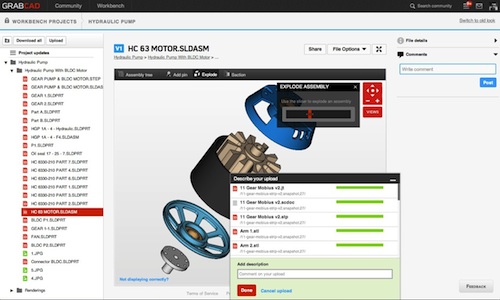
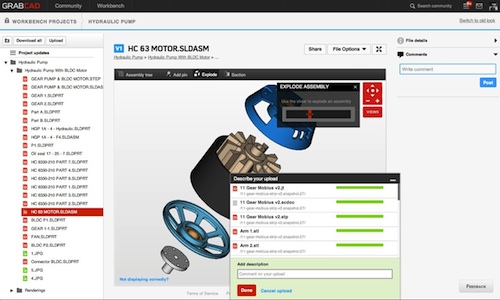 GrabCAD's Workbench cloud collaboration product caught Stratasys' eye as a way to make the steps around 3D printing more accessible. Image Courtesy of Stratasys.
Rob Stevens, GrabCAD's vice president of marketing & business development said the company wasn't actively looking to be acquired, but was open to the Stratasys offer given the companies' shared vision for open engineering.
"The engineering process is changing and there's a lot of people helping to get the word out and we're one of them," he said. "Stratasys is another with its vision of rapid manufacturing and 3D printing, which changes how things are made."
While Stevens declined to discuss specifics, he said GrabCAD Workbench, which lets engineers and designers share, view, and manage CAD files and other design data easily in the cloud, will be tightly integrated with Stratasys' 3D printer offerings to help make 3D printing more accessible.
"If you think about 3D printing, there are a lot of steps in the process, and Workbench could make collaboration across those steps easier, simplifying how engineers go from design to 3D printing," he explained.
The GrabCAD community is also very synergistic with some of Stratasys' other acquisitions, Stevens said, including last year's $430 million purchase of Makerbot, a manufacturer of desktop 3D printers, and Thingiverse, the largest database of digital designs. "We see the GrabCAD community as a complement to those communities," Stevens said.
Beyond interest in its technology, Stevens said Stratasys also had its eye on GrabCAD's engineering team, which is spearhead by Hardi Meybaum, a pioneer in 3D cloud collaboration tools and the author of a book, "The Art of Product Design."
In the book, Meybaum explains the concept of Open Engineering, an approach that takes advantage of web-based communities like GrabCAD, knowledge, and tools to break down barriers and accelerate the design and manufacturing process.
"Stratasys was very excited by the team here, which has a lot of experience in CAD-related technology," Stevens said.
Not much will change post acquisition. Stevens said the GrabCAD community will remain in tact, the GrabCAD leadership team is not changing, and the products will continue to be supported and enhanced under a separate brand.
Check out this video to hear Desktop Engineering Senior Editor Kenneth Wong's early review of GrabCAD Workbench:
For more information, visit Stratasys.


Beth Stackpole is a contributing editor to Digital Engineering. Send e-mail about this article to [email protected].
Follow DE
Join over 90,000 engineering professionals who get fresh engineering news as soon as it is published.






About Us · Contact Us · Editorial Team · Advertising · Privacy Policy · Subscriber Services · © 2026 Digital Engineering 24/7 · Peerless Media