Helping design and engineering professionals discover, evaluate and specify technologies and processes that shorten the design cycle and enable success.



Digital Engineering April 2026
In the latest issue of Digital Engineering, we take a look at the latest innovations in design for additive manufacturing, including the use of natural language inputs, social media cosplayers, and AI integration. The issue also includes a feature…

January Special Focus Issue: Design for Additive
In this Special Focus Issue of Digital Engineering, learn about the latest advancements in design for additive manufacturing, including new software tools, additive in automotive, custom medical devices, and more.
Its machine control utility is designed to enable customers to manipulate thousands of materials at the voxel level to produce 3D models that fit precise material requirements, according to Gina Scala, director of marketing for Global Education, Stratasys.
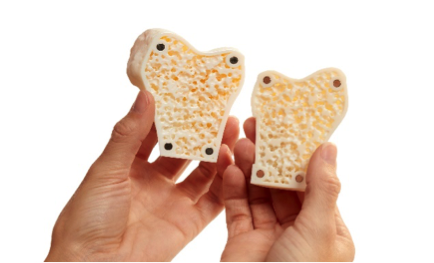 Academic and medical research, as well as training groups, can use GrabCAD Voxel Print to create realistic anatomical models, such as this cancellous mesh-like bone, for practicing surgical procedures. Image courtesy of Stratasys.
Stratasys’ Digital Materials are achieved by combining PolyJet photopolymers inside the 3D printer. The Stratasys J750 platform, equipped with GrabCAD Voxel Print, enables the ability to manipulate these 3D printed material concentrations, structures and color mapping at the voxel level. This allows users to produce new Digital Materials for their specialized needs – creating advanced structures, gradient color patterns, internal properties and textures with 3D printing, to meet precise material requirements for various applications.
Users can use their own model layer slicer tool to assign properties at the voxel level, slice by slice, creating the ability to go beyond boundary representation to volumetric modeling. Stratasys is enabling the user to design and fabricate a part from the inside out. GrabCAD Voxel Print generates a GrabCAD Voxel File (GCVF) that can be directly loaded to GrabCAD and fabricated on the Stratasys J750 3D Printer.
GrabCAD Voxel Print is immediately available for use with the Stratasys J750 full-color, multi-material 3D Printer and GrabCAD Print.
For more info, visit Stratasys.
Sources: Press materials received from the company.


DE's editors contribute news and new product announcements to Digital Engineering. Press releases may be sent to them via [email protected].
Follow DE
Join over 90,000 engineering professionals who get fresh engineering news as soon as it is published.






About Us · Contact Us · Editorial Team · Advertising · Privacy Policy · Subscriber Services · © 2026 Digital Engineering 24/7 · Peerless Media