Helping design and engineering professionals discover, evaluate and specify technologies and processes that shorten the design cycle and enable success.



Digital Engineering April 2026
In the latest issue of Digital Engineering, we take a look at the latest innovations in design for additive manufacturing, including the use of natural language inputs, social media cosplayers, and AI integration. The issue also includes a feature…

January Special Focus Issue: Design for Additive
In this Special Focus Issue of Digital Engineering, learn about the latest advancements in design for additive manufacturing, including new software tools, additive in automotive, custom medical devices, and more.
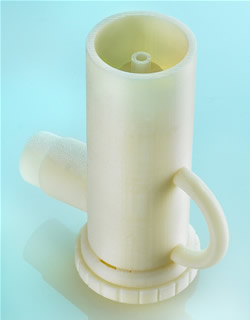 Stratasys, Inc. (Eden Prairie, MN) announced the availability of ABS-M30i, a new biocompatible material for use with the company’s FDM 400m prototyping and production system. Stratasys anticipates that the typical prototyping and production applications of this new material will include pharmaceutical handling, processing, and packaging; food processing and packaging systems; and surgical instruments. ABS-M30i is FDA compatible and meets ISO 10993 standards; the material may be sterilized using either the gamma radiation or ethylene oxide (EtO) method.
In addition to being biocompatible, ABS-M30i offers substantial improvements over standard Stratasys ABS across a number of mechanical properties, including tensile, impact, and flexural strength. The material’s mechanical properties for strength are up to 67 percent stronger than standard Stratasys ABS and bonding strength between layers has more than doubled.
“ABS-M30i opens up a variety of direct digital manufacturing possibilities for medical device and food and pharmaceutical companies interested in developing sterile, biocompatible parts in-house,” said Stratasys FDM product manager Patrick Robb.Build speeds using ABS-M30i on the Stratasys FDM 400mc are 29 percent faster, on average, than the same part built in ABS on a Stratasys FDM Titan, Vantage SE or Vantage S system. ABS-M30i also uses the new SR20 soluble support technology, enabling automated support-material removal. In addition, ABS-M30i parts can be built with 0.005, 0.007, 0.010, and 0.013 inch slices. It is initially available in “natural” off-white color.
Stratasys manufactures additive fabrication machines for prototyping and direct digital manufacturing and prototype and part manufacturing services. The company holds more than 180 granted or pending additive fabrication patents globally. Its products are used in the aerospace, defense, automotive, medical, education, electronic, and consumer product industries. On the Web, visit Stratasys at www.stratasys.com.
Sources: Press materials received from the company and additional information gleaned from the company’s website.


DE's editors contribute news and new product announcements to Digital Engineering. Press releases may be sent to them via [email protected].
Follow DE
Join over 90,000 engineering professionals who get fresh engineering news as soon as it is published.






About Us · Contact Us · Editorial Team · Advertising · Privacy Policy · Subscriber Services · © 2026 Digital Engineering 24/7 · Peerless Media