Helping design and engineering professionals discover, evaluate and specify technologies and processes that shorten the design cycle and enable success.



Digital Engineering April 2026
In the latest issue of Digital Engineering, we take a look at the latest innovations in design for additive manufacturing, including the use of natural language inputs, social media cosplayers, and AI integration. The issue also includes a feature…

January Special Focus Issue: Design for Additive
In this Special Focus Issue of Digital Engineering, learn about the latest advancements in design for additive manufacturing, including new software tools, additive in automotive, custom medical devices, and more.
Stratasys (Eden Prairie, MN) announced its FDM 400mc, a new direct digital manufacturing and prototyping system slated to ship this month. The new system is designed for improved speed, flexibility, and part quality compared with existing FDM (fused deposition modeling) systems.
"Manufacturing experts have said that general industry advances in these areas were needed to encourage migration to direct digital manufacturing," says FDM product manager Patrick Robb. "Stratasys took this seriously when designing the FDM 400mc. These enhancements are part of our focused effort to meet the needs of the direct digital manufacturing market with our high-end FDM systems."
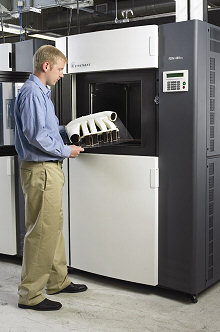 |
| The new Stratasys FDM 400mc is available with two different built chamber sizes. |
Hardware and software enhancements in the FDM 400mc allow plastic to be deposited more precisely thanks to smooth head movement, precise head positioning, and consistent material-bead width.
Improvements in both the design and manufacturing of the extrusion head gantry make it straighter and stiffer. This holds the extrusion head to a tighter positional accuracy that can produce parts with a higher tolerance. It also results in performance that is repeatable.
Stratasys says that its testing shows that the FDM 400mc maintains repeatable performance when manufacturing multiple identical parts in different runs, at various platform positions, and on various machines.
Debuting along with the FDM 400mc is a new material, ABS-M30. ABS-M30 offers real improvements over standard Stratasys ABS across a number of mechanical properties, including tensile, impact, and flexural strength. ABS-M30 mechanical properties are up to 67% stronger than standard Stratasys ABS.
The FDM 400mc features a build speed 29% faster than its FDM predecessors when averaging all material types and slice thicknesses. The stiffer gantry, improved extrusion parameters, and better extrusion flow control maintain part quality even at faster build speeds.
The standard build envelope measures 14 x 10 x 10 in. (356 x 254 x 254mm). An optional build-envelope size of 16 x 14 x 16 in. (406 x 356 x 406mm) is available. The larger option includes additional material bays for longer running jobs.
The FDM 400mc can build with the following optional materials: ABS-M30, PC, PC-ABS, and PPSF. Plans call for the eventual addition of ABS, ABSi, and PC-ISO, which are currently available on other Stratasys FDM systems.


DE's editors contribute news and new product announcements to Digital Engineering. Press releases may be sent to them via [email protected].
Follow DE
Join over 90,000 engineering professionals who get fresh engineering news as soon as it is published.






About Us · Contact Us · Editorial Team · Advertising · Privacy Policy · Subscriber Services · © 2026 Digital Engineering 24/7 · Peerless Media