Helping design and engineering professionals discover, evaluate and specify technologies and processes that shorten the design cycle and enable success.



May 2026 Special Focus: Artificial Intelligence in Design and Simulation
In this Special Focus Issue, learn about the latest developments in the integration of artificial intelligence into engineering workflows.

Design & Simulation Software Guide 2025
In this Special Issue, Digital Engineering presents its second annual guide to design and simulation software vendors.
AI-enabled workflows are helping engineering teams generate nearly four times as many design variants per program, compared to convention approaches, according to a new survey from cloud engineering software provider SimScale. As a result, AI is helping these engineers test more ideas, iterate faster, and find optimial designs earlier in their development processes. The company's 2026 State of Engineering AI Report sruveyed 350 engineering leaders in the U.S., UK, and Germany.
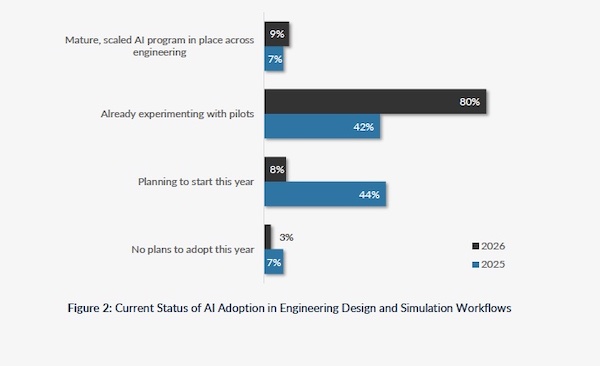
"For years, AI in engineering was viewed primarily as potential," said David Heiny, CEO and co-founder of SimScale. "What we're seeing now is a shift from experimentation to scaled execution. Compared with our 2025 report, the share of organizations actively experimenting with pilots and running mature, scaled AI programs has nearly doubled, signaling a clear wave of adoption. The teams pulling ahead are not just adopting AI tools, they're embedding AI into real engineering workflows built on cloud-native platforms, expanding the design space in ways that simply aren't possible with legacy infrastructure. That's when you move beyond incremental efficiency gains and start seeing measurable impact on both innovation and commercial performance.”
The report findings point to several defining themes shaping how engineering organizations are adopting, scaling, and operationalizing AI today:
75% of organizations with mature AI programs cite cloud-native infrastructure as a key enabler.
70% of respondents cite secure data governance and access controls as critical enablers of scaling AI initiatives.
According to SimScale, the data reinforces the idea that scale is less dependent on perfect data architecture and more closely associated with infrastructure readiness and governance maturity. The broader opportunity hinges on modernizing infrastructure so AI can deliver value within real engineering processes now, while data foundations continue to mature.
The survey also found that 92% of respondents reported deploying surrogate models to accelerate simulatoin or design exploration in 2025. However, they are still using those models in a limited way, with just 8% saying those models are extensively deployed in their workflows.
The survey also found that:
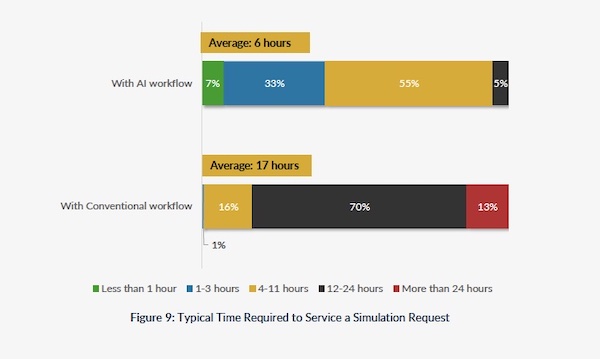
Organizations using AI-enabled workflows reported an average 2.8x speedup in servicing simulation requests compared to conventional workflows.
Organizations using AI-enabled workflows report request for quote (RFQ) and technical bid turnaround times approximately three times faster than those using conventional workflows
Accelerating simulation turnaround and RFQ response times helps organizations respond to customer requirements faster and compete more effectively in time-sensitive markets.
Across every major stage of product development, AI copilots are significantly more common than autonomous agents, with adoption ranging from 67% in requirements engineering to 76% in simulation/computer-aided engineering (CAE), while only about 10% reported deployment of fully autonomous AI agents.
87% of organizations have the necessary governance in place for AI to take autonomous pass/fail decisions at design gates, with 8% routinely adopting this practice. This trend indicates a widespread expectation of increasing autonomy of AI agents.
According to the report, the data reveals that organizations are progressing deliberately when it comes to full autonomy. Copilots are becoming embedded in day-to-day engineering tasks, assisting with simulation setup, analysis, and workflow coordination. However, fully autonomous agents remain limited in deployment, reflecting the high-consequence nature of engineering decisions.
The report also looked at the impact of AI on design space exploration in different verticals:
In Machinery and Industrial Equipment teams, 88% of organizations using AI workflows iterate daily or multiple times per day, compared with just 12% using conventional workflows.
In Life Sciences and Healthcare teams, 64% of organizations using AI workflows iterate daily, while conventional workflows show virtually no daily iteration.
Across industries, the survey results show that AI-enabled workflows are significantly changing how quickly engineering teams can explore and refine designs. Instead of running simulations only periodically due to time and compute constraints, many teams can now iterate on designs daily or even multiple times per day. This faster pace of experimentation allows engineers to test more configurations, identify potential issues earlier, and converge on optimized solutions more quickly, expanding the practical design space within a single development cycle, the company said.
The full 2026 State of Engineering AI Report, including detailed findings and analysis, is available here.
Sources: Press materials received from the company and additional information gleaned from the company’s website.


DE's editors contribute news and new product announcements to Digital Engineering. Press releases may be sent to them via [email protected].
Follow DE
Join over 90,000 engineering professionals who get fresh engineering news as soon as it is published.






About Us · Contact Us · Editorial Team · Advertising · Privacy Policy · Subscriber Services · © 2026 Digital Engineering 24/7 · Peerless Media