Helping design and engineering professionals discover, evaluate and specify technologies and processes that shorten the design cycle and enable success.


Sponsored
 Dear Desktop Engineering Reader:
SRP (subtractive rapid prototyping) – milling – enables you to do a lot of things that you cannot do or do as efficiently with 3D printing. Today’s Check It Out link takes you to a gem of a document that explains how, why and much more.
Originally a Roland DGA booklet, Product Development Inc. (PDI), an employee-owned VAR (value-added reseller) based out of Knoxville, TN, extended and repurposed “Can Your 3D Printer Do This?” PDI sells and services Roland SRP equipment as well as leading 3D printers. What designers and engineers vetting rapid prototyping systems get here is a lot of valuable information to use in their research. Here are some highlights.
An eye-opening part of this 10-page paper comes early with a comparison of the same part made by an SRP unit and a 3D printer using similar polymers. The highpoint here is a terrific set of high-magnification images showing the differences between tolerances, surface finishes and deviations.
The advanced applications discussion is cool. A key value-add PDI offers its clients are exclusive accessories for Roland’s SRP equipment, including Roland’s new SRM-20. With these accessories, you can handle jobs like PC board prototyping, rotary and diamond drag engraving and 3D scanning. For example, PDI has a small touch probe for 3D scanning for collecting points. It’s said to offer a 0.002-in. scanning pitch for collecting small details.
Money merits two discussions, both well done. First, it focuses on ROI (return on investment). Demo SRP parts are deconstructed into such constituent dollar amounts as material costs, build time and labor. Comparative prices for the 3D-printed versions are based on data from an outside service bureau.
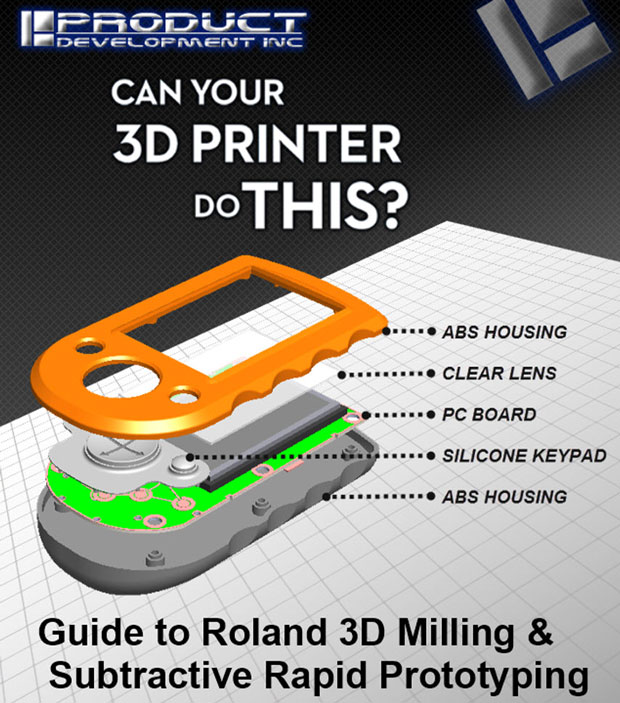 “Can Your 3D Printer Do This?” provides a comparison of 3D printing and SRP (subtractive rapid prototyping) that includes form, fit and function, cost of ownership and return on investment. Image courtesy of Product Development Inc.
Second, it’s all about cost of ownership. Here, a chart shows hard-dollar comparisons of SRP systems and equivalent 3D printers. Equated expenditures include system price, warranty, options, annual fees and materials over a five-year period.
The money talk parts of “Can Your 3D Printer Do This?” should interest anyone eyeballing the ledger. But many will find the advanced applications the most intriguing. This is the stuff of innovation. PDI’s extensions to the Roland SRP line seem to offer a swift path to nimbleness – especially for small shops and departments with limited funds for new equipment needing a competitive edge.
Download your copy of “Can Your 3D Printer Do This?” from today’s Check it Out link now. It’s well worth your time.
Thanks, Pal. – Lockwood
Anthony J. Lockwood
Editor at Large, Desktop Engineering


Anthony J. Lockwood is Digital Engineering's founding editor. He is now retired. Contact him via [email protected].
Follow DE
Join over 90,000 engineering professionals who get fresh engineering news as soon as it is published.






About Us · Contact Us · Editorial Team · Advertising · Privacy Policy · Subscriber Services · © 2026 Digital Engineering 24/7 · Peerless Media