Helping design and engineering professionals discover, evaluate and specify technologies and processes that shorten the design cycle and enable success.



Digital Engineering April 2026
In the latest issue of Digital Engineering, we take a look at the latest innovations in design for additive manufacturing, including the use of natural language inputs, social media cosplayers, and AI integration. The issue also includes a feature…

January Special Focus Issue: Design for Additive
In this Special Focus Issue of Digital Engineering, learn about the latest advancements in design for additive manufacturing, including new software tools, additive in automotive, custom medical devices, and more.
Editor’s note: This commentary was sponsored as part of DE’s Visionary Voices section.
Additive manufacturing (AM) is instrumental in bringing products to life. Its role now spans concept development to manufacturing. While many of today’s conversations turn to the amazing ability to manufacture end-use items with little more than CAD data, I believe there is still much more we can do to assist design engineers in creating great products.
We see three distinct areas, each with distinct needs. Desktop 3D printers will be office peripherals that deliver professional-grade parts. 3D production systems will be a centralized solution for the more demanding applications. They are also the bridge between 3D printers and on-demand manufacturing systems.
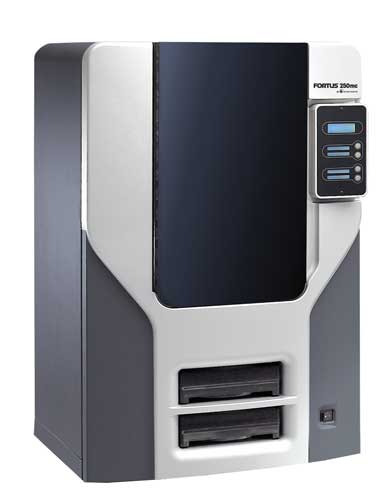
The recently launched Fortus 250mc offers the total process
control of a 3D production system at an entry-level price.
Through user interaction and our RedEye On Demand production services, we’ve learned that an all-in-one system isn’t the best option. Systems are multi-purpose, but the engineer in me knows that the demands are too diverse to tackle in one system. A system for all applications overcomplicates the design, and this breaches our prime tenet for desktop systems.
In the near term, you will have professional-grade desktop 3D printers for less than $10,000. But as we have witnessed, low price alone doesn’t mean much. To be your go-to device, this CAD peripheral has to work transparently. You won’t accept anything other than perfect, high-quality prints every time. You want a push-button device that spits out parts without any effort. And you demand a whisper-quiet machine without nasty emissions.
To do all that, the next-generation 3D printer will have few user options and small capacity. They will also be designed for one or two materials.
When you need more--more materials, bigger working envelopes and total control over speed and quality--you will turn to your company’s shared 3D production systems. We recently rolled out the Fortus 250mc for those very reasons. Our Dimension customers wanted a low price-point system that allows them to dictate exactly how a part is built.
Like 3D production machines for manufacturing, these systems will get faster and the material selection will get bigger. The engineer’s 3D production systems and those for manufacturing will have a lot in common. Advances in one will find their way to the other. Yet, they will become increasingly distinct.
A new class of 3D production systems will emerge. These machines will be industrial grade. Our direction is to make them with the traits of a CNC workhorse. They will be even more dependable, predictable and rugged. Part-to-part and machine-to-machine repeatability won’t be a concern. And to keep pace with demand, these systems will have higher throughput and extended duty cycles with fast, automated post-processing.
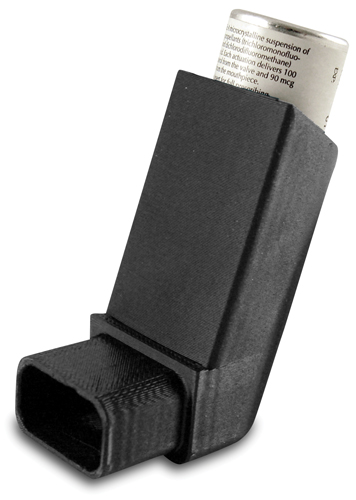
Expect more application-specific materials,
such as ABS-ESD7, which dissipates electrostatic
charge in this medical inhaler.
The challenge for design engineers will be keeping pace with all the advances; knowing what is possible with each platform. You will use a combination of 3D printers and shared 3D production systems. And when capacity peaks or alternative materials are needed, you will turn to outsourced services.
Another challenge is preparing for the future of manufacturing. Design engineers will be vital to AM’s success as a production method. Design innovation will be critical. Merely replicating today’s designs with AM marginalizes the technology. So, you must learn how to leverage AM, how to design around limitations and understand when direct digital manufacturing makes sense.
You will need to break free of established design standards. I know that habits are hard to break, but trust me, adopting new practices will be well worth it. You will be free to innovate your designs in extraordinary ways.
Scott Crump is CEO, President and Chairman of the Board at Stratasys.


DE's editors contribute news and new product announcements to Digital Engineering. Press releases may be sent to them via [email protected].
Follow DE
Join over 90,000 engineering professionals who get fresh engineering news as soon as it is published.






About Us · Contact Us · Editorial Team · Advertising · Privacy Policy · Subscriber Services · © 2026 Digital Engineering 24/7 · Peerless Media