Helping design and engineering professionals discover, evaluate and specify technologies and processes that shorten the design cycle and enable success.



Digital Engineering April 2026
In the latest issue of Digital Engineering, we take a look at the latest innovations in design for additive manufacturing, including the use of natural language inputs, social media cosplayers, and AI integration. The issue also includes a feature…

January Special Focus Issue: Design for Additive
In this Special Focus Issue of Digital Engineering, learn about the latest advancements in design for additive manufacturing, including new software tools, additive in automotive, custom medical devices, and more.
The lack of standards for rapid prototyping (RP) is a perennial barrierto launching it on the fast track to wide acceptance. A time and moneysaver when compared to traditional subtractive machining, RP can alsoproduce parts otherwise not physically buildable, but there are stillno official methods for evaluating its benefits and limitations. WhileRP equipment and materials suppliers provide their own specifications,users are seeking objective information.
Every year at the Society of Manufacturing Engineers (SME) RapidPrototyping and Manufacturing Conference, roundtable forumsinevitably turn to the need for national or international standards.Despite the apparent demise of several government-led projects, thereare pockets of activity addressing this subject around the world. DEcaught up with some of the activists involved to get a status report.
Stepping Up to the Plate
Wondering if a given material will behave consistently from batch tobatch? Can you predict how behavioral properties may or may not varybetween traditional and RP parts? Where can you go for answers?
The SME, continuing its efforts to meet the needs of professionals,companies, and industry, recently launched the Rapid Technologies andAdditive Manufacturing Community (RTAM) to address such questions. Itevolved from the Rapid Prototyping Association of SME (RPA/SME), agroup that had been active since 1993. Within the RTAM, the Materialsand Process Standards committee is working to research and collect justthis kind of data, and eventually determine a path that could bring theresults together as universally accepted standards.

Image of cowling Courtesy of Stratasys, Inc.
Carl Dekker, last year's Chairman of the RTAM Steering Committee andPresident of Met-L-Flo, an RP service bureau located in Geneva,Illinois, notes that one drawback to developing standards is that mostpeople don't want to fund something if the end result only applies toprototyping, rather than large-scale manufacturing. "The groupacknowledges that material and process standards are critical toevolving rapid prototyping into true 3D digital manufacturing," headds, "but what's needed are definitions."In the mid-1990s, both the NationalInstitute of Standards andTechnology (NIST) and ASTM International (originally known as theAmerican Society for Testing and Materials), supported independent workin this area. The former generated a flurry of articles andpresentations by its Manufacturing Systems Integration Division, butthat work does not appear to have stimulated action toward eitherformal standards—possibly defined by the American National StandardsInstitute—or de facto standards, such as an improved or replaced STLfile format. And while ASTM's website still lists an RP subcommittee aspart of its mechanical testing group, activity on the subcommitteeended sometime prior to 1998. So, the search continues.
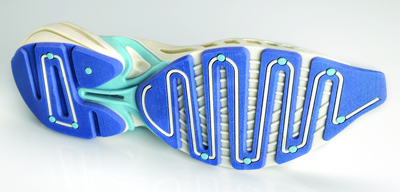
Z Corp's Spectrum Z510 System prints prototypes like this running shoe sole inhigh-definition color to reflect original design data and to make sure modelsaccurately communicate thedesign intent.
Academic Research Digs Deep
Of the several dozen universities spread around the world that areheavily involved in a range of RP material and process research, manyhave projects that tackle bits of the standards puzzle.
An RP Parts Library?
Many of the aspects of an RP standards solution were proposed inarticles and reports following an NIST workshop in October 1997. One ofthose was to develop a standard library of 3D features (e.g., spheres,cylinders, prisms, cones) defined in a variety of sizes and orientationangles.1 Measured attributes could include flatness of surfaces,roundness of holes and cylinders, minimum thickness of walls and slots,and surface roughness, to help potential users compare and trade offaspects of using different processes and materials for a given part.
More recently, the talk has swung toward creating standards strictlyfor the raw materials. If you'd like to comment about this and otheraspects of potential RP standards, contact SME or Tim Gornet([email protected]).
—PJW
1. "Rapid Prototyping's Second Decade," Kevin Jurrens, ed.; RapidPrototyping Association of the Society of Manufacturing Engineers, Vol.4, No. 1, First Quarter 1998.
Upcoming Events SME Rapid Prototyping and Manufacturing 2005 Conference and Exposition 6th National Conference on Rapid Design, Prototyping and Manufacturing 2nd International Conference on Advanced Research in Virtual and RapidPrototyping (VRAP) 2005, Leiria, Portugal, September 28-October 1 |
Contributing editor Pamela J. Waterman is an electrical engineer and afreelance technical writer based in Arizona. You can contact her aboutthis article via e-mail c/o [email protected].
Companies Mentioned in this Article:
Align Technology
Santa Clara, CA
ANSI
Washington, DCASTM International
West Conshohocken, PAGeorgia Institute of Technology
Athens, GALoughborough University
Loughborough, Leicestershire, UKUniversity of Louisville
Louisville, KYMet-L-Flo, Inc.Geneva, IL
Milwaukee School of Engineering Rapid Prototyping Center
Milwaukee, WINational Center for Manufacturing Sciences
Ann Arbor, MIOn-Demand Manufacturing
Camarillo, CARapid Prototyping Mailing List
Society of Manufacturing Engineers
Dearborn, MIUniversity of Texas at Austin
Austin, TXWohlers Associates
Ft. Collins, CO


Pamela Waterman worked as Digital Engineering's contributing editor for two decades. Contact her via DE-Editors@ digitaleng.news.
Follow DE
Join over 90,000 engineering professionals who get fresh engineering news as soon as it is published.






About Us · Contact Us · Editorial Team · Advertising · Privacy Policy · Subscriber Services · © 2026 Digital Engineering 24/7 · Peerless Media