Helping design and engineering professionals discover, evaluate and specify technologies and processes that shorten the design cycle and enable success.



Digital Engineering April 2026
In the latest issue of Digital Engineering, we take a look at the latest innovations in design for additive manufacturing, including the use of natural language inputs, social media cosplayers, and AI integration. The issue also includes a feature…

January Special Focus Issue: Design for Additive
In this Special Focus Issue of Digital Engineering, learn about the latest advancements in design for additive manufacturing, including new software tools, additive in automotive, custom medical devices, and more.
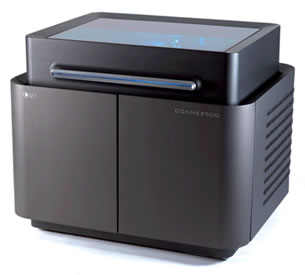 Objet Geometries Ltd. (Rehovot, Israel; 2objet.com) announced its new PolyJet Matrix Technology, a method of rapid prototyping and manufacturing (RP&M) enabling the simultaneous jetting of different types of model materials. The company says it makes for virtually unlimited opportunities for emulating the look, feel, and function of final products.
In combination with Objet’s new Connex500 printer, the technology allows for the printing of parts and assemblies made of multiple model materials, all in a single build. The Connex500 printer also fabricates digital materials on the fly, enabling users to create composite materials that have preset combinations of mechanical properties.
The process allows, for example, creating a product with a rubber-like handle perfectly bonded to a rigid tool, and in one step. It also means designers can combine two different materials in a variety of combinations to result in numerous degrees of mechanical values resulting in what the company calls Digital Materials (DM).
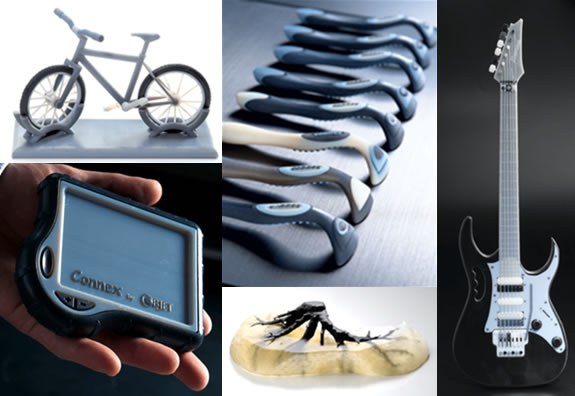
Objet’s patent-pending PolyJet Matrix Technology works by jetting two distinct Objet FullCure model materials in preset combinations. The technology controls every nozzle in each print head, enabling combinations of model materials to be jetted from designated nozzles according to location and model type. The ability to manage the jetting matrix provides full control of the mechanical properties of the jetted materials, allowing the user to choose and fabricate the most suitable composite materials to emulate the target design.
Printing parts and assemblies with multiple model materials eliminates the need to design, print, and glue together separate model parts to make a complete model. The savings are realized in printing and postprocessing time.
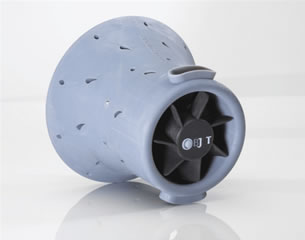 Another inherent benefit of the process is the dramatic reduction in the cost of error when creating complex molds for double injection.
“This is an industry first,” stated Terry Wohlers of Wohlers Associates, Inc., after reviewing the capabilities of the new PolyJet Matrix Technology. “This opens up exciting new options that before were impossible with methods of additive fabrication.”
With the new system, it is possible to produce parts and assemblies with 21 preset combinations of materials, as well as the seven original materials from the FullCure line. The Connex500 prints parts with specific Shore A values, a scale used to indicate material hardness in soft, flexible materials. Consequently, users of the machine can match the Shore A values to those of production materials.
The Connex500 is capable of producing prototypes of products that use overmolding in the manufacturing process. The new system can print multimaterial parts in a single build process that eliminates the difficulties and expense of the traditional process. What’s more, the system is capable of fabricating translucent models that can aid in medical applications by showing nerves, tumors, and other areas of interest.
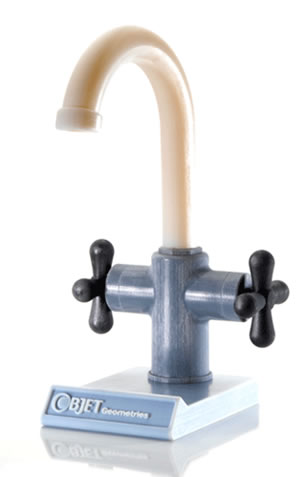 Printing 600 x 600 dpi in both the x and y axes, the Connex500 enables walls of 0.6mm, fine details in all dimensions, and a smooth surface finish regardless of geometric complexity. Precision printing, with a maximum tolerance of 0.3mm over large models, ensures accuracy and repeatability.
The Connex500 offers three printing modes. The DM mode operates at 12mm per hour in 30-micron layers and is used for Digital Materials and multiple model material printing. The HQ mode builds parts at 12mm per hour in 16-micron (0.0006 inch) layers, and the HS mode runs at 20mm per hour in 30-micron (0.001 inch) layers. The Connex500’s build volume is 500 x 400 x 200 mm (19.7 x 15.7 x 7.9 in.).
New Objet Studio software is included to assign multiple materials to STL files and create files that include different material types, assemblies, and model characteristics.
Objet will unveil the Connex500 and PolyJet Matrix at the EuroMold 2007 exhibition on December 5-8 in Frankfurt, Germany (Hall 8.0, Stand H-144).
For more information, visit Objet Geometries Ltd. at 2objet.com.


DE's editors contribute news and new product announcements to Digital Engineering. Press releases may be sent to them via [email protected].
Follow DE
Join over 90,000 engineering professionals who get fresh engineering news as soon as it is published.






About Us · Contact Us · Editorial Team · Advertising · Privacy Policy · Subscriber Services · © 2026 Digital Engineering 24/7 · Peerless Media