Helping design and engineering professionals discover, evaluate and specify technologies and processes that shorten the design cycle and enable success.


Sponsored

With the emergence of digital manufacturing through initiatives like Industry 4.0 and the Internet of Things (IoT), tools used for design, engineering, production and process control are now linked together digitally.
The ability to share information in a digital thread has led to advances in collaboration, efficiency and cost reduction throughout the product lifecycle. However, the digital connectivity required between systems and software in the digital thread has exposed the digital manufacturing ecosystem to an abundance of cybersecurity threats.
On the design and engineering side, computer-aided design tools like NX™ software from Siemens PLM Software allow for design, simulation, and visualization of individual parts, assemblies and even manufacturing processes. Often, many different tools are utilized in the design process, each requiring interoperability with the other tools in the thread to maximize efficiency.
On the production and manufacturing side of Industry 4.0, many of the devices and machines used in the production flow are capable of receiving and sending digital information to drive the operation of the device or machine, all while still reporting on the data collected during the process. Over the last few decades, computer numerical control (CNC) machines have utilized
G-code files to direct the automated sequence of machine control commands. Additive manufacturing (AM) has taken digitization a step further with the ability to simultaneously create a whole array of parts defined by a digital package of information. Meanwhile, sensors and smart devices embedded in machines are collecting massive amounts of data.

Simcenter™ software, from Siemens Digital Industries Software, uniquely combines system simulation, 3D CAE and test to help you predict performance across all critical attributes earlier and throughout the entire product lifecycle. By combining…
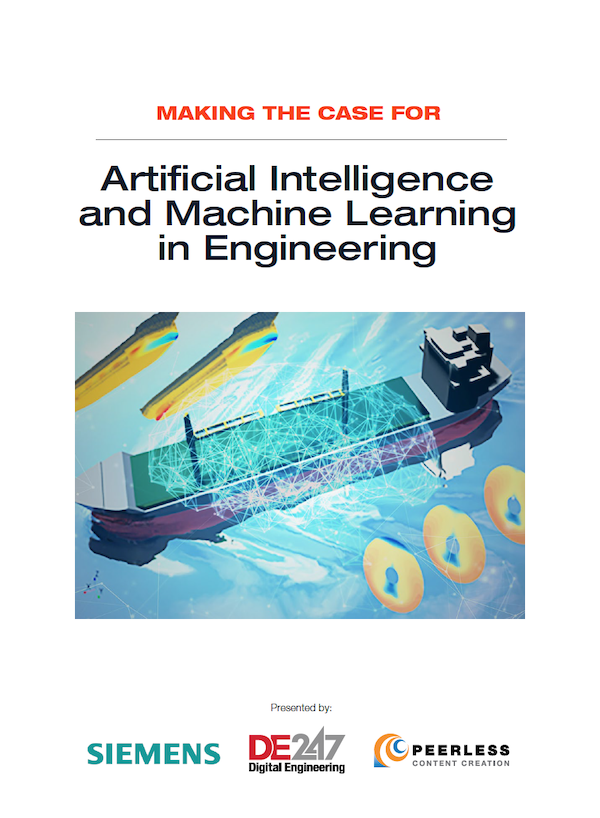
Making the Case for Artificial Intelligence and Machine Learning in Engineering
In this paper, Siemens Digital Industries Software and Digital Engineering will provide an overview of how AI/ML-enabled software can improve design workflows, while also addressing common questions and concerns around implementing this technology in an engineering organization.




About Us · Contact Us · Editorial Team · Advertising · Privacy Policy · Subscriber Services · © 2026 Digital Engineering 24/7 · Peerless Media