Helping design and engineering professionals discover, evaluate and specify technologies and processes that shorten the design cycle and enable success.


Sponsored
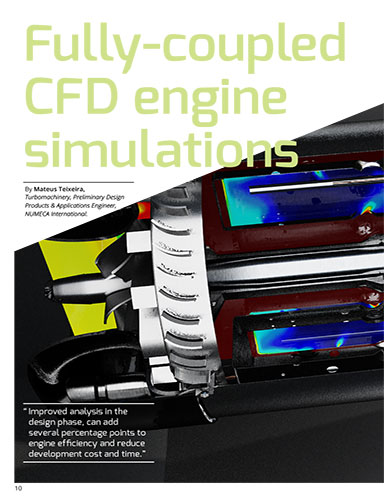
The aerospace industry, like many other industries, is under pressure to drastically reduce its environmental footprint. The Flightpath 2050 goals of the European Union state that by the year 2050 all CO2 emissions per passenger kilometer must be reduced by 75%, NOx by 90% and noise pollution by 65% (relative to the year 2000).
One of the ways to achieve these environmental goals is by increasing turbomachinery performance. Improved analysis in the design phase, more specifically development of more reliable predictions, advancement in accuracy, inter-disciplinarity and speed of simulation tools, can add several percentage points to engine efficiency and reduce development cost and time.
One of the main challenges in designing an engine is the complexity in terms of geometrical details (combustion chamber features, turbine cooling holes...) and of interaction effects between the components which must be modelled with accuracy and acceptable computation time.
One of the main challenges in designing an engine is the complexity in terms of geometrical details (combustion chamber features, turbine cooling holes…) and of interaction effects between the components which must be modelled with accuracy and acceptable computation time.

NUMECA is recognized today as the most innovative company in the field of Computational Fluid Dynamics (CFD) and multiphysics design, analysis and optimization. Driven by creativity, innovation & quality, we proudly turn our passion into…

Aerodynamic Optimization of Exhaust for Car Compressors
Pollution and fuel consumption are the most important features of thermal engines that must be drastically improved in the coming years.




About Us · Contact Us · Editorial Team · Advertising · Privacy Policy · Subscriber Services · © 2026 Digital Engineering 24/7 · Peerless Media