Helping design and engineering professionals discover, evaluate and specify technologies and processes that shorten the design cycle and enable success.



Digital Engineering April 2026
In the latest issue of Digital Engineering, we take a look at the latest innovations in design for additive manufacturing, including the use of natural language inputs, social media cosplayers, and AI integration. The issue also includes a feature…

January Special Focus Issue: Design for Additive
In this Special Focus Issue of Digital Engineering, learn about the latest advancements in design for additive manufacturing, including new software tools, additive in automotive, custom medical devices, and more.
Rapid Ready has covered this sort of AM before, and now the technology is commercially available in the form of the Photonic Professional GT. The new system uses laser lithography and two-photon polymerization to build sub-micrometer polymer structures at, according to the company, high speed.
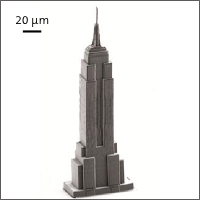
"A tremendous speed-up of the writing process is driven by an embedded ultra-high precision galvo technology, which laterally deflects the laser focus position by use of a galvanic mirror system. Thus, the fabrication of large area 3D micro- and nanostructures is now feasible in the shortest time," according to Nanoscribe. "In addition to rapid x-y-beam-scanning, a piezoelectric scanning stage provides ultra-precise x-y-z-movements of the substrate relative to the laser focus position …"
The example print of a spaceship design taken from the Wing Commander video game measured 125µ x 81µ x 26.8µ (about the width of a human hair) and was completed in under a minute. The build envelope of the Photonic Professional GT is limited to 100µ objects, but these can be fused together to create larger structures.
While it might be cool to make super miniature spaceships with the technology, the Photonic Professional GT is aimed at applications in the biotech field, finding use in building scaffolding for cell growth research. Other fields that might be interested in the AM system include micro-optics, photonic crystals, metamaterials, micro and nanofluidics, and freeform surfaces.
Below you’ll find a video of the Photonic Professional GT at work building the previously mentioned spaceship model.
Source: Nanoscribe


John Newman is a Digital Engineering contributor who focuses on 3D printing. Contact him via [email protected] and read his posts on Rapid Ready Technology.
Follow DE
Join over 90,000 engineering professionals who get fresh engineering news as soon as it is published.






About Us · Contact Us · Editorial Team · Advertising · Privacy Policy · Subscriber Services · © 2026 Digital Engineering 24/7 · Peerless Media