Helping design and engineering professionals discover, evaluate and specify technologies and processes that shorten the design cycle and enable success.



Digital Engineering April 2026
In the latest issue of Digital Engineering, we take a look at the latest innovations in design for additive manufacturing, including the use of natural language inputs, social media cosplayers, and AI integration. The issue also includes a feature…

January Special Focus Issue: Design for Additive
In this Special Focus Issue of Digital Engineering, learn about the latest advancements in design for additive manufacturing, including new software tools, additive in automotive, custom medical devices, and more.
Up to now, surgeons could rebuild portions of the jaw removed as part of cancer treatment by using part of the patient’s fibula. However, that method could result in misshapen jawlines or difficulty in inserting dental implants.
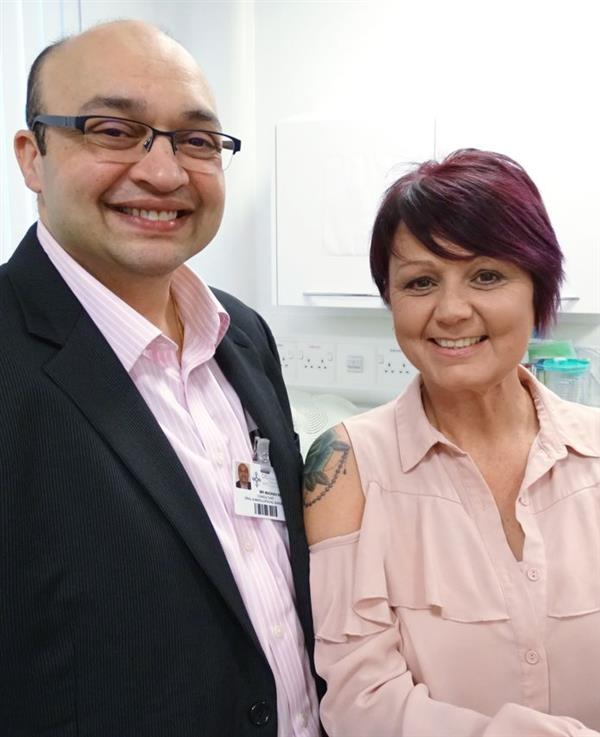
 Patient Debbie Hawkins received the first printed jaw implant at Morriston Hospital thanks to surgeon Madhav Kittur. Image: Morriston Hospital
As with other similar medical implants, 3D printing has enabled surgeons at Swansea’s Morriston Hospital in Wales to create custom structures that can help rebuild the jawlines of cancer patients. The hospital uses 3D-printed titanium implants (combined with bone grafts) that are custom built to fit each patient.
The first patient to receive an implant was Debbie Hawkins, a Swansea native who lost part of her jaw after having a large tumor removed. The hospital was able to use CT scan images to create an anatomically accurate implant that fixes the fibula bone graft in place. It also maintains the natural shape of the patient’s jawline.
"The titanium implant fits the patient's jaw perfectly without the surgeon having to do any adjustment,” said Peter Llewelyn Evans, maxillofacial laboratory services manager at Morriston Hospital.
The hospital has now performed five of these procedures. Using custom-built implants has also saved time during surgery.
“It has taken away the uncertainty. We know exactly what is going to happen before we go into theatre as everything is computer planned,” said surgeon Madhav Kittur. “This can save a lot of time - up to two hours. On average this operation takes eight to 10 hours, so when we take two hours out of that it is quite a sizable reduction.”
Earlier this year, the hospital created a new biomedical 3D technician position, which is believed to be the first such designation in the UK National Health Service (NHS). Technician Heather Goodrum helps physicians plan reconstruction surgery and design implants and cutting guides using 3D printing.
Source: BBC


Brian Albright is the editorial director of Digital Engineering.
Contact him at [email protected].

Join over 90,000 engineering professionals who get fresh engineering news as soon as it is published.






About Us · Contact Us · Editorial Team · Advertising · Privacy Policy · Subscriber Services · © 2026 Digital Engineering 24/7 · Peerless Media