Helping design and engineering professionals discover, evaluate and specify technologies and processes that shorten the design cycle and enable success.



Digital Engineering April 2026
In the latest issue of Digital Engineering, we take a look at the latest innovations in design for additive manufacturing, including the use of natural language inputs, social media cosplayers, and AI integration. The issue also includes a feature…

January Special Focus Issue: Design for Additive
In this Special Focus Issue of Digital Engineering, learn about the latest advancements in design for additive manufacturing, including new software tools, additive in automotive, custom medical devices, and more.
Additive manufacturing, with all its variations in underlying physics, mechanical functions, material possibilities and quality controls, offers a textbook case of a technology that has been both disruptive and yet slowly evolving at the same time. Intriguing improvements come to light here and there, and the overall field keeps moving forward. But game-changing tactics, of the type that elicit a “wow” response don’t happen often.
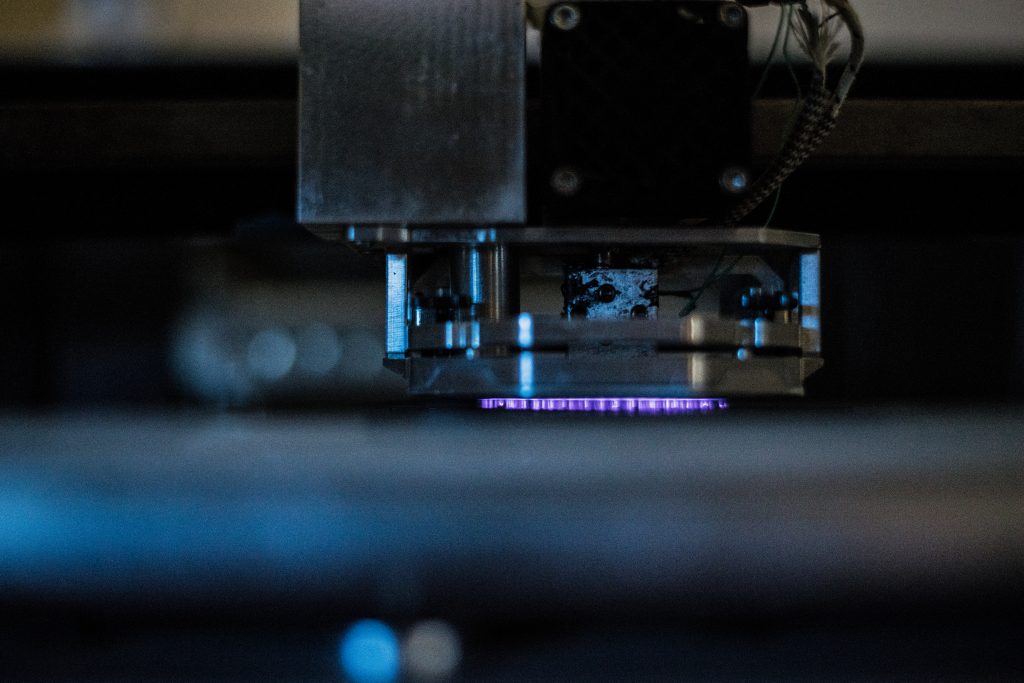 Improving Z-layer strength of 3D-printed parts with Essentium's FlashFuse plasma process applied to nanotube-coated filament. Image courtesy Essentium.
FlashFuse from Essentium, first highlighted at RAPID+TCT 2017, is going for the “wow.” The Texas-based company has developed a process that enhances the strength of parts made on fused filament fabrication (FFF) 3D printers, specifically addressing the universal problem of weakness in Z-strength behavior, and the results are impressive.
The FlashFuse process works hand-in-hand with filament-fusion systems, applying a high-density plasma energy field to each layer of specially-coated filament deposited during a build. As explained on the company website, FlashFuse technology is “a two-part solution that combines material science innovation and a hardware technology that harnesses the power of plasma to weld a 3D-printed part during the printing process.”
The first step involves treating plastic filament (such as polyamide nylon) to coat it with energy-responsive carbon nanotubes. Then, as each layer is extruded, the printer, enabled with an Essentium FuseBox unit, “flashes” the layer with plasma in an electric-welding process.
Last year, when integrated with a Stacker 3D printer, the FlashFuse process created polyamide nylon parts that achieved 98% of the strength of comparable injection-molded parts. This year, the team at Essentium has improved the process to now generate parts whose isotropic strength is at times more than 100% that of parts produced via injection molding, according to the company.
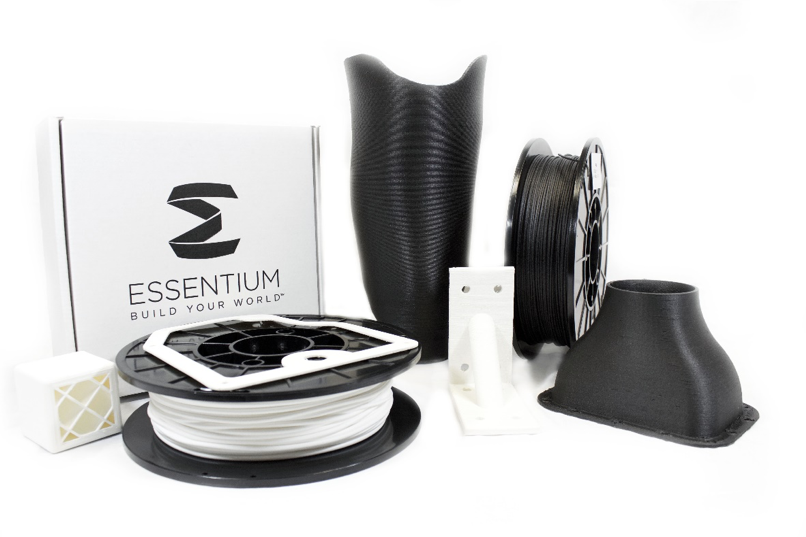
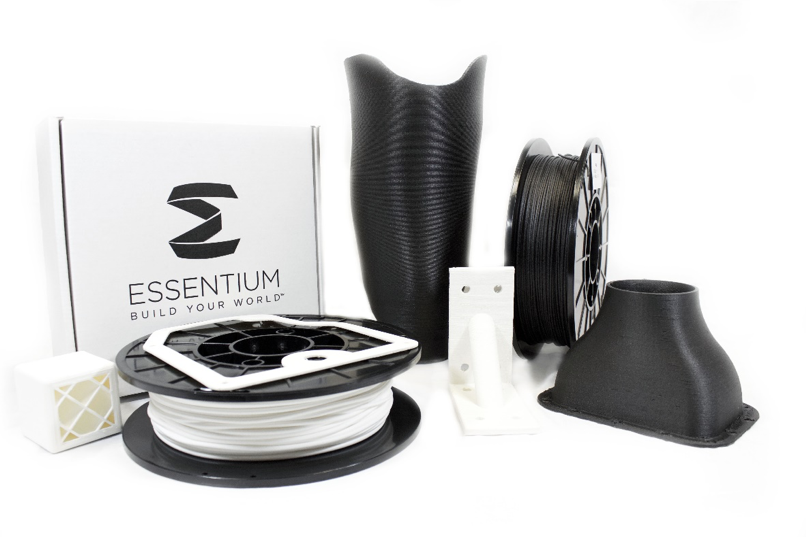 Examples of high-strength 3D-printed parts, made of FlashFuse-enhanced PA nylon on a Stacker FlashFuse system. Image courtesy Essentium.
“This has been a breakthrough for us. Now we’re moving into alternative materials to work with the FlashFuse technology," says Josh Lawson, head of Sales and Marketing at Essentium. “We’re testing everything from thermoplastic polyurethane (TPU) to carbon-filled polymamide, and even going up to higher temperature materials such as polyetherether ketone (PEEK) and polysulfone (PSU).”
3D printing with PEEK is attractive because it produces parts with high temperature performance and outstanding chemical resistance. “Obviously our goal is isotropic strength,” explains Lawson, “however each material is going to perform differently. We’re going to continue to work closely with our customers to understand what their strength needs are for each material.”
The FlashFuse Studio package, which consists of a Stacker S4 3D printer combined with Fusebox technology and Essentium’s new Industrial DryBox, will be available in April and demonstrated at SME RAPID+TCT 2018 and NPE2018: The Plastics Show events.
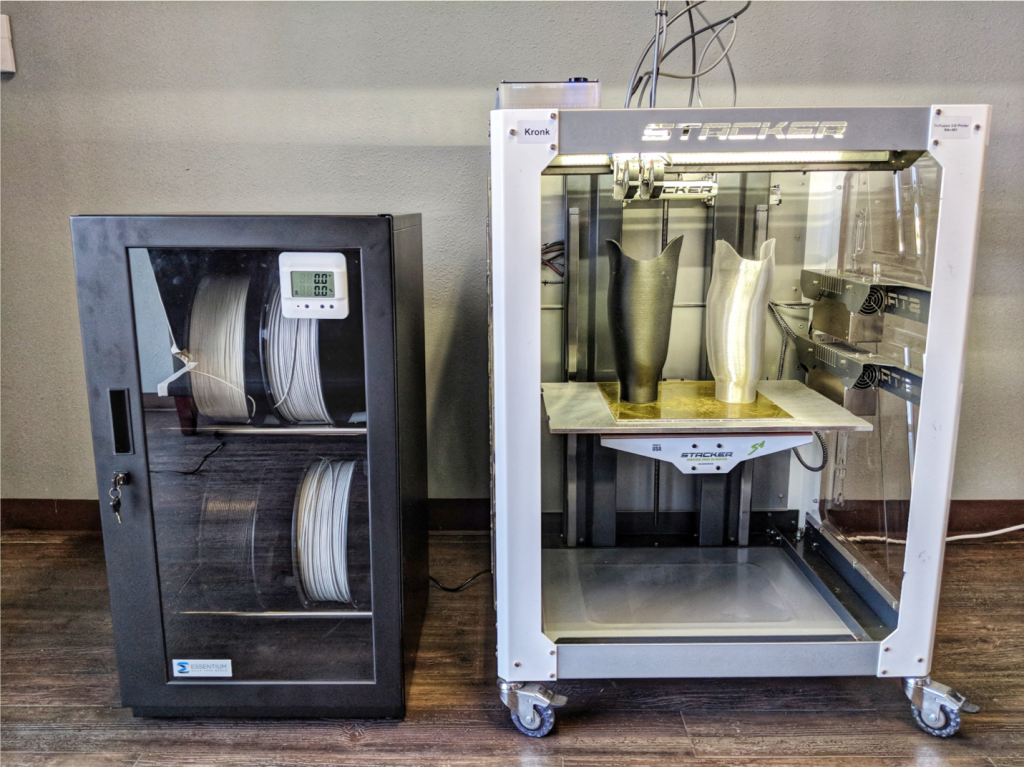 FlashFuse Studio Package 3D printer, comprising a Stacker S4 3D printer, Fusebox technology and Essentium's new Industrial DryBox. The system produces parts whose strength can be equivalent to, or greater than that of injection-molded parts. Image courtesy Essentium.
Essentium has quite a few other endeavors underway, including continuing joint work with BASF on filament development. One distinct characteristic of the carbon-nanotube coated materials is that they also serve as electrostatic discharge (ESD) materials. Essentium has shown great breakthroughs with ESD printed parts that don’t mar or chalk like current ESD filament offerings.
Another ongoing project involves discussions with other 3D printer companies to incorporate FlashFuse technology into their systems.
“People have designed around the weaknesses of 3D printing, and specifically the Z-strength issue, for so long,” notes Lawson. “Our goal has been to unleash the design process; we’re beginning to unlock what those new parts can be for people, and it’s exciting.”
Lastly, a major effort in the works is an intense project aimed at producing the world’s fastest extrusion 3D-printing system. This new machine will have the FlashFuse technology built into it and will have the ability to extrude at speeds 10x that of current printers with 10x the accuracy, according to the company. “This is the next generation of industrial machines built to transform manufacturing floors,” says Lawson. “What we’ve seen is current solutions do not compete at scale. The goal with this new platform is to go from design to prototype to scale on the same platform using the same materials.”
Want to get the inside-scoop regarding this “not-your-average-FFF” development? The company is hosting private meetings at the AMUG conference, RAPID, and NPE for people to get a look at the new printer and discuss what its implications could be for their business. Contact [email protected] for details.


DE's editors contribute news and new product announcements to Digital Engineering. Press releases may be sent to them via [email protected].
Follow DE
Join over 90,000 engineering professionals who get fresh engineering news as soon as it is published.






About Us · Contact Us · Editorial Team · Advertising · Privacy Policy · Subscriber Services · © 2026 Digital Engineering 24/7 · Peerless Media