Helping design and engineering professionals discover, evaluate and specify technologies and processes that shorten the design cycle and enable success.



Digital Engineering April 2026
In the latest issue of Digital Engineering, we take a look at the latest innovations in design for additive manufacturing, including the use of natural language inputs, social media cosplayers, and AI integration. The issue also includes a feature…

January Special Focus Issue: Design for Additive
In this Special Focus Issue of Digital Engineering, learn about the latest advancements in design for additive manufacturing, including new software tools, additive in automotive, custom medical devices, and more.
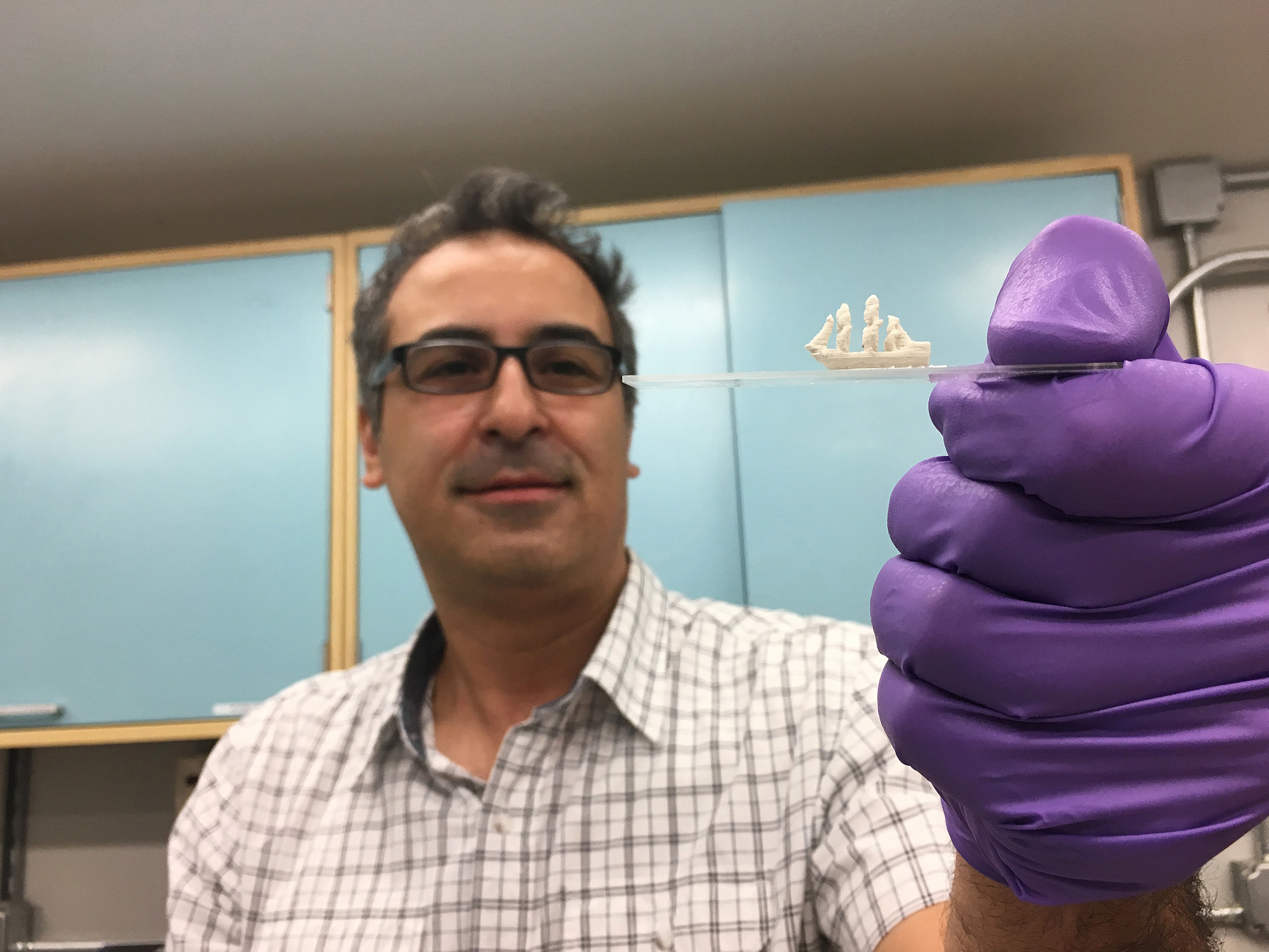
3D printing with extremely viscous or thick materials presents a challenges—the more viscous the material, the harder it is to print with any degree of precision. In some cases, you can’t move the material through a 3D printer at all. Researchers at Purdue University’s Zucrow Labs claim to have solved this problem, developing a 3D printing approach that will allow the printing of customized ceramics, solid rockets, biomedical implants, food and other objects using extremely viscous materials.
The researchers were able to accomplish this by applying a high-amplitude ultrasonic vibration to the nozzle of the 3D printer. This allowed them to print without fundamentally changing the composition of the materials.
"We found that by vibrating the nozzle in a very specific way, we can reduce the friction on the nozzle walls, and the material just snakes through," said Emre Gunduz, assistant research professor in the School of Mechanical Engineering at Purdue.
The team has been able to print at 100-micron precision at a high print rate.
The Purdue researchers conducted high-speed microscopic X-ray imaging of the 3D print process at Argonne National Laboratory in Illinois.
"It’s very exciting that we can print materials with consistencies that no one’s been able to print,” Gunduz said. "We can 3D print different textures of food; biomedical implants, like dental crowns made of ceramics, can be customized. Pharmacies can 3D print personalized drugs, so a person only has to take one pill, instead of 10."
Zucrow Labs focuses on propulsion, and one of the first applications of the new process could be for solid rocket fuel. These solid propellants have the consistency of cookie dough and are highly sensitive to temperature, which makes them very difficult to print with. Using the new technique, the team was able to print strands of solid fuel that burned comparably to traditionally cast fuels.
Potentially, this could enable printing customized rocket geometries and different types of combustion models.
You can read more about the project in the journal Additive Manufacturing and in the video below.
Source: Purdue


Brian Albright is the editorial director of Digital Engineering.
Contact him at [email protected].

Join over 90,000 engineering professionals who get fresh engineering news as soon as it is published.






About Us · Contact Us · Editorial Team · Advertising · Privacy Policy · Subscriber Services · © 2026 Digital Engineering 24/7 · Peerless Media