Helping design and engineering professionals discover, evaluate and specify technologies and processes that shorten the design cycle and enable success.


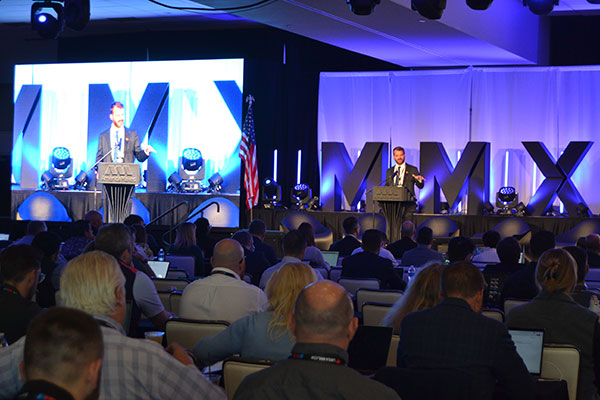
America Makes, the Department of Defense-sponsored manufacturing innovation institute, gathered a full house of about 450 attendees (100 over 2024 numbers) at its 13th annual MMX (Members’ Meeting and Exchange) Aug. 5-6, 2025 in Canfield, OH. Among the guests were those working in government, industry, and academia who experienced two days of technical content via presentations and panels alongside top-level networking conversations.
In an opening keynote address, “How America Makes Supported Ursa Major’s Start-up and Continued Success,” Bill Murray, co-founder and chief engineer at Ursa Major who previously worked at Blue Origin, shared a brief history of Ursa Major, which launched in 2015.
“As we started the company, we were resource-strapped, as any start-up is and that’s where America Makes has been critical to our success as we scaled into additive manufacturing,” Murray reflected. He shared how within 18 months, with a team of 6, the company hotfired its first cabin of a rocket engine. “We manufactured a rocket engine that was 80% 3D printed.”
“As we scaled the company… we leveraged the open supply chain for about half a decade. This was where America Makes was essential to our success, allowing us to bring the additive manufacturing capability in-house,” Murray shared. “We’ve seen tremendous increase in repeatability of the products, we’ve been able to develop our own alloys, we’ve been able to control our own fate. Coming to Ohio, it’s been fantastic to leverage a lot of the industrial base here, the talent, the schools and lot of the graduates who have been absolutely crucial to be able to manufacture some of this hardware in a scaled facility.”
Murray continued: “We are applying modern manufacturing to traditional aerospace propulsion products. Short and sweet, it’s a small rocket engine. There’s nothing fundamentally different about how it operates compared to the ones the Russians made back in the Cold War. But instead of very difficult coatings they used all over the engine, forgings and castings, we are utilizing modern additive alloys and manufacturing processes to turn it on its head. It's been a fun ride. We went from flight testing to lowering production in 18 months. We don’t just prototype; we’re delivering flight hardware. American security really depends on these technologies,” Murray said.
Following Murray’s opener, John Wilczynski, America Makes executive director, looked at America Makes’ position as an institute: “This is the biggest event we’ve had to date in our 13-year existence at America Makes,” he shared at opening day, which included 20-plus sponsors. “There’s a really strong voice of membership here.”
State of Affairs
“We have the largest portfolio of active programs going on that we’ve ever had at the institute,” Wilczynski shared. “The question is: How do we scale up things that are working at the institute? At the same time, we need to be looking at things that aren’t working and get rid of those. We’ve been using this term public-private partnership for years. But in preparing for a townhall meeting around the National Advanced Manufacturing Strategy, effectively the main takeaway from that is: How do we work on technology development, education and workforce development and build a supply chain?
“We are a strategic partner of the DoD for additive manufacturing,” he continued. “How are we ensuring that the warfighter has what they need when they need it? That is the role of this community is to figure out and ask the question—can additive support that? If so, what do we do to actually support that?”
During his PowerPoint presentation, he shared some recent numbers out of America Makes: it embodies a total portfolio of $582 million spanning 364 total projects, with 10,311 learners reached in FY24.
Wilczynski asked: “Where do we go next? Our scope is being broadened to include adaptive manufacturing. Additive is ultimately an enabling technology where we are feeding information into a system, into a data framework, that we’re collecting information and constantly modifying based on the inputs going into it. Adaptive manufacturing is an advanced production strategy that leverages data, automation and intelligent systems to enable a factory to adjust its processes in real time. It is something that from a members’ point of view is very interesting,”
“Our expansion of scope is looking at how do we consider things more holistically?” Wilczynski asked. “If we think of adaptive manufacturing as a strategic framework that is allowing us to actually use some of the tools of industry 4.0 and our ability to gather information off of systems and off of in-situ monitoring, we can make rapid changes to it to support outputs. Some of what we’re looking to address with adaptive manufacturing is how do we get things where we need when we need them produced in a particular place—this concept of distributed manufacturing.”
Later, Keith DeVries, director of DoD Manufacturing Technology (ManTech) program, spoke on “Made in America, Ready for Battle.”
“It’s time to get busy,” DeVries chided the audience. “United States manufacturing…faces significant challenges today— decline in market share due to globalization, skills gap, aging infrastructure, supply chain vulnerabilities, slow technology adoption and lack of collaboration.
MMX is here as a specific event to address collaboration. These issues collectively undermine competitiveness and innovation of the U.S. manufacturing sector.”
He explained how to work directly with this program to advance tomorrow’s manufacturing. “We are stronger together. I want you engaged, networking, being stronger together than you are alone. Bring your innovative idea and solutions to the table. We can’t do this tomorrow if we don’t invest in tomorrow’s workforce. Our warfighters can’t have it if we don’t make it.”
Kimberly Gibson, Industrial Base Integration Director, at America Makes updated the audience with strategies of America Makes, including what she referred to as regional clusters. She cited a collaboration with the Youngstown Business Incubator (YBI) to create an innovation hub, a project call through the state of Ohio.
“The idea here is to move the needle on additive for aerospace and defense with real economic impact in the region, in the state of Ohio, job creation, STEM education and certain certificates. Aligning regional clusters that will allow us to scale additive production in your area is exactly what we’re looking at.”
Barb Ewing, CEO at YBI, says the incubator’s current goal is to bring Ursa Major and Juggerbot 3D back downtown to Youngstown. YBI focuses on helping develop digital businesses, promoting women & minority entrepreneurship, and supporting advanced manufacturing technologies. “We are technology agnostic,” Ewing shared. “We work with any machine manufacturer and in any material. We think that’s truly one of the differentiators for the hub is our ability to go out and work with our existing manufacturers to help get them into the supply chain or build that supply chain.”
Ben DiMarco, technology transition director, America Makes, later moderated a panel on the “Technology Transition in AM—What’s Working and What’s Not?” The panel featured DeVries of the ManTech program; Eric Fodran, Ph.D., Northrop Grumman; Travis Mayberry, Ph.D., Divergent3D; and Mark Shaw, Wichita State University, National Institute for Aviation Research. DiMarco opened by asking panelists to define tech transition, noting the DoD’s complicated definition.
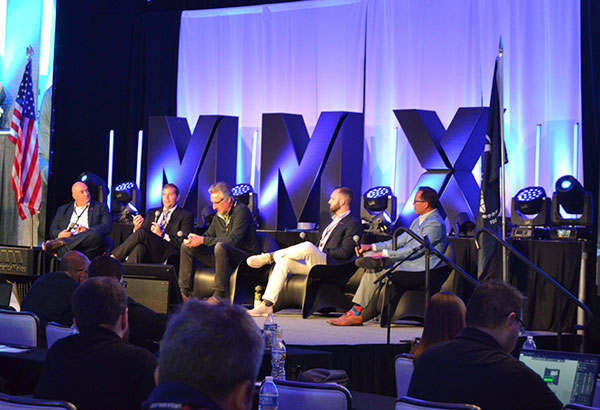
Mayberry shared: “What tech transition ultimately boils down to: do you have the right process and material for the application you’re going after, understanding you can’t have one process and material to solve everything?”
DeVries added, “Tech transition is more than this part, this process, this widget. It’s a cultural shift for the community that needs to receive it to trust it. It relies on flawed human beings to step out of their comfort zone and understand that tomorrow’s capabilities are only realized through today’s assumption of moderate manageable risk.”
Dimarco then asked panelists the No. 1 reason additive parts don’t make it into production, even after a successful pilot.
Northrop Grumman’s Fodran shared: “It really depends on the platform. Why haven’t we had as much success as quickly as we envisioned we would? It comes down to how much risk are we willing to assume internally? There is a lot of resistance even after we go through a very arduous building block approach for some of our chief engineers to really sign up to say, ‘I’m really willing to take that risk and sign my name on the dotted line.’ That’s generally what we see as the biggest challenge.”
An audience member asked the panel how to address qualification of parts, and how acceptance and confidence in additive manufacturing fits into the picture.
DeVries answered, “I don’t think anyone wants to make qualification easier. We want to make it more streamlined, faster, better understood. Qualification is the mechanism for us to quantify our acceptance. We’re trying to prove to the risk accepter that the part they hold in their hand will not fail. That is so hard to do when we’ve changed the modality of creation of that part.”
Travis DeMeester, DIU program manager, gave an overview of the Defense Innovation Unit and Blue Manufacturing Initiative, a new program in its early stages. The mission of the initiative, according to DeMeester, is to “accelerate adoption of commercial technology at speed and scale to deter major conflict or win, if forced to fight.”
Categories within the Blue Manufacturing Initiative will cover process-based manufacturing; end product based manufacturing; and digital enablers. Based on the government website, the Blue Manufacturing Initiative, launched in April 2025, is designed to build partnerships and serve as a matchmaker for U.S. and allied companies by pairing them with advanced manufacturing providers. The purpose? Deliver capabilities faster at scale and activate domestic manufacturing to build and scale an “agile defense industrial base.”
America Makes handed out awards to close out day 1: Distinguished Collaborator and Ambassador Awards.
Adele Ratcliff, director, Industrial Base Analysis and Sustainment, Washington, D.C., inspired the audience with regard to the future of AM: “Be bold in your vision and start. Make a decision; act with violent action, relentless will, and an urgency.
“Additive seems to be ubiquitous and yet we still are struggling to field qualified parts at pace. We still have much work to do. We have to think about how we’re going to push manufacturing forward. Our job at America Makes … is to put the technology in the hands of every warfighter and every U.S. company regardless of what they make – dental, automotive or other. That is how we declare success,” Ratcliff noted.
Potential Plans and Trends
Wilczynski mentioned how America Makes is exploring whether there’s a way to serve other parts of the country? “One thing we’re looking at is a regional model where we’d have concentrations around the U.S. This is exploratory. We pulled together 20 different organizations and had a roundtable conversation recently. Why there’s interest in regional clusters is, obviously, to pursue resources, trying to get a concentration of activity in their area to pull the community together.”
On another note, “One of the biggest trends of the institute is reusability. If dissemination of information is not executed in a way that you need it to be so that you can adopt it, it [may be] better that you know that it exists, but it might not be actually reusable. Members push pretty hard on us to rethink how we’re doing things,” Wilczynski shared.
Reflecting on the evolving Blue Manufacturing Initiative, “I think we have an opportunity to really help. The Department (of Defense) is counting on this technology to work,” he shared.
Closing Hot Take
“I would bet we’re going to be very engaged in drones,” Wilczynski said. “It’s absolutely everywhere. If you think through some of what we heard today, it’s about finding where the technology makes sense. It appears as though additive has a tremendous opportunity to enable what we are looking for in a variety of drone applications. I see that being a major play for us.”
As for now, Wilczynski advised, “Move with intention. Take risks. Be bold. That is what we need to do. We need to strike now. In our current environment from a defense posture we need to do that or it will be determined that another technology is the approach that we will use because we’re not moving fast enough. That will be key for us.”


Stephanie is the Associate Editor of Digital Engineering.
Follow DE
Join over 90,000 engineering professionals who get fresh engineering news as soon as it is published.






About Us · Contact Us · Editorial Team · Advertising · Privacy Policy · Subscriber Services · © 2026 Digital Engineering 24/7 · Peerless Media