Helping design and engineering professionals discover, evaluate and specify technologies and processes that shorten the design cycle and enable success.



Digital Engineering April 2026
In the latest issue of Digital Engineering, we take a look at the latest innovations in design for additive manufacturing, including the use of natural language inputs, social media cosplayers, and AI integration. The issue also includes a feature…

January Special Focus Issue: Design for Additive
In this Special Focus Issue of Digital Engineering, learn about the latest advancements in design for additive manufacturing, including new software tools, additive in automotive, custom medical devices, and more.
Operating out of a modest office in Brooklyn, NY, Buildatron is innovating its way into the workshops of hobbyists and 3D printer enthusiasts. Buildatron currently offers two printers, both based on the Prusa Mendel RepRap open source machine, which uses fused deposition modeling. According to the company’s website, Buildatron intends to create machines to fuel the home and small business 3D printing revolution.
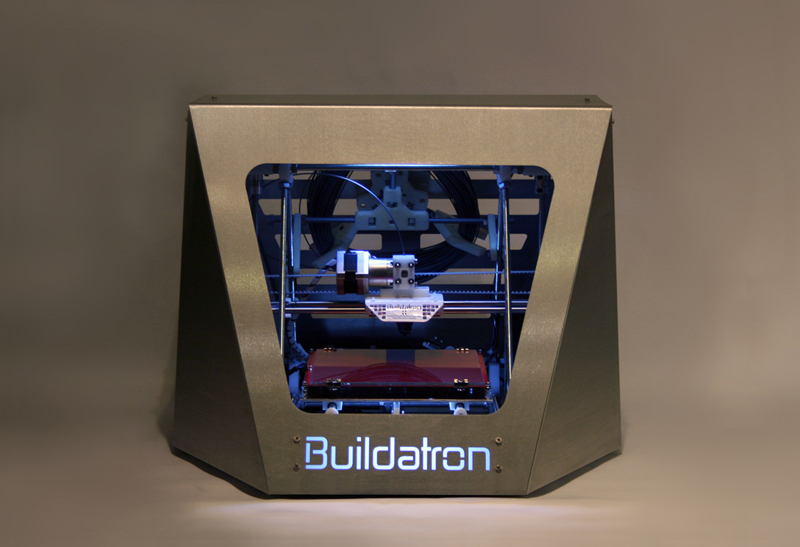
Buildatron’s newest product is the Buildatron 2. The machine uses 12 LM8UU bearings, which are intended to give the printer a smooth X, Y, Z build trajectory with a placement accuracy of 0.0125mm. Intended for home use, the printer has a reasonable footprint measuring 21.65. x 23.25 x 16.5 in. (550 x 590 x 420mm) and weighs around 15.5 lbs (7.0 kg). The build envelope is 8 x 8 x 5.5 in. (200 x 200 x 140mm).
Along with a PCB heated bed, the Buildatron 2 comes in a .40 in. thick aluminum case that has been designed for ease of use. According to the company, replacing filament is as easy as lifting the magnetic hood and dropping in a new spool. The extruder is capable of working with either 1.75mm or 3mm plastic filament. The company sells and promotes PLA (bioplastic) as a green alternative to ABS for use with its machine.
On the software front, the printer uses an in-house developed version of netfabb Studio Basic and a standard printer interface. Most standard CAD files are supported and the printer can be attached to a computer by USB. Buildatron even offers a number of links where customers can find pre-made files ready to print.
Not quite as inexpensive as other home printers we’ve covered, the price seems reasonable for the product. A fully assembled printer arrives at your home for $2,499, while a DIY kit is a bit easier on the wallet at $1,599. The build envelope is what to consider for the price here. Less expensive systems usually top out at around a 5 x 5 x 4 in. envelope and the resolution isn’t quite as good.
Below you’ll find a video featuring the Buildatron 2.
Source: Buildatron


John Newman is a Digital Engineering contributor who focuses on 3D printing. Contact him via [email protected] and read his posts on Rapid Ready Technology.
Follow DE
Join over 90,000 engineering professionals who get fresh engineering news as soon as it is published.






About Us · Contact Us · Editorial Team · Advertising · Privacy Policy · Subscriber Services · © 2026 Digital Engineering 24/7 · Peerless Media