Helping design and engineering professionals discover, evaluate and specify technologies and processes that shorten the design cycle and enable success.



Digital Engineering April 2026
In the latest issue of Digital Engineering, we take a look at the latest innovations in design for additive manufacturing, including the use of natural language inputs, social media cosplayers, and AI integration. The issue also includes a feature…

January Special Focus Issue: Design for Additive
In this Special Focus Issue of Digital Engineering, learn about the latest advancements in design for additive manufacturing, including new software tools, additive in automotive, custom medical devices, and more.
Collaboration between researchers at Tsinghua University, Beijing, China, and Drexel University, Philadelphia, US, has resulted in an improved method for building embryonic stem cells from scratch. Rather than manufacturing the cells in a Petri dish by encouraging growth, researchers have been able to print cells directly using additive manufacturing (AM). This development has the potential not only to improve stem cell research, but could also result in building more complex organic structures.
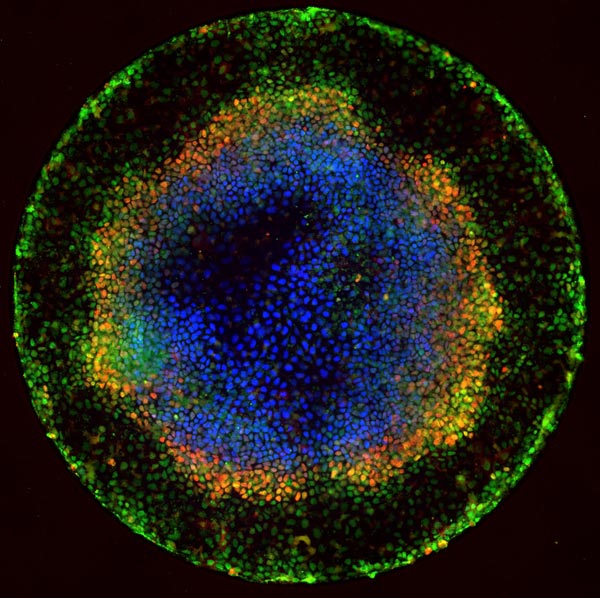 Stem cell research has the potential to cure a large number of diseases. Courtesy of NIH.
The standard method for building cells is to grow them in a Petri dish, or to slowly drip them into place, eventually aggregating the cell in a manner similar to how you might dribble wet sand to build a sand castle. Both of those method result in fairly unsophisticated structures without the homogeneity of cells that develop naturally.
By using AM, scientists are able to build specific chains of cells in three dimensions. Additionally, by printing the cells using hydrogel, the structures are given a measure of support. Generally, cells are so fragile that they can “break” if not treated delicately. Hydrogel acts as a sort of scaffolding, and also allows for a variety of cells to be built in close proximity, perhaps leading to the creation of micro-organs.
“It was really exciting to see that we could grow embryoid body in such a controlled manner,” said Wei Sun, a lead author on the paper. “The grown embryoid body is uniform and homogenous, and serves as a much better starting point for further tissue growth.”
The research findings were printed in the journal Biofabrication, under the title “Three-dimensional bioprinting of embryonic stem cells directs highly uniform embryoid body formation.” Below you’ll find a video that discusses the potential offered by stem cell research.
Source: LiveScience


John Newman is a Digital Engineering contributor who focuses on 3D printing. Contact him via [email protected] and read his posts on Rapid Ready Technology.
Follow DE
Join over 90,000 engineering professionals who get fresh engineering news as soon as it is published.






About Us · Contact Us · Editorial Team · Advertising · Privacy Policy · Subscriber Services · © 2026 Digital Engineering 24/7 · Peerless Media