Helping design and engineering professionals discover, evaluate and specify technologies and processes that shorten the design cycle and enable success.



Digital Engineering April 2026
In the latest issue of Digital Engineering, we take a look at the latest innovations in design for additive manufacturing, including the use of natural language inputs, social media cosplayers, and AI integration. The issue also includes a feature…

January Special Focus Issue: Design for Additive
In this Special Focus Issue of Digital Engineering, learn about the latest advancements in design for additive manufacturing, including new software tools, additive in automotive, custom medical devices, and more.
No matter how fast current prototyping might be, some people are never satisfied. They want more customization, and even faster speeds. "Rapider prototyping," if you will. Those people are called innovators, and some of them reside at Cornell University, where a research team has developed a new option for building and modifying prototypes.
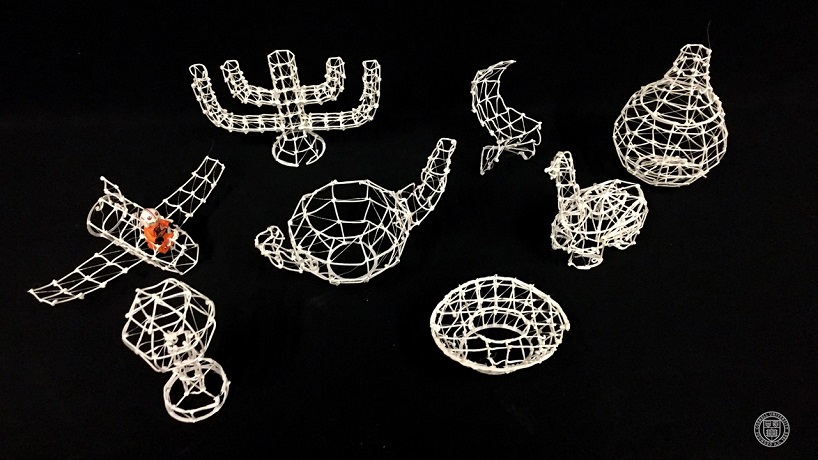 These parts were printed using Cornell's On-the-fly rapid prototyping system. Courtesy of Cornell University.
Rapid prototyping is faster than traditional prototyping methods because a designer has to wait a few hours to see results, rather than days or weeks. If the prototype doesn’t meet with satisfaction, it gets tossed into the recycling bin, the designer tweaks a CAD file, and tries again. Cornell’s prototyping system, which has been published as “On-The-Fly Print: Incremental Printing While Modeling” simply makes changes to the existing prototype, rather than starting from scratch with every iteration.
From the paper:
… we propose On-the-Fly Print: a 3D modeling approach that allows the user to design 3D models digitally while having a low-fidelity physical wireframe model printed in parallel. Our software starts printing features as soon as they are created and updates the physical model as needed. Users can quickly check the design in a real usage context by removing the partial physical print from the printer and replacing it afterwards to continue printing.
The system operates using a standard plastic filament 3D printing system that has been outfitted with a retractable cutting blade, and a misting system to help cool extruded filament. The platform has also been altered, allowing for five degrees of freedom by moving and tilting to offer different facings to the extruder head. Finally, a magnetic system allows for an object that has been partially built to be removed and examined, before replacing it in exactly the same spot to continue with a build.
In combination with the mister, Cornell’s system makes prototyping faster by printing a wireframe “low-fidelity” print, rather than a solid object. This allows the cutting blade to chop off parts that don’t meet with satisfaction, reduces material consumption, and generally speeds up the process by leaving large areas “blank” for initial prototyping.
The software developed for On-the-Fly printing allows the user to make changes to the design while the object is being printed. When the program comes to an area that is being redesigned, it pauses the print process, then continues printing once that area is finalized.
Below you’ll find a video about Cornell’s research.
Source Cornell University


John Newman is a Digital Engineering contributor who focuses on 3D printing. Contact him via [email protected] and read his posts on Rapid Ready Technology.
Follow DE
Join over 90,000 engineering professionals who get fresh engineering news as soon as it is published.






About Us · Contact Us · Editorial Team · Advertising · Privacy Policy · Subscriber Services · © 2026 Digital Engineering 24/7 · Peerless Media