Helping design and engineering professionals discover, evaluate and specify technologies and processes that shorten the design cycle and enable success.



Digital Engineering April 2026
In the latest issue of Digital Engineering, we take a look at the latest innovations in design for additive manufacturing, including the use of natural language inputs, social media cosplayers, and AI integration. The issue also includes a feature…

January Special Focus Issue: Design for Additive
In this Special Focus Issue of Digital Engineering, learn about the latest advancements in design for additive manufacturing, including new software tools, additive in automotive, custom medical devices, and more.
History was made in 2012 when surgeons performed the very first complete human face transplant. Plastic surgeons have continued to advance this procedure, and just this past summer completed the most complex face transplant operation to date — in part with the help of 3D printing technology.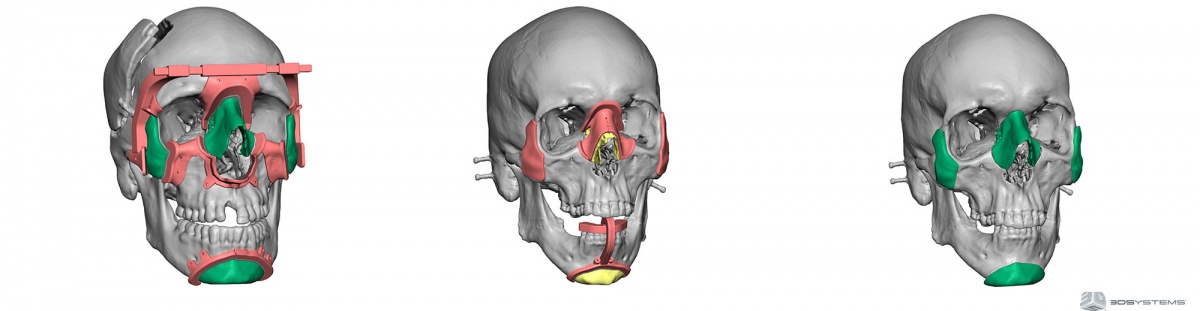
Surgeons have been using 3D printing technology to create models and planning guides for complex surgeries for several years now. This type of pre-surgical planning was critical in the case of former Mississippi volunteer firefighter Patrick Hardison, recipient of one of the first full face transplants. In that case, physicians at the Hansjörg Wyss Department of Plastic Surgery at NYU’s Langone Medical Center used 3D Systems' Virtual Surgical Planning (VSP) solution to ensure accuracy of the procedure.
VSP uses 3D scan data to create models of anatomical structures that can then be printed to help visualize a surgery, or to create patient-specific instruments and guides.
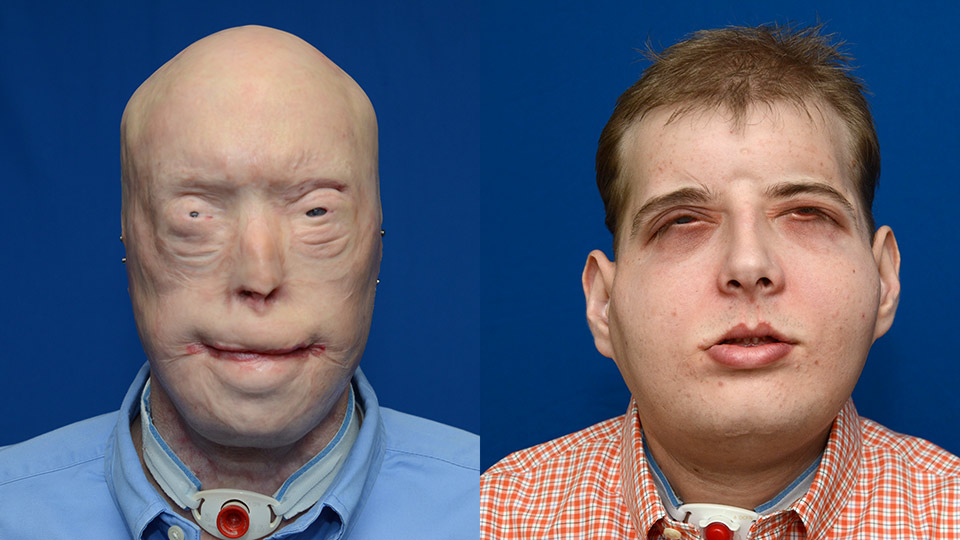 A before and after photo of firefighter Patrick Hardison, whose complex face transplant was accomplished with the help of 3D-printed models. Image courtesy 3D Systems
Hardison's was one of the most intensive face transplant surgeries ever performed.
The hospital created cut patterns for both the donor and for Hardison. The hospital also created transferal templates using a biocompatible material that could be sterilized and used in the operating room.
Hardison lost his face while responding to a mobile home fire 14 years prior. The new face belonged to a 26-year-old Brooklyn bike mechanic. The surgeon in charge of the procedure, Dr. Eduardo Rodriguez, is a pioneer in the field, having performed the very first full human face transplant in 2012 at the University of Maryland.
Hardison applied for the surgery after meeting Rodriguez in 2013, but a donor wasn't located until August 2015. 3D Systems' medical modeling team received the donor scans at the same time Hardison was contacted for surgery. The team in Colorado prepared and couriered the surgical guides to the hospital in New York in just a few hours.
The surgery took 26 hours and required a team of more than 100 doctors, nurses and support staff.
The surgery was a success, but Hardison still faces months of recovery and the risk of transplant rejection in the future. In the meantime, he's looking forward to a brighter future. "That donor and his family gave me this gift, and I can never thank them enough for giving me something as great as this, something I thought I would never have," he told Nightline.
You can read more about Hardison and his donor in this New York Magazine article, and in the video below.
Source: 3D Systems
http://www.3dsystems.com/blog/2015/11/virtual-surgical-planning-assists-full-face-transplant


Brian Albright is the editorial director of Digital Engineering.
Contact him at [email protected].

Join over 90,000 engineering professionals who get fresh engineering news as soon as it is published.






About Us · Contact Us · Editorial Team · Advertising · Privacy Policy · Subscriber Services · © 2026 Digital Engineering 24/7 · Peerless Media