Helping design and engineering professionals discover, evaluate and specify technologies and processes that shorten the design cycle and enable success.



May 2026 Special Focus: Artificial Intelligence in Design and Simulation
In this Special Focus Issue, learn about the latest developments in the integration of artificial intelligence into engineering workflows.

April 2026 Special Focus Issue: Generative Design
In this Special Focus Issue, Digital Engineering takes a look at how generative design solutions can be used across different types of design problems and with a variety of manufacturing approaches to accelerate design space exploration, and…
If you’ve ever watched shows like Bones or CSI, you’ve no doubt seen scenes where forensic wizards reconstruct faces to match unidentified remains, but in the real world, it isn’t as simple as pushing a few buttons. A recent effort involving coordination between Florida law enforcement departments and the University of Southern Florida (USF) used 3D printing as one method of assisting police with identification.
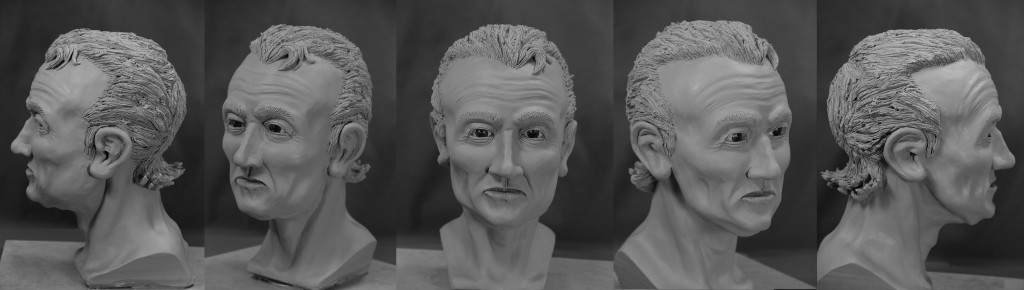 This image of a 45-65 year old male is the result of artistic reconstruction over a 3D printed skull. Courtesy of NamUs.
Dubbed, “The Art of Forensics,” students and faculty at USF’s Institute of Forensic Anthropology and Applied Science were given access to materials belonging to nine different unidentified bodies, including plastic skulls. The skulls were the result of 3D scans of actual remains that were then built using a 3D printer. Using replicas allows for facial reconstruction work without tampering with the original remains.
Students were then asked to reconstruct the images of the unidentified individuals, using the skulls as a template. The reconstruction process works in a manner similar to 3D printing by creating the face in layers. The process begins by creating a layer of clay muscle tissue over the skull, then adding a layer of facial tissue, followed by a small touches to give each reconstruction at least the semblance of a real face.
The only liberty allowed the reconstruction artists is in hair style. The resulting faces were run in local newspapers and listed in the National Missing and Unidentified Persons database.
3D printing as a tool is becoming more valued by forensics experts across the world, many times replacing older technologies for its ability to produce replicas without destroying original evidence. Another example is shoe molds. Using a 3D scanner to create digital records of footprints at a crime scene is quicker and less invasive than plaster molds.
Below you’ll find a short video about students being introduced to forensics and 3D printing.
Source: Tampa Bay Times


John Newman is a Digital Engineering contributor who focuses on 3D printing. Contact him via [email protected] and read his posts on Rapid Ready Technology.
Follow DE
Join over 90,000 engineering professionals who get fresh engineering news as soon as it is published.






About Us · Contact Us · Editorial Team · Advertising · Privacy Policy · Subscriber Services · © 2026 Digital Engineering 24/7 · Peerless Media