Helping design and engineering professionals discover, evaluate and specify technologies and processes that shorten the design cycle and enable success.



Digital Engineering April 2026
In the latest issue of Digital Engineering, we take a look at the latest innovations in design for additive manufacturing, including the use of natural language inputs, social media cosplayers, and AI integration. The issue also includes a feature…

January Special Focus Issue: Design for Additive
In this Special Focus Issue of Digital Engineering, learn about the latest advancements in design for additive manufacturing, including new software tools, additive in automotive, custom medical devices, and more.
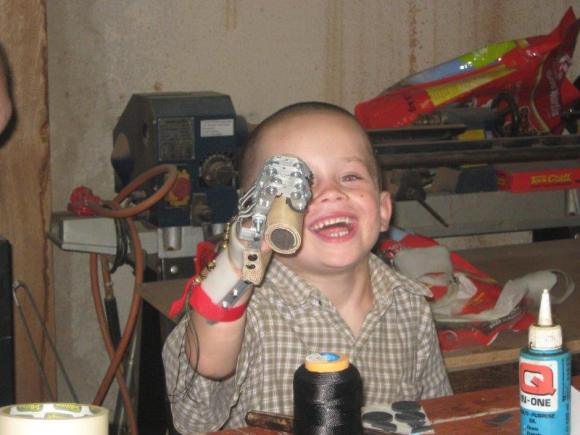
Another example can be found in a 5-year-old boy from South Africa named Liam who was born with Ambiotic Band Syndrome. He has no fingers on his right (dominant) hand and his parent’s aren’t wealthy enough to afford the sort of prosthetic that would make life easier for him. Then they met Richard Van.
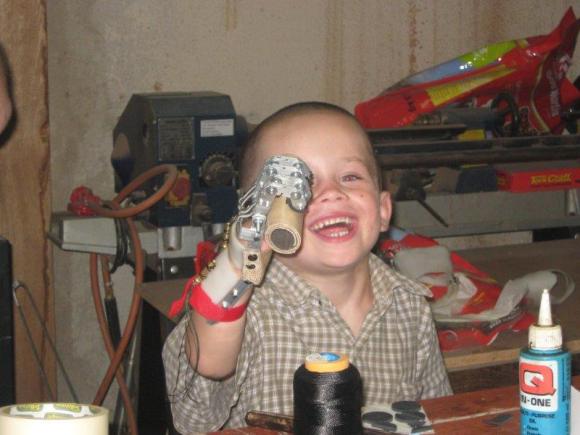
Richard has some missing fingers of his own. Rather than being born with a disability, he lost the fingers during a machining accident. Since that time, Richard has been working on affordable prosthetics to assist himself and others with the same disability. The first prosthetic he designed for Liam was a simple sheet of thermal plastic held on with rubber bands that allowed Liam to hold a pencil. A more complex prosthetic would require a far more complicated design.
During his research on prosthetics, Richard came across a video by Ivan Owen, a PLC Programmer/automation technician, living in Washington. Ivan had built a mechanical hand that copied the motions of the user. Richard asked Ivan to work with him to create functional prosthetics to replace missing fingers and, regardless of the 10,000-mile separation, the two began to collaborate.
The first, more advanced design the duo created for Liam was made of metal and it worked. For the first time, he was able to pick up objects on his own. But, although the project had succeeded, Richard and Ivan concluded they could do better, so they turned to 3D printing for help.
They contacted MakerBot for information about the technology, and the company responded by sending them two Replicator 2s, free of charge. One was sent to Ivan and the other was shipped to Richard. Via the Internet, the two collaborated on a new design in real time and, after some final tweaks, the new prosthetic was printed out in 20 minutes.
The improved prosthetic allowed Liam to pick up and play with a ball, bringing a huge smile of joy to the child’s face. Even with that success, Richard and Ivan don’t feel their work is complete and continue to work on improvements. Even more astonishing than the idea of two people separated by a vast distance working together on this ambitious a project is the fact they are releasing their designs for free. The entire project is open source, and the files can be downloaded from Thingiverse.
Even with the good intentions of Richard and Ivan, and the generosity of MakerBot, the project is seeking additional funding. You can find out more about Richard, Ivan and Liam on the project blog, Coming Up Shorthanded.
Below you’ll find a couple videos featuring Liam and the prosthetic.
Source: Coming Up Shorthanded


John Newman is a Digital Engineering contributor who focuses on 3D printing. Contact him via [email protected] and read his posts on Rapid Ready Technology.
Follow DE
Join over 90,000 engineering professionals who get fresh engineering news as soon as it is published.






About Us · Contact Us · Editorial Team · Advertising · Privacy Policy · Subscriber Services · © 2026 Digital Engineering 24/7 · Peerless Media