Helping design and engineering professionals discover, evaluate and specify technologies and processes that shorten the design cycle and enable success.



Digital Engineering April 2026
In the latest issue of Digital Engineering, we take a look at the latest innovations in design for additive manufacturing, including the use of natural language inputs, social media cosplayers, and AI integration. The issue also includes a feature…

January Special Focus Issue: Design for Additive
In this Special Focus Issue of Digital Engineering, learn about the latest advancements in design for additive manufacturing, including new software tools, additive in automotive, custom medical devices, and more.
A new project from the Institute for Advanced Architecture of Catalonia (IAAC) and the Fab Lab BCN in Barcelona, Spain might convince me to head back to the beach. The two groups have collaborated to design a 3D printer they call Stone Spray that uses sand to build objet d'art from sand or concrete.
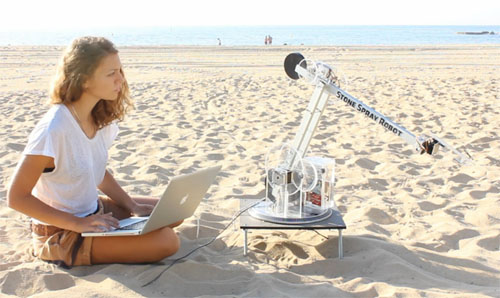
Stone Spray uses sand and a binder to cement it together, similar to the D-shape process. Although the printer has been used to create sand structures, the end goal was to create a system capable of building architecture using additive manufacturing (AM). In all, the project took six months to complete, which, I think, shows how quickly AM fundamental concepts can be tuned for specific applications.
As with other uses with AM, much of the desirability for adoption is the ability to create highly complex internal geometries with a single build. A 3D printed sand castle or larger piece of architecture can also be added to later in a way that will form a single structure. The bonding agent attaches without the need for additional bolts, screws, nails or rivets.
Even using sand, the objects created using Stone Spray were reported as “rock hard” and resistant to water. Even better, sand is pretty widely available as a building material, making it fairly simple for other groups to reproduce the project and advance the research.
It may occur to some of you to wonder how much actual use people could find for sand structures. Leaving aside the fact that the same procedure could use cement, the Sand Spray process could create temporary shelters for displaced survivors of natural disasters without requiring tons of building materials to be shipped into an area that could be hard to reach. While you might not want to permanently reside in an oversized sand castle, having a place to sleep out of the elements or quick fabrication of emergency medical centers could save lives.
Below you’ll find a video demonstration of the Stone Spray.
Sources: Stone Spray, SolidSmack


John Newman is a Digital Engineering contributor who focuses on 3D printing. Contact him via [email protected] and read his posts on Rapid Ready Technology.
Follow DE
Join over 90,000 engineering professionals who get fresh engineering news as soon as it is published.






About Us · Contact Us · Editorial Team · Advertising · Privacy Policy · Subscriber Services · © 2026 Digital Engineering 24/7 · Peerless Media