Helping design and engineering professionals discover, evaluate and specify technologies and processes that shorten the design cycle and enable success.



Digital Engineering April 2026
In the latest issue of Digital Engineering, we take a look at the latest innovations in design for additive manufacturing, including the use of natural language inputs, social media cosplayers, and AI integration. The issue also includes a feature…

January Special Focus Issue: Design for Additive
In this Special Focus Issue of Digital Engineering, learn about the latest advancements in design for additive manufacturing, including new software tools, additive in automotive, custom medical devices, and more.
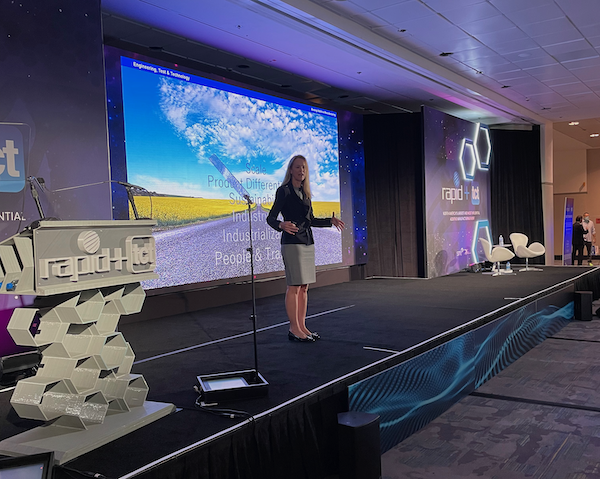
Live industry events have been few and far between since the start of the COVID-19 pandemic in 2020. On Sept. 13, the RAPID + TCT conference (co-located with the FABTECH expo) drew a healthy (and masked) crowd to McCormick Place in Chicago.
2021 marks the 30th RAPID event, and the day kicked off with remarks from Stratasys CEO Nadav Goshen and Society of Manufacturing Engineers (SME) CEO Bob Willig -- who noted that he had recently had cervical spinal fusion surgery that involved receiving a disc spacer that had been created via additive manufacturing.
The headliner, though, was Melissa Orme, vice president of additive manufacturing at Boeing, a leading adopter of 3D printing in the aerospace sector. She noted that Boeing has more than 70,000 additively manufactured parts flying today in Boeing aircraft.
She described several categories of added value that additive brings to manufacturing. First, there is product value. “We can use additive manufacturing to design in those small, conformal spaces and create components and segments of products that cannot be made traditionally.”
“There is no Plan B for using traditional methods,” she said. “If you have a Plan B, you have limited yourself because you haven't got the most out of additive manufacturing.”
There is also program value. “You can win a contract because of additive content. We can deliver faster or cheaper, or we can accelerate design-to-market because of how we create tooling and mock ups. And sustainability is embedded into that,” Orme added.
Additive also allows for greater product differentiation. “This more than making the part better and inserting that part into an airplane or whatever your end use is,” she said. “You do not get a good business case from a part-for-part replacement. AM will allow you to improve functionality and performance. Additive manufacturing permits a strategy to adapt to moving to an environment of product development for faster, ccleaner, cheaper, smarter products that cannot be made traditionally.”
Additive is also a sustainability driver. Lighter weight and optimized designs mean less material is used. Additive manufacturing allows for recycling of support structures and unprocessed powder. Users can also re-use and repair these parts and make products more durable, Orme added.
According to Orme, Boeing is expanding from laser sintering AM to DMLS technology. The company is also open to more out of the box thinking and hybrid approaches.
“We have to keep our minds open for what is next ,and be able to face the technology leaps with agility,” she said. “That is hard working in aerospace, where we have to prove repeatable, reliable performance. How do we scale?”
A key element that does not yet exist is a standardized data framework that will allow Boeing to continuously adopt new technologies while reducing material inconsistencies.
“We have to make sure the material we are creating with the machines is consistent, and we need to remove the brute force post-processing if we want repeatable and reliable [parts],” she said. “We need to repair the disjointed AM ecosystem and create a digital infrastructure so we can collect all of that data dn connect to the digital thread.”
She emphasized that AM efforts must be focused on that repeatability/reliability mantra. “We create a great part in additive, and it works great the first time, but then it doesn’t work the next time. We have to make sure every single time out of that machine, and out of the next machine, we are getting the same exact thing.”
To get there, additive machines must be industrialized. “If I am opening up two fo the same machines, they need to have the same ducting, the same wiring, the same bill of materials Orme said. If they don't, then they are two different machines. If you have two different machines, you can’t expect the same thing out of them,” Orme said.
OEMS must also provide more data access so that users can optimize their processes and prints. Data protocols among OEMs can vary considerably. She also noted that design allowables have an impact on the business case, so coupon data is critical to reduce costly testing. And when machines become obsolete, the material data should be transferable to new machines based on those design allowables.
The digital thread is another key focus at Boeing. According to Orme, digital thread technology allows the company to collect data from across the value stream (engineering data, post processing inspection, machine data, in-situ monitoring, oxygen content) and perform analytics. The analytics leverages AI and machine learning.
“We use that to create models and feed that back into our value stream for optimization,” Orme said. “That allows us to get better, to optimize our value stream, and to really ensure quality.”
Data will be critical for expanding the use of additive manufacturing, Orme said. “We need to have done the homework and we need that deep understanding of how to mitigate risk so that additive manufacturing becomes a standard, viable manufacturing option so we can create differentiated products, not just differentiated parts,” she said.
Companies also need to embrace additive as a new way of approaching part and product design. “To really embrace additive manufacturing, you have to let glo of the Plan B of traditional manufacturing solutions,” she said. “That is going to be limiting in terms of the value you get.”


Brian Albright is the editorial director of Digital Engineering.
Contact him at [email protected].

Join over 90,000 engineering professionals who get fresh engineering news as soon as it is published.






About Us · Contact Us · Editorial Team · Advertising · Privacy Policy · Subscriber Services · © 2026 Digital Engineering 24/7 · Peerless Media