Helping design and engineering professionals discover, evaluate and specify technologies and processes that shorten the design cycle and enable success.




Digital Engineering April 2026
In the latest issue of Digital Engineering, we take a look at the latest innovations in design for additive manufacturing, including the use of natural language inputs, social media cosplayers, and AI integration. The issue also includes a feature…

January Special Focus Issue: Design for Additive
In this Special Focus Issue of Digital Engineering, learn about the latest advancements in design for additive manufacturing, including new software tools, additive in automotive, custom medical devices, and more.
In this case, Amazon has filed for a patent describing mobile 3D printing factories that are not only able to fill a customer order, but potentially deliver it to the home as well, reducing the need for warehouse space. Warehouses have the potential to be Amazon’s Achilles Heel, as a result of increased scrutiny on how much workers are paid, and how well they are treated.
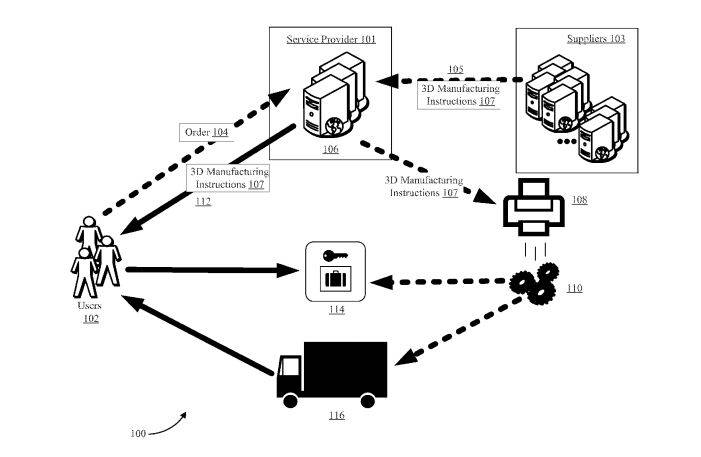 A diagram illustrating how 3D printed goods would get from Amazon to the customer. Courtesy of US Patent Office.
According to the patent:
“In the modern age of e-commerce, many items are bought or sold electronically … The multiplicity of items offered may require the electronic marketplace owner/operator to maintain a large inventory requiring sufficient space to store the inventory. An electronic marketplace may also face the challenge of time delays related to the process of finding the selected item among a large inventory.
“Increased space to store additional inventory may raise costs for the electronic marketplace. Additionally, time delays between receiving an order and shipping the item to the customer may reduce customer satisfaction and affect revenues generated. Accordingly, an electronic marketplace may find it desirable to decrease the amount of warehouse or inventory storage space needed, to reduce the amount of time consumed between receiving an order and delivering the item to the customer, or both.”
In a nutshell, Amazon sees 3D printing, and mobile 3D printing mini-factories, as a potential solution to their warehousing headaches. Rather than keeping multiples of every physical object, the company could more easily maintain a digital library of goods to be printed out as requested.
The patent is obviously forward looking because it seems to assume a number of things about 3D printing that aren’t necessarily true at the moment. One assumption is the speed of 3D printing. You can put one on a truck (or on a boat, or on a duck) and it still won’t spit out completed builds any faster.
Finally, the assumption that may sink this idea nearly as soon as it becomes viable is that customers won’t have access to quality 3D printing from other sources. UPS, the Post Office and a number of other entities have already expressed interest in producing print-on-demand products, which likely makes the entire idea less attractive, trucks or no.
Below you’ll find a video about the robots that shuffle goods around in an Amazon warehouse.
Sources: The Register, US Patent Office


John Newman is a Digital Engineering contributor who focuses on 3D printing. Contact him via [email protected] and read his posts on Rapid Ready Technology.
Follow DE
Join over 90,000 engineering professionals who get fresh engineering news as soon as it is published.






About Us · Contact Us · Editorial Team · Advertising · Privacy Policy · Subscriber Services · © 2026 Digital Engineering 24/7 · Peerless Media