Helping design and engineering professionals discover, evaluate and specify technologies and processes that shorten the design cycle and enable success.



Digital Engineering April 2026
In the latest issue of Digital Engineering, we take a look at the latest innovations in design for additive manufacturing, including the use of natural language inputs, social media cosplayers, and AI integration. The issue also includes a feature…

January Special Focus Issue: Design for Additive
In this Special Focus Issue of Digital Engineering, learn about the latest advancements in design for additive manufacturing, including new software tools, additive in automotive, custom medical devices, and more.
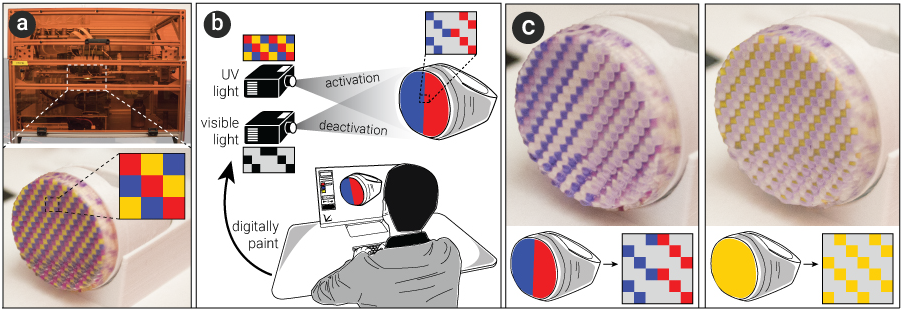
MIT researchers have come up with a technology – ColorMod – that would allow users to repeatedly change the color of a 3D-printed object after it is fabricated.
The team (working at MIT’s Computer Science and Artificial Intelligence Laboratory, CSAIL) are using a 3D printing ink that can change color when exposed to ultraviolet light. An object can be recolored in around 20 minutes.
“Largely speaking, people are consuming a lot more now than 20 years ago, and they’re creating a lot of waste,” says Stefanie Mueller, X-Consortium Career Development Assistant Professor in the departments of Electrical Engineering and Computer Science and Mechanical Engineering at MIT. “By changing an object’s color, you don’t have to create a whole new object every time.”
The ColorMod solution allows people to upload a 3D model and choose color patterns prior to printing. Using ultraviolet light, they can then activate different colors and visible light to deactivate other colors. Pixels are changed from transparent to colored and then back again, depending on the process.
The custom-developed ink includes a photoinitiator and light-adaptable dyes that can bring out the color of the base dye.
The recoloring time could be accelerated in the future using a more power light or a greater concentration of light-adaptable dyes.
Users could potentially change colors of their printed accessories to match clothing. Retailers could also use the process to customize items for sale.
“This is the first 3D-printable photochromic system that has a complete printing and recoloring process that’s relatively easy for users,” said Parinya Punpongsanon, co-author of the study. “It’s a big step for 3D printing to be able to dynamically update the printed object after fabrication in a cost-effective manner.”
Source: MIT


Brian Albright is the editorial director of Digital Engineering.
Contact him at [email protected].

Join over 90,000 engineering professionals who get fresh engineering news as soon as it is published.






About Us · Contact Us · Editorial Team · Advertising · Privacy Policy · Subscriber Services · © 2026 Digital Engineering 24/7 · Peerless Media