Helping design and engineering professionals discover, evaluate and specify technologies and processes that shorten the design cycle and enable success.


Alert!
Digital Engineering ceased publication on July 1, 2026. This website remains available as an archive of engineering content.
For inquiries or information, please email [email protected].

Digital Engineering April 2026
In the latest issue of Digital Engineering, we take a look at the latest innovations in design for additive manufacturing, including the use of natural language inputs, social media cosplayers, and AI integration. The issue also includes a feature…

January Special Focus Issue: Design for Additive
In this Special Focus Issue of Digital Engineering, learn about the latest advancements in design for additive manufacturing, including new software tools, additive in automotive, custom medical devices, and more.
Researchers at MIT have come up with a new, faster method for moving materials through a printhead, which could accelerate the 3D print process, and also developed a process for using biorenewable cellulose as an alternative to plastics.
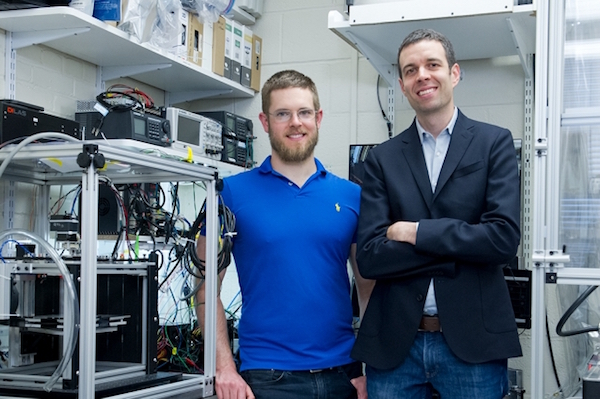
Professor A. John Hart, an associate professor of mechanical engineering and director of the Laboratory for Manufacturing and Productivity and the Mechanosynthesis Group at MIT, worked with Jamison Go and doctoral student Adam Stevens on the project.
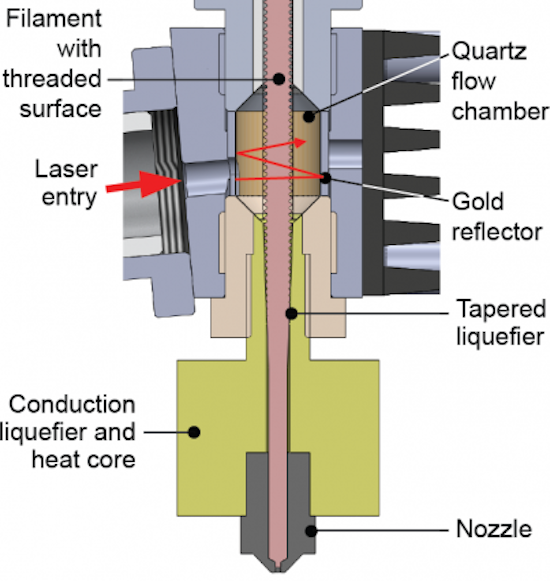
The researchers determined that volumetric build rates for traditional printers were limited by how much force the printhead could apply as it pushed the material through the nozzle; how quickly the printer could transfer heat to the material; and how fast the printer could move the printhead.
In the new printer design, a filament with a threaded surface goes into the top of the printhead between two rollers that keep it from twisting, and then passes through a rotating nut with matching internal threads. The filament is passed through a quartz chamber and exposed to a laser, which is reflected by gold foil around the chamber.
As the filament enters a hot metal block, it is heated further until it melts, and then is extruded through the nozzle into the print bed. The printer can transfer a high force to the filament without losing traction, and preheating the filament in the chamber ensures that it melts before it reaches the nozzle.
In testing, the printhead delivered at least two and a half times more force to the filament than standard desktop models, and achieved an extrusion rate 14 times greater. In comparisons with commercial desktop printers, the MIT printer achieved an average volumetric build rate up to 10-times higher than the desktop models, and three times better than an industrial-scale printer with a larger printhead.
Hart and also worked with Sebastian Pattinson (another MIT veteran who is a lecturer at the University of Cambridge) to create feedstock out of cellulose. Traditionally, cellulose has properties that make it difficult to use in 3D printing. If it is heated, it decomposes.
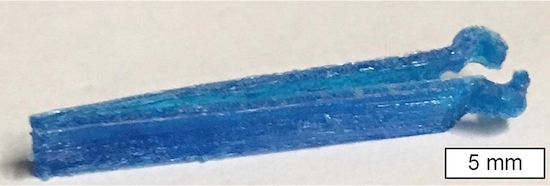
The MIT team used cellulose acetate that had been dissolved in an acetone solvent. The resulting feedstock can flow through a printer nozzle at room temperature. The solvent then evaporates on the print bed. Once completed, the printed object is immersed in sodium hydroxide to remove the acetate, which restores all of the hydrogen bonds in the cellulose.
The resultant objects demonstrated strength and stiffness that were comparable to, and in some cases superior to, parts made of traditional materials.
Hart’s team printed items out of cellulose with antimicrobial properties.
Source: MIT


Brian Albright is the editorial director of Digital Engineering.
Contact him at [email protected].






About Us · Contact Us · Editorial Team · Advertising · Privacy Policy · Subscriber Services · © 2026 Digital Engineering 24/7 · Peerless Media