Helping design and engineering professionals discover, evaluate and specify technologies and processes that shorten the design cycle and enable success.



Digital Engineering April 2026
In the latest issue of Digital Engineering, we take a look at the latest innovations in design for additive manufacturing, including the use of natural language inputs, social media cosplayers, and AI integration. The issue also includes a feature…

January Special Focus Issue: Design for Additive
In this Special Focus Issue of Digital Engineering, learn about the latest advancements in design for additive manufacturing, including new software tools, additive in automotive, custom medical devices, and more.
The NIH defines scoliosis as “a musculoskeletal disorder in which there is a sideways curvature of the spine or backbone.” In some cases, scoliosis requires bracing or monitoring by a physician to ensure the curvature doesn’t increase. The worst cases require surgery using rods to straighten the spine. A new option has been developed by Medicrea, based on the flexibility offered by 3D printing. The company uses the technology to produce patient-specific fusion implants, helping prepare the patient for surgery.
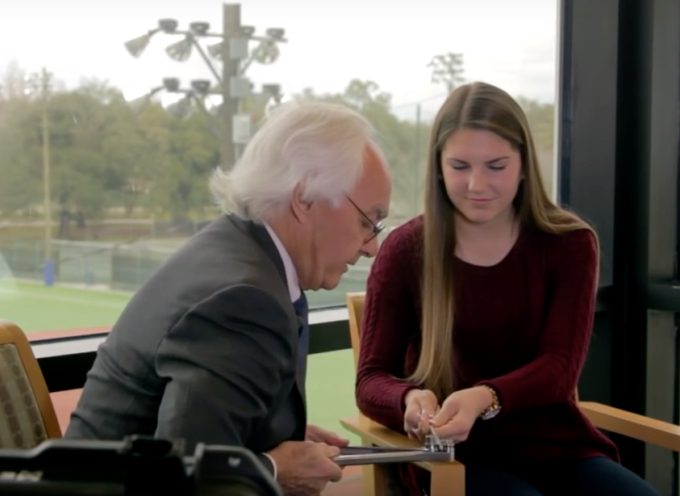
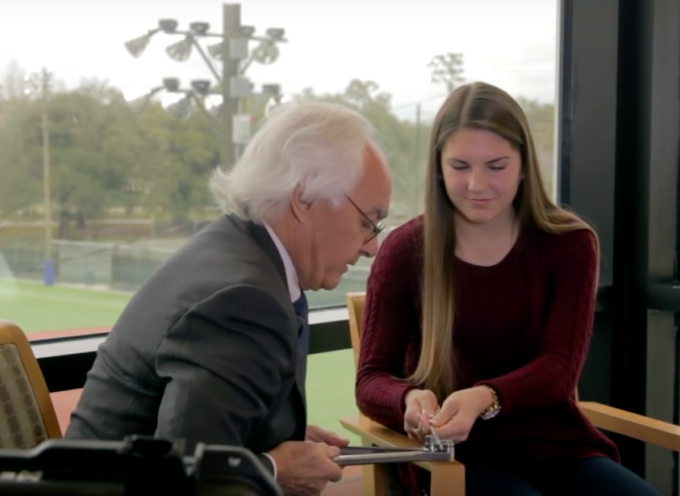 Dr. King demonstrates the difficulty of bending a spinal rod by hand. Image courtesy of Medicrea.
Traditionally, when surgery is required to fix severe cases of scoliosis, doctors are required to bend the rods by hand and fit them in place as best they can. This can be a difficult procedure, even for the most experienced doctors.
“I personally have been bending those rods for 34 years,” said Dr. Andrew G. King, Children’s Hospital orthopedic surgeon. “I’ve been underwhelmed by my ability to bend a rod so that it matches the perfect numbers. The surgical rods which we put in to fix the scoliosis are specific to each particular patient.”
With recent FDA approval, Medicrea’s UNiD system allows doctors to build spinal rods specific to each patient before surgery even begins with precision contouring. Patients are measured for the rods, which are then implanted along with 3D-printed interbody fusion devices -- such as osteosynthesis cages and vertebral body replacements. In the short time since approval was granted, more than 700 patients have benefited from the UNiD system.
Along with a surety that a treatment will correctly adjust a patient’s spine, recovery time has also been reduced as a result of UNiD.
“If I slept a certain way or just sat certain ways it would cause pain,” said Karly, a 14-year old patient. “I was worried that I wouldn’t be able to play softball or do cheer. It’s been almost four months. I started playing softball again and made the team.”
Below you’ll find a video about the UNiD system.


John Newman is a Digital Engineering contributor who focuses on 3D printing. Contact him via [email protected] and read his posts on Rapid Ready Technology.
Follow DE
Join over 90,000 engineering professionals who get fresh engineering news as soon as it is published.






About Us · Contact Us · Editorial Team · Advertising · Privacy Policy · Subscriber Services · © 2026 Digital Engineering 24/7 · Peerless Media