Helping design and engineering professionals discover, evaluate and specify technologies and processes that shorten the design cycle and enable success.



Ten years ago, product lifecycle management (PLM) advocates began using the phrase “a single source of the truth.” It meant all different stakeholders should be working around the same data to avoid misunderstandings, inconsistencies and unnecessary revisions. In engineering, it served as a warning and a guiding principle, because different teams simultaneously working on the same product needed to stay on top of the design changes, material changes and part substitutions.
Today, the same burden is shifting to digital twins, which are swiftly becoming the centerpiece of collaboration in product development. Therefore, digital twins now confront the same dilemma PLM once did: how to give different stakeholders exactly what they need without overwhelming them with everything available on the product.
Imagine the digital twin of a wind turbine that encompasses CAD models at various stages, hourly temperatures and windspeeds from the field, maintenance records, and structural and airflow analyses. It’s a valuable deposit of data and history; however, for the design engineer, the maintenance technician and the data analyst, the digital twin in its entirety will be far more data than they need to perform their respective tasks.
Is the solution to develop and maintain different digital twins, customized for each type of user: one for Finite Element Analysis (FEA); one for Computational Fluid Dynamics (CFD); one for predictive maintenance; one for tracking parts and suppliers; and so on? If so, how can teams ensure they’re working from a single source of the truth?
In this article, we examine the middle way: giving everyone a tailormade view of the same twin.
In theory, many speak of digital twins as comprehensive representations of products, processes or systems, but for daily operations, that characterization may not be valid, according to Dale Tutt, vice president of Industry Strategy, Siemens Digital Industries Software.
“A lot of different elements come together to create the comprehensive digital twin, so the simulation model, the flow model, the electrical model and the PCB layout are different pieces of the twin. But they have to be connected with a digital thread and kept in sync,” says Tutt.
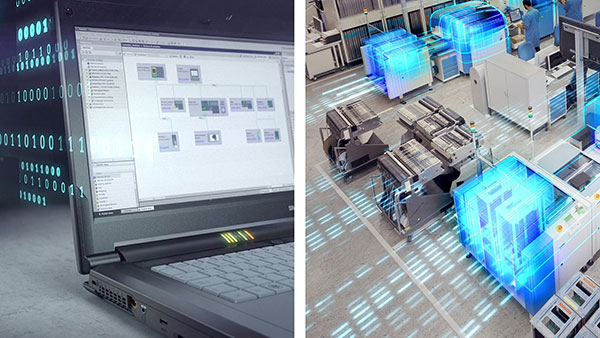
In Siemens’ setup, the mechanical designer may access the twin from NX, the company’s integrated CAD-CAM-CAE modeling software; the electrical designer may access it from Capital, the company’s electrical design software; and the PCB designer will access it from Siemens’ EDA software (formerly Mentor Graphics). Each user uses a tool that’s the standard package for his or her domain. But all the data is housed in Teamcenter, Siemens’ PLM software.
A similar setup can be found in Hexagon. “The key is, you need access to the industrial asset with contextualized data you can visualize along with the 3D model,” says Lawrence Benson, vice president of Portfolio Strategy, Hexagon’s Asset Lifecycle Intelligence division.
Hexagon offers HxGN SDx2, a cloud-hosted software-as-a-service solution that bridges the physical and digital worlds, for digital twin operators. The solution allows integration of real-time data and advanced visualization options to create and manage digital twins.
“SDx2 is the amalgamation of information authored in CAD software, operational information and other places, so in SDx2, you can locate a piece of equipment and then find contextualized data about it,” explains Benson. The user interface for the users, he says, “is geared toward workflows for different personas, like a design reviewer, for example. In this case, the workflow allows him or her to review the proposed change, validate the change and make sure the updated engineering documents are in place.”
Dheeraj Vemula, technical specialist for digital twins, AI, simulation, Altair, also proposes “multiple versions of the same digital twin for different departments, connected via a digital thread.”
A designer’s version of the digital twin would be a CAD model. On the other hand, a digital twin for predictive maintenance could be an artificial intelligence or machine learning model. “But the important feature is, they’re pulling data from the same source, clarifies Vemula.
For Altair customers, the digital thread is Altair One, described as a “cloud innovation gateway for collaborative engineering, data engineering, and analytical application development.” But for design and simulation, users will most likely rely on the Altair HyperWorks suite.
Sanjay Thakore, director of business strategy, Autodesk, believes different phases and aspects of the digital workflow can be represented as digital twins. “A single twin for the entire system contains so much information, but different departments need only some aspects of the twin,” he points out. “There should be a single source of the truth, but different teams should be able to carve out what’s relevant to them in an easy way.”
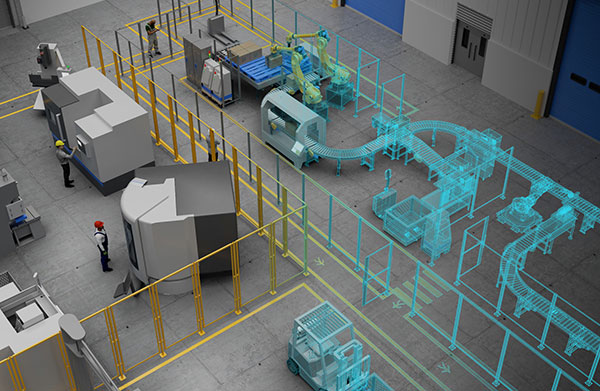
For manufacturing customers, Autodesk offers Autodesk Fusion as the industry cloud solution. Different departments can use Fusion’s CAD, CAM and CAE tools to spin up, access and edit variants of the twin relevant to them. In addition, Autodesk’s digital factory solution offers layout, simulation and optimization of a factory digital twin, including enriching that data with real-time production and building information.
For photorealistic visualization of digital twins, or different twin components, NVIDIA’s Omniverse has emerged as a major platform. The company promotes its GPU-accelerated, cloud-based interactive platform as the ideal environment for model sharing, viewing and collaboration. Hexagon, Siemens and other leading CAD and simulation software vendors have partnerships with NVIDIA to allow visualization of their models in Omniverse.
If the digital thread that connects the different parties accessing the digital twin doesn’t allow data filtering, then the risk of spawning unsynchronized variants of the digital twin is high. But there’s a cost to this phenomenon. “If you build and use multiple twins, then you risk duplicating the integration processes to keep them in sync. And the more points of integration you have, the greater the uncertainties and the risks of failure,” Benson says.
Data filtering is important not only for ease of use but also for security, Benson explains. “If someone is a contractor in one region, then you probably don’t want him or her to be looking at the work done in other regions, for example.”
Tutt points out that, in addition to technology, data governance plays a crucial role. “With structured data, you gain new insights and you can bring in AI to do more, like generative engineering,” he says.
Data governance is more than change-management and version-tracking mechanisms in the technology. It tends to fall apart when the people involved begin to bypass the established protocols. “For example, a few engineers download the model and work on it offline, creating out-of-sync versions,” Tutt explains.
Vemula thinks it’s much easier to implement a digital twin setup from scratch, but much harder to restructure different types of legacy data into a digital twin-ready state. Unfortunately, most firms’ challenges will fall into the second category.
“Most customers are not starting from the ground up. They have lots of historical models. And each department has its own data management system, ranging from paper documents to locally developed, highly customized software. Bringing them into a common platform is the biggest challenge,” he reflects.
Benson noted that to address this challenge, Hexagon is turning to AI. Historical documents are analyzed to identify critical tags and metadata, which then become searchable elements within the system, contextually aligned to the appropriate assets. This dramatically improves efficiency and accuracy for what traditionally would be a manual process.
Thakore also notes that most Autodesk customers are not building a holistic digital twin of their products or processes all at once.
“I usually encourage them to start somewhere, and usually that’s where they’re encountering challenges. If they’re facing bottlenecks in production, then maybe start with a digital twin of the production process,” he suggests.
Benson points out that different companies would pivot their digital twin solutions toward their strengths: for example, a simulation software vendor offering a twin solution that leverages physics-based simulation. “We are focused on facility engineering and operations, so that’s what you’d see in our offerings,” he says.
As a descendent of the PLM market, the digital twins market is also dominated by four or five major players. Each player would ideally want the users to rely on them exclusively for the entire digital twin setup and workflow, but Benson warns, “As you move from the project space to operations, things become less monolithic. Users demand and expect interoperability. So we have to be prepared to work with not just our own solutions but those from our rivals as well.”
Vemula says, “We promote vendor-agnostic digital twin solutions. Most people have historical data in different formats. We don’t want them to have to reinvent their simulation workflows to build a digital twin.” In practical terms, that means supporting the FMU (functional mockup) interface in Altair tools. FMU is described as a format “to simplify the creation, storage, exchange and (re-) use of dynamic system models of different simulation systems for model/software/hardware-in-the-loop simulation …”
Choosing the platform for a digital twin is a long-term commitment, not easily undone. Whereas different aspects of the twin captured as CAD, FEA and PCB models can be moved to new platforms (with some data loss), untethering a comprehensive digital twin from its digital thread would be highly complex.
As Thakore sees it. “At the highest level of maturity, the twin is enriched with sensor data and analytics so you could run what-if scenarios. It’s highly entwined with your processes. It’s a lot more cumbersome to transfer that kind of twin to a new platform,” he says.


Kenneth Wong is Digital Engineering's resident blogger and senior editor. Email him at [email protected] or share your thoughts or suggestions at digitaleng.news/facebook.
Follow DE
Join over 90,000 engineering professionals who get fresh engineering news as soon as it is published.






About Us · Contact Us · Editorial Team · Advertising · Privacy Policy · Subscriber Services · © 2026 Digital Engineering 24/7 · Peerless Media