Helping design and engineering professionals discover, evaluate and specify technologies and processes that shorten the design cycle and enable success.



May 2026 Special Focus: Artificial Intelligence in Design and Simulation
In this Special Focus Issue, learn about the latest developments in the integration of artificial intelligence into engineering workflows.

Design & Simulation Software Guide 2025
In this Special Issue, Digital Engineering presents its second annual guide to design and simulation software vendors.
You hear a lot about pain points in the analysis community these days. And often, you must reach a certain pain point before even looking to an alternative solution.
|
In the composites analysis community, there are several subjects that are considered to be well beyond the pain point. In general, the composites industry uses heritage designs based on methodology more than 30 years old. These techniques use expensive experiments like open-hole tension tests to produce strength values and then treat the composite laminates as a single material—or black aluminum (a term coined by the analysts). This approach has led to extreme conservatism in composite structures.
In an unprecedented program funded by the Air Force Research Laboratory’s (AFRL) Space Vehicles Directorate, CSA Engineering and Firehole Technologies set out to not only prove this overdesigned-out-of-ignorance theory, but to provide a software solution that is integrated with current finite element analysis (FEA) packages, uses standard material characterization, addresses the analysis of the composite in a multiscale fashion, completes these tasks efficiently, and robustly converges on a solution.
“The genesis for the large structural failure program at AFRL Space Vehicles Directorate was really to make a definitive statement regarding the ability of the aerospace community to optimize designs of large composite structures,” said Dr. Jeffrey Welsh, former program manager for integrated structural systems at the directorate.
The program started with qualification and failure testing of the Composite Adapter for Shared Payloads (CASPAR). This structure was designed to carry multiple payloads aboard the Minotaur IV launch vehicle (the first two launches are scheduled later this year) by optimizing the available payload envelope.
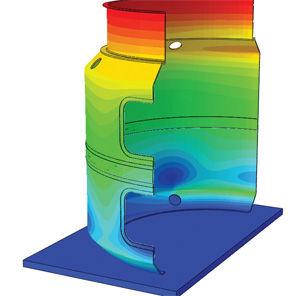 This isometric view of CASPAR shows a displacement plot with red indicating maximum—and blue, no—displacement. |
Consisting of two symmetric 74-in. diameter solid composite laminate cylinders, CASPAR is approximately 60 plies thick, comprising industry-standard carbon/epoxy pre-impregnated (pre-preg) composite material. The major diameter tapers to an all-composite flange at both ends. Each of the two shells contains a single access door in the cylinder and four equally spaced vent holes are located in the fore and aft flanges.
All analysis of this structure was performed with the commercially available software package, Helius:MCT from Firehole Technologies in conjunction with Abaqus/Standard from SIMULIA, Inc. Prior to the physical failure testing of CASPAR, a progressive failure analysis was completed with Helius:MCT based upon the worst-case load condition from the qualification test. This loading scenario placed maximum compression opposite the access doors.
The CASPAR structure was successfully tested to failure, exhibiting highly nonlinear behavior. A significant level of localized matrix and fiber failures occurred prior to the ultimate failure of the structure. The MCT analytical and experimental results show excellent correlation. Initial matrix cracking was predicted within 11 percent, gradual global softening of the structure was predicted with the increase of matrix failures, failure of the lower radius was predicted within 1 percent, and the ultimate failure of the structure was predicted within 15 percent of the actual experimental load.
The CASPAR structure survived a loading of more than eight times the worst-case service load condition. This conservatism translates into mass inefficiency. Lack of confidence in analytical simulation is a major contributor to the extreme conservatism that exists in most composite structures.
Over the course of the program, it was shown that accurate failure predictions can be provided for space structures. Analysis was performed using advanced methods in an industry setting:
• Predictions for failure initiation, propagation, and ultimate failure were provided.
• Materials were characterized using available data generated from standard test methods and previously reported.
• All analysis was performed in a time frame measured in weeks, including model developent, run time, and documentation.
Researchers achieved the most accurate results when multicontinuum technology composites failure simulation was coupled with advanced FE techniques. Analysis using traditional techniques consistently over-predicted failure by a factor of two or more.
Although a change in analysis philosophy will be required; accurate, meaningful analysis of composite structures is achievable. Improved confidence can be gained, producing better designs. With advanced tools like Helius:MCT, a mass efficient structure can be achieved, providing improved mission performance and reduced cost.
While one of the most complex in terms of response to loading, CASPAR is one of several recent success stories for Firehole’s Helius:MCT product. Blind failure predictions made on two other space flight hardware items were within 3 percent accuracy of ultimate failure.
More Info:
Air Force Research Laboratory
Space Vehicles Directorate
Jason Gies is VP of business development for Firehole Technologies. Send comments to [email protected].


DE's editors contribute news and new product announcements to Digital Engineering. Press releases may be sent to them via [email protected].
Follow DE
Join over 90,000 engineering professionals who get fresh engineering news as soon as it is published.






About Us · Contact Us · Editorial Team · Advertising · Privacy Policy · Subscriber Services · © 2026 Digital Engineering 24/7 · Peerless Media

