Helping design and engineering professionals discover, evaluate and specify technologies and processes that shorten the design cycle and enable success.



Digital Engineering April 2026
In the latest issue of Digital Engineering, we take a look at the latest innovations in design for additive manufacturing, including the use of natural language inputs, social media cosplayers, and AI integration. The issue also includes a feature…

January Special Focus Issue: Design for Additive
In this Special Focus Issue of Digital Engineering, learn about the latest advancements in design for additive manufacturing, including new software tools, additive in automotive, custom medical devices, and more.
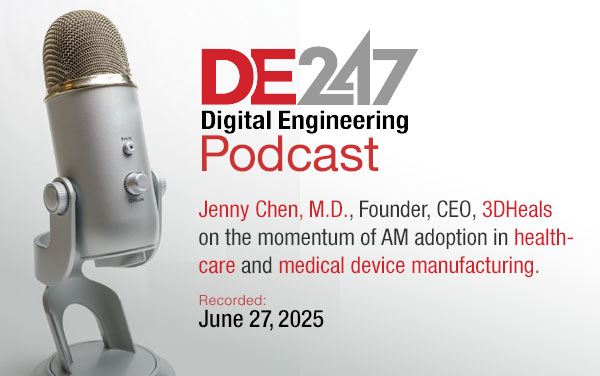
Ten years ago, Jenny Chen, M.D., founded 3DHeals, to focus on educating, connecting, and discovering innovators and entrepreneurs in the space of bioprinting, regenerative medicine, and healthcare applications using 3D printing. She is a practicing neuroradiologist, who holds degrees in both medicine and radiology from the David Geffen School of Medicine at UCLA. She has completed fellowship training in neuroradiology at Harvard Medical School/MGH. She has served as Adjunct Clinical Faculty in neuroradiology at Stanford University Medical Center between 2013 through 2021.

"We create platforms for people to network with one another, either in person or virtually -- mostly virtually these days, but we do host a couple of in-person events," she explained. "We also want to help early stage startups in the 3D technology space. That includes software, hardware, material. These are startups focusing on 3D printing or 3D technologies such as AR/VR. We help them with their fundraising. We are free. There's no any catch."
She also launched Pitch3D, allowing startup founders to pitch their ideas and products to potential investors on Zoom.
Reflecting on the last ten years, Chen said, "The adoption [ of AM] is incredible, and in particular, in the orthopedic industry, the penetration of AM is significant. Almost all the major players are not only investing in the hardware, but also the ecosystem of the orthopedic implants."
In the past there were barriers to usage, due to the limitation in printable resolution and materials. But many of these barriers are disappearing as the technology improves. Use of AM to construct microfluidic devices, for example, was previously unimaginable. "Microfluidic devices require very high resolution, because you are focusing on droplets of fluids and cells at a cellular level. These devices have channels, and they need to be transparent to visualize the cells inside," Chen explained.
With implants, new printing materials have emerged, improving bone integration. "Typically, implants last in a human body 10-15 years, and the goal is to improve that outcome. We have made significant progress across many metrices for these devices," Chen said.
Along with technology improvements, the regulatory bodies' attitude toward AM applications is also changing, from skepticism to acceptance in many areas. "FDA really made significant efforts to bring all the stakeholders together to have conversations. And I think that, in the U.S. at least 3D-printed medical devices have made significant progress because of the clarity that the regulatory entities have provided us," she said.
For the full conversation, listen to the podcast.

About this podcast
Additive Manufacturing Becomes an Integral Part of Medical Device Manufacturing
June 27, 2025 at 10:00 am
9:29 hr/min/sec
Media file
Latest podcasts
Find us
Tune in to Digital Engineering 24/7's podcast and get engineering news, products and analysis from industry experts delivered in real time. Follow us on these popular platforms:

Kenneth Wong is Digital Engineering's resident blogger and senior editor. Email him at [email protected] or share your thoughts or suggestions at digitaleng.news/facebook.
Follow DE
Join over 90,000 engineering professionals who get fresh engineering news as soon as it is published.






About Us · Contact Us · Editorial Team · Advertising · Privacy Policy · Subscriber Services · © 2026 Digital Engineering 24/7 · Peerless Media