Helping design and engineering professionals discover, evaluate and specify technologies and processes that shorten the design cycle and enable success.


Alert!
Digital Engineering ceased publication on July 1, 2026. This website remains available as an archive of engineering content.
For inquiries or information, please email [email protected].

Digital Engineering April 2026
In the latest issue of Digital Engineering, we take a look at the latest innovations in design for additive manufacturing, including the use of natural language inputs, social media cosplayers, and AI integration. The issue also includes a feature…

January Special Focus Issue: Design for Additive
In this Special Focus Issue of Digital Engineering, learn about the latest advancements in design for additive manufacturing, including new software tools, additive in automotive, custom medical devices, and more.
3DHEALS, according to the organizers, aims to "[foster] a global collaborative and innovative healthcare 3D printing ecosystem." In a guest blog post for Print Your Mind 3D, 3DHEALS founder and CEO, Jenny Chen M.D., writes, "The concept of creating physical objects based on digital data in a layer-by-layer fashion was quickly extended to bio-printing, where the raw material is bio-ink or stem cells. In a way, 3D printing represents an evolved form of human-computer interaction."
The challenges, advantages, and benefits brought up by the attendees -- the need for manual cleanup of digital data and the use of 3D printed models as a communication tool, to name but two -- may sound oddly familiar to those in automotive, aerospace, and consumer goods.
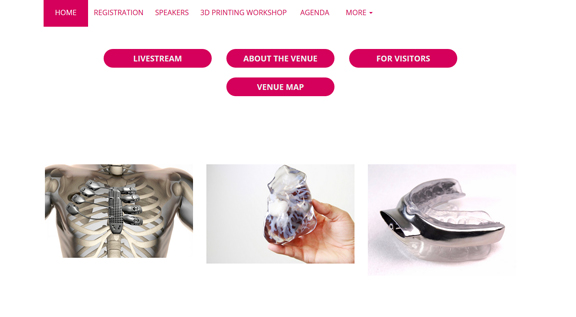
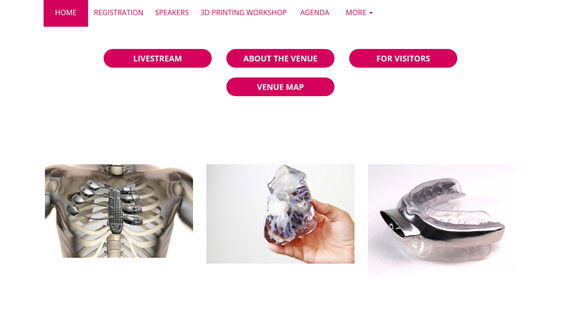 3DHEALS Conference in San Francisco explores 3D printing application in healthcare.
In the panel focusing on different 3D printing applications for healthcare, Peter Liacouras, director of services for 3D Medical Applications Center, Walter Reed National Military Medical Center, said, "I feel, our strength is in inter-professional communication. We have to be able to speak the doctor's language, but also the engineer's language."
Paul D'Urso, neurosurgeon & founder of Anatomics, recalled a charity case he was involved with. The patient, a child with birth deformity from Guadalcanal, needed skull reconstruction. For pre-surgery analysis and brainstorming, the team printed the patient's skull model based on CT-scan data.
"This was one of the first cases where we printed a model to look at the [patient's condition] before the surgery," said D'Urso, "It was a crude model, but I was able to show the patient's mom what was happening. She couldn't really speak English, was scared ... obviously it was a major event for her child."
Aenor Sawyer, director of UCSF's Skeletal Health Service, Health Innovation Technology in Ortho, similarly noted, "A patient's understanding of the procedure is so much better with the 3D-printed model. Not everyone has the ability to visualize in different [2D cross-section] planes."
In manufacturing, engineers often use 3D-printed design prototypes to communicate their concepts with clients who are not tech-savvy, nor in a position to open a 3D CAD model to examine the proposed design idea. In healthcare, 3D-printed surgical models also serve a similar purpose in communicating the proposed surgical solution to the patients and their loved ones who cannot easily interpret CT scans and X-ray charts.
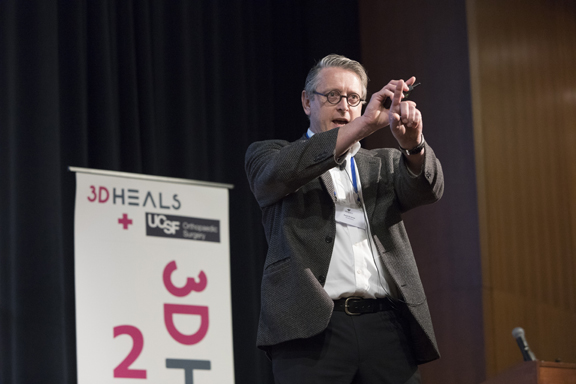 Paul D’Urso, neurosurgeon & founder of Anatomics, discusses using 3D-printed models to communicate with patients and fellow surgeons, at a panel discussion at 3DHEALS 2017 (San Francisco, California)
Sanjay Prabhu, codirector of SIMPeds3D Print Service at Boston Children's Hospital (BCH), said, "Simulation is the center point of what we do. It's inextricably linked to preparedness ... Simulation resulted in 20% reduction in surgical morbidity and mortality."
Currently, surgeons use 3D-printed models of the patient's limb, bone, or organ to plan and practice the procedure. For bone and skull models, current technology proves sufficient. But, for models that involve more delicate human anatomy, such as blood vessels, medical professionals need printers capable of printing in higher resolution, with materials that more closely mimic the human muscular texture.
Most 3D system vendors tailoring to the healthcare field have made efforts to be able to work with CT-scan data. But for better results, medical professionals want the printer -- or, to be more precise, the data cleanup and preparation software -- to be able to work with a meshup of data, which may include CT-scan, MRI, and ultrasound images.
Currently, in scanned patient data, it is getting easier to single out bones and ligaments but much more difficult to isolate anatomical components made of soft tissues. It's an opportunity and a challenge for software developers to research and add automatic shape-recognition features that cater to the medical field.
Materialise, a firm that caters to manufacturers with its 3D printing solutions, also serves the medical field. If offers Materialise Mimics software suite, which covers medical image segmentation and anatomical measurement to finite element meshing.
Last November, Materialise launched AnatomyPrint, an on-demand printing service that can print anatomical models out of STL files.
D'Urso pointed out the incredible volume of waste generated by surgeries, due to the need to provide surgical kits and sets outfitted with everything a surgeon might possibly need (for example, drill guides and drill instruments to address a wide range of scenarios, or trays of screws, each priced at roughly $1,500).
D'Urso's suggested a better approach is to have patient-specific instruments, small enough to fit in a typical lunch box. "That is the disruption," he said. "You've got your drill guide, your 3D-printed titanium implant, maybe about five screws, and the surgeon can check it before the operation."
The tactile verification and custom-manufactured surgical kits point to consolidation and waste reduction. The strategy is similar to how manufacturers have turned to 3D printing to replace multi-part assemblies made of standard components with consolidated pieces that require less materials to produce.
Prabhu pointed out, in the current healthcare field, maladies and conditions that affect a wide segment of the population tend to get more attention. "You can't build a business out of one item [something only one patient might need]," he said."Yet, at BCH, we see many of these types of cases, so we can print and design [a solution] specific to a patient."
Commercial solution providers focus on producing solutions like knee joints, which can be mass-produced to address the condition of a large pool of patients. This explains why BCH needs an in-house 3D printing division, to address unique cases and one-off cases where commercial solutions are not readily available. Prabhu joined the program first as a consultant in 2013. Eventually, when the program grew, he joined BCH as an employee.
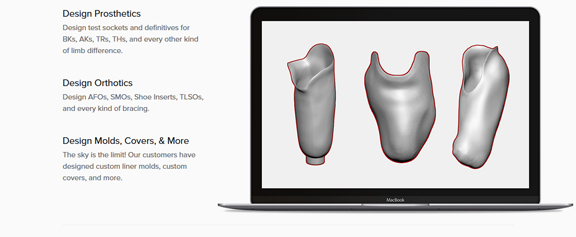 Standarg Cyborg offers iPad-compatible 3D modeling software for anatomical design.
Alexis Dang, associate professor UCSF's Department of Orthopaedic Surgery, pointed out the push back from some veterans and old timers. "Some surgeons will tell us, Look, I'm doing fine with my tracing papers," he recalled. Similarly, Ben Salatin, clinical rehabilitation engineer from U.S. Dept of Veterans Affairs (VA), said championing 3D printing for medical use sometimes makes him feel like "a car salesmen talking to people who still want to ride horses."
The design skills required to use modeling programs still prove to be a hurdle in 3D printing adoption for medical use. Current crop of CAD/CAM software, originally designed for engineers and architects, presents a high barrier of entry for doctors, clinical technicians, and surgeons, whose primary job function is not 3D modeling.
"At the VA, we currently don't have CAD designers on staff. This has been a blockage," said Salatin. "Do we make a clinical professional a CAD expert? Or do we outsource? Either way, the [digital] design phase is the bottleneck."
Jeff Huber, CEO of Standard Cyborg, noted, "Creating shapes for anatomical design is still very difficult. Software programs like Grasshopper [a plug-in to surface modeling software Rhino] are great, but they also require a high degree of skill and expertise."
Huber believes his company can ease the modeling pain. Standard Cyborg offers a cloud-hosted tablet-based software for scanning, modeling, and fabrication of custom prosthetics and orthotics.
For 3DHEALS founder Jenny Chen's advice to software and system developers hoping to work with medical professionals, visit this previous blog post.
For more on 3DHEALS 2017 conference, visit the event's home page here.


Kenneth Wong is Digital Engineering's resident blogger and senior editor. Email him at [email protected] or share your thoughts or suggestions at digitaleng.news/facebook.
Follow DE






About Us · Contact Us · Editorial Team · Advertising · Privacy Policy · Subscriber Services · © 2026 Digital Engineering 24/7 · Peerless Media